[[trackingImage]]

Journey Through Spotsylvania VA250 Scavenger Hunt

Welcome to the Spotsylvania County Museum's VA250 Virtual Scavenger Hunt: Journey Through Spotsylvania! We are excited to celebrate our history with 18 unique clues. Each clue includes a riddle accompanied by some historical background. Your task is to identify the Spotsylvania site, business, or landmark described in the riddle. To submit an answer for all 18 clues in one sitting, use the form below. To submit answers one clue at a time, click here. More details on how to play can be found below the clue. Good luck, and enjoy your journey through Spotsylvania's fascinating history!

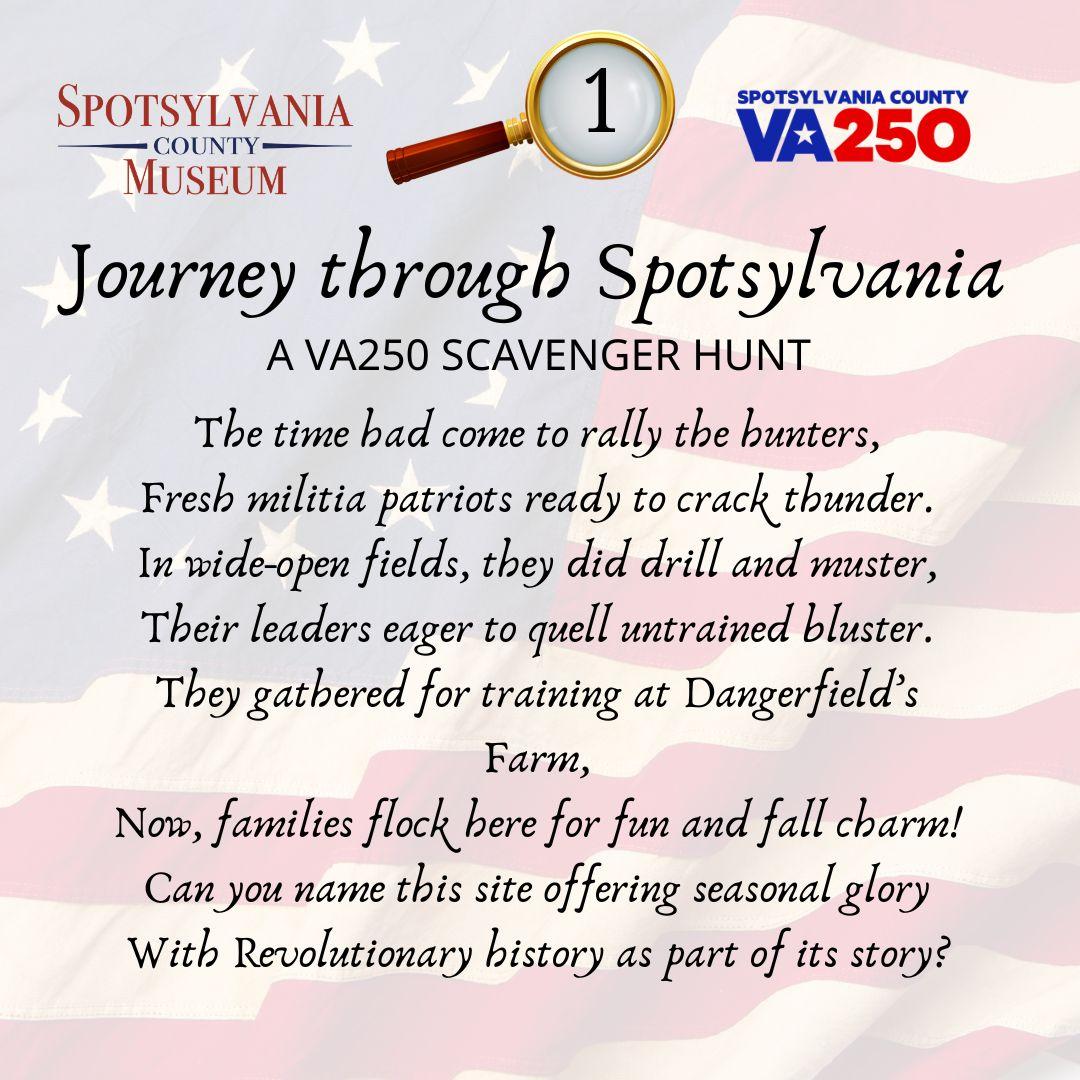
Clue 1: From Patriots to Pumpkins

At the onset of the American Revolution in 1775, Spotsylvania County readied for war. During peacetime, Spotsylvania and other localities across the Thirteen Colonies maintained militia companies — units of qualifying local men legally required to muster for training, inspection and the defense of their homes. To prepare the droves of inexperienced militia volunteers for the Revolutionary War, officers like Col. William Dangerfield of Spotsylvania County turned their private estates and plantations into training stations.

From Patriots to Pumpkins Answer (Clue No. 1):
0/50

Clue 2: Swearer's Sanctuary?

In pre-Revolutionary Virginia, the Baptist Church was in its infancy, and its followers often faced religious persecution from British colonial authorities. One Spotsylvania figure — known in his youth as “Swearin’ Jack” for his coarse language and brutish demeanor — grew to become a stalwart Baptist leader. Despite constant harassment, he led followers in defense of their beliefs. While Spotsylvania County’s Baptist population was small at first, the community remained resilient. Their perseverance laid the groundwork for a surge in membership after the Revolutionary War, helping shape the religious landscape of the region.

Swearer's Sanctuary Answer (Clue No. 2):
0/50

Clue 3: Blasts in the Past

The story of Spotsylvania’s colonial standing as a top producer of an essential metal can be told through the lens of one family. In the early 1700s, Virginia’s lieutenant governor sparked an industrial revolution in the wilderness, establishing the colony’s first "blast furnaces." Virginia’s subsequent ironworks became so successful that by the 1750s, the British Parliament attempted to stifle American competition through restrictive legislation. Decades later, the governor’s grandson — a close associate of George Washington — divested from the family’s industrial holdings and led troops in the Continental Army. 

Blasts in the Past Answer (Clue No. 3):
0/50

Clue 4: You Scream, We All Scream

In the Revolutionary era, ice cream was a rare luxury rather than a common indulgence. Before the advent of modern refrigeration, crafting the dessert was an arduous process that demanded a dedicated ice house, expensive ingredients like sugar and cream, and hours of physical labor. In Virginia, it remained an exclusive delicacy for the elite. Both Thomas Jefferson and George Washington were famous aficionados; Jefferson penned the first known American recipe for vanilla ice cream, while Washington’s commitment to the treat was so great that he stocked the presidential mansion with more than 300 specialized ice cream-making tools. 

You Scream, We All Scream Answer (Clue No. 4):
0/50

Clue 5: Ready for the Revolution

Fearing a rebellion against the Crown, Virginia Gov. Lord Dunmore ordered gunpowder stocks removed from Williamsburg’s public magazine on April 21, 1775, igniting anger across Virginia. As word spread, independent companies of mounted volunteers from throughout the region gathered in Fredericksburg. At a moment’s notice, these troops were ready to travel to Williamsburg and force the return of the gunpowder at the end of a musket barrel. Several famous patriots familiar with the area — Hugh Mercer, George Weedon and George Washington — were astonished by the number of the volunteers who rallied in Fredericksburg. To ease tensions, Spotsylvania politician Mann Page III led a contingent of local militiamen to Williamsburg to negotiate with Dunmore. The Revolution in Virginia had begun!

Ready for the Revolution Answer (Clue No. 5):
0/50

Clue 6: Spotsylvania Schooling

Education in Spotsylvania County has traveled a long road from its Colonial roots. What began as a scattered collection of home-based tutoring, church-led instruction, and trade apprenticeships eventually took a more formal shape with the 1811 opening of a school at "Belle Air" plantation. This early milestone marked the beginning of a long journey toward public education. Over the subsequent decades, the county navigated the transition from the era of segregated schoolhouses to the establishment of the unified, inclusive, and robust school system that defines the community today. 

Spotsylvania Schooling Answer (Clue No. 6):
0/50

Clue 7: From Command Post to Goal Post

While Spotsylvania’s wealthy landowners took up commissions in the Continental Army during the dawn of the Revolution, ambitious Alexander Spotswood (grandson of Spotsylvania founder Lt. Gov. Alexander Spotswood) maintained regular correspondence with close friend George Washington. Upon Washington’s appointment as commander in chief, Spotswood congratulated his friend, and jokingly requested a job in the Continental Army. Spotswood opened his home, Nottingham, as a training site for those interested in becoming volunteer minutemen. Spotswood was commissioned as major of the 2nd Virginia Regiment of the Continental Virginia Line in 1776, and eventually rose to colonel. In fall 1777, he commanded the 2nd Virginia at the battles of Brandywine and Germantown. He resigned that post under the mistaken belief that his brother had fallen in battle at Germantown. Later, he reached the rank of brigadier general while serving in Virginia state forces. 

From Command Post to Goal Post Answer (Clue No. 7):
0/50

Clue 8: Spotsylvania's Story

The site of multiple Civil War battles, Spotsylvania County is well-known for its pivotal role in that conflict. However, Spotsylvania was also a major contributor to the American fight for independence. The county’s men, including several notable officers, raised arms for the patriotic cause. Spotsylvanians provided essential resources, such as gunpowder, ironworks, supplies and manpower, during the Revolution. This establishment aims to highlight all the chapters of Spotsylvania County history, including its Revolutionary-era significance. 

Spotsylvania's Story Answer (Clue No. 8):
0/50

Clue 9: The Brooke Brothers

The Revolution sent many fathers, sons, and brothers into harm’s way in the name of resisting British rule. Four brothers of a notable Spotsylvania family all served in the Revolution in different roles. Robert Brooke served in the 4th Regiment of Continental Light Dragoons, a unit of mounted infantrymen. On the recommendation of Benjamin Franklin, Dr. Lawrence Brooke served as the surgeon aboard the Bonhomme Richard, under the command of John Paul Jones. Lawrence saw some of the era’s most devastating combat at the 1779 Battle of Flamborough Head, where Jones is said to have uttered his famous line: “I have not yet begun to fight!” Lastly, Francis Brooke documented in a memoir his service as a Continental Army artillery officer guarding weapon stores in Virginia during the latter part of the war while his twin brother John also served as a Continental artillery officer.

The Brooke Brothers Answer: (Clue No. 9)
0/50

Clue 10: Revolutionary Speed

During the time of the American Revolution, organized competitive racing was a well-established and highly popular pastime, particularly for the elite. The primary forms of racing centered on the most critical means of transportation: horses and boats. Today’s high-octane environment of motor racing, while a modern spectacle, embodies several fundamental virtues that resonate deeply with the spirit of patriotism, such as competition, teamwork, and the pursuit of excellence.   

Revolutionary Speed Answer (Clue No. 10):
0/50

Clue 11: Keeping Watch

Virginia had reached a dire point by spring 1781. The young state’s Revolutionary forces were dangerously depleted, still reeling after suffering catastrophic losses at the Siege of Charleston and Battle of Camden in South Carolina a year earlier. What remained of Virginia’s fighting force was stretched woefully thin, scattered under the orders of Gov. Thomas Jefferson. When word arrived in May that British commander Lord Cornwallis’s forces were heading northward toward Spotsylvania and Fredericksburg, panic swept through the region. A few Spotsylvania militiamen, under Capt. Francis “Frank” Coleman, were posted at key defensive points throughout the region. This meager defense had Spotsylvanians fearing the region would be completely overwhelmed if the Brits invaded.

Keeping Watch Answer (Clue No. 11):
0/50

Clue 12: Historic Sanctuary

The structures built during the Revolutionary era, in Spotsylvania County and throughout Virginia, were often constructed from sturdy log and timber to endure the demands of frontier life. This Spotsylvania County lodging venue honors deep colonial legacy by carefully relocating and meticulously restoring 18th- and 19th-century log cabins and cottages. 

Historic Sanctuary Answer (Clue No. 12):
0/50

Clue 13: Fording History

In June 1781, as Lord Cornwallis and his British forces marched north toward Spotsylvania, the Marquis de Lafayette shadowed the British commander’s movements with tactical precision, anticipating his every step. Believing the military equipment stores in Fredericksburg were Lord Cornwallis’s primary target, Lafayette ordered local Spotsylvania militiamen and Continental soldiers to fortify a strategic crossing over the Rapidan River. When Cornwallis diverted his path toward Charlottesville, the Marquis maneuvered his troops over the river westward to shield Spotsylvania from the British advance. After this successful pivot, Lafayette’s forces joined Brig. Gen. “Mad Anthony” Wayne’s Continental soldiers at Racoon Ford in Culpeper County, beginning the decisive march south toward the ultimate victory at Yorktown.

Fording History Answer (Clue No. 13):
0/50

Clue 14: Brewing Up History

During the American Revolutionary period, beer was a fundamental dietary staple and a safer alternative to often-contaminated well and river water. The war dramatically impacted the brewing landscape, forcing colonists to shift from reliance on English imports to using local ingredients and domestic production. Today, Spotsylvania County is home to three breweries with locally crafted brews on tap.  

Brewing Up History Answer (Clue No. 14):
0/50

Clue 15: The Waters of Time

Though initially fueled by an outpouring of patriotism and zeal, Spotsylvania residents grew increasingly weary as the Revolutionary War dragged on. Harsh living conditions for Virginia-raised Continental soldiers, combined with severe losses from combat, a collapsing economy, and inadequate pay, all weakened public morale. Each call for raising men into service became more unpopular than the last. Regardless, Spotsylvania resident and militia Capt. Francis “Frank” Coleman maintained command over what few men remained in service, joining the Continental Army’s push toward Yorktown in mid-1781. Though his unit was ravaged by disease, his men played a vital role in the Siege of Yorktown that fall, helping to secure the Pigeon Hill Redoubt as British forces withdrew. In this final push to defeat the British, the men of Spotsylvania stood witness as the long conflict finally reached its conclusion on Virginia soil.

The Waters of Time Answer (Clue No. 15):
0/50

Clue 16: The Tale of Towles

Among the many Spotsylvanians who answered the call during the Revolutionary War was Oliver Towles, a lawyer-turned-officer who was commissioned into the 6th Virginia Regiment on February 16, 1776. Towles’s service was marked by personal and professional strife. At one point, George Washington declined Towles’s request to resign after a fire destroyed his home along with many of his clients’ legal documents; instead, he was granted temporary leave to stabilize his affairs. His military career took a dramatic turn when he was captured at the Battle of Germantown on October 4, 1777. After years as a prisoner of war, Major Towles was freed, allowing him to witness the British surrender at Yorktown. Despite being awarded extensive land bounties for his service, crippling debt later forced the veteran to sell off much of his property.

The Tale of Towles Answer (Clue No. 16):
0/50

Clue 17: Revolutionary Rations

We've certainly come a long way from the days of chewing on weevil-infested hard tack! Forget those rock-hard rations that were staples of the Revolutionary War soldier’s diet — today, you deserve something delicious! 

Instead of a tough, dry biscuit meant for mere survival, stop by this restaurant at Spotsylvania Courthouse Village for a mouth-watering biscuit — a modern treat that pays homage to the flour staple of the past, without any of the historic misery! 

Revolutionary Rations Answer (Clue No. 17):
0/50

Clue 18: Une Visite d'Apres-Guerre

The Marquis de Lafayette played a large role in Virginia’s defense during the late stages of the Revolutionary War. Serving as a shield to block and parry the advancing British forces of Lord Cornwallis and Banastre “the Butcher” Tarleton, Lafayette positioned himself as the main defender of Spotsylvania and Fredericksburg in June 1781. Though deeply beleaguered by the area’s exhausted militias, Lafayette nonetheless made effective use of what men he could raise to defend the region. Years later, with no British soldiers to give him trouble, Lafayette passed through Spotsylvania during his 1825 tour of America, staying overnight at an estate that would witness the bloodshed of another war decades later. 

Une Visite d'Après-Guerre Answer (Clue No. 18):
0/50

Contact Information


To be eligible for prizes, you must fill out contact information.

* First Name
0/50
* Last Name
0/50
* Email Address
0/50
* Phone Number
0/50
Do you wish to receive free monthly e-newsletters containing news and updates on Spotsylvania County attractions from Visit Spotsy?

How to Play:


  • Follow Along: Clues can be found HERE and will be posted to the Spotsylvania County Museum's Facebook and Instagram pages throughout April 20 to June 18, 2026.
  • Submit Your Answer: You must submit all answers via the official form(s) to be eligible.
  • Identify Yourself: You must provide your contact information on every form so we can track your progress toward the grand prize.
  • Be Precise: Please use the full, official name of the location where possible. For example, use Spotsylvania Court House Battlefield rather than "Battlefield."


The Prizes:


Participants who answer all 18 clues correctly will be entered into a prize drawing. If no one achieves a perfect score, the prize(s) will be awarded to the entrant(s) with the highest number of correct answers, with a drawing held if required to determine the winner. Winners and answers will be revealed at Spotsylvania Stars & Stripes Spectacular on Saturday, June 27. For updates and details, stay tuned to Spotsylvania County Museum's Facebook page.


Terms & Conditions:


Age: Open to all ages, but participants under 18 must have parent/guardian permission. Prizes may only be claimed by an adult (18+).

Employees: Spotsylvania County Office of Community Engagement & Tourism employees and their immediate family members are ineligible to win prizes, but are encouraged to play for fun.

Entry Period: The hunt begins on Monday, April 20, 2026, and ends on Wednesday, June 24, 2026. Submissions received after the deadline will not be counted.

Submission: Only entries submitted via this official form will be eligible for prizes. Social media messages or "likes" do not constitute a formal entry.

Winner Selection: Winners will be selected randomly from all entrants who enter all correct answers or those entrants who answer the most correctly. Decisions by the organizers are final. Winner(s) will be announced Saturday, June 27, 2026, at Spotsylvania Stars and Stripes Spectacular.

Cost: No purchase is necessary to play. Spotsylvania County is not responsible for any travel costs, data usage fees, or parking fees incurred during the virtual scavenger hunt.

Data Privacy: Information collected via the entry form (Name, Email, etc.) will be used solely for the administration of this contest. We will not sell your data to third parties.

Liability Waiver: By participating, you agree to release Spotsylvania County, its staff, and sponsors from any and all liability for injuries, loss, or damage of any kind arising from or in connection with this scavenger hunt.