An Introduction to the New Kirkpatrick Model for a Results-Driven World A modern framework for evidence-based decision making
Organizations are under increasing pressure to demonstrate results, make better decisions, and use resources wisely. In this environment, evaluation can no longer be treated as a reporting exercise—it must function as a leadership capability.
This white paper introduces the New Kirkpatrick Model as a framework for evidence-based decision making. Rather than attempting to prove direct causation or reduce impact to a single metric, the model helps leaders understand contribution, alignment, and progress within complex performance systems.
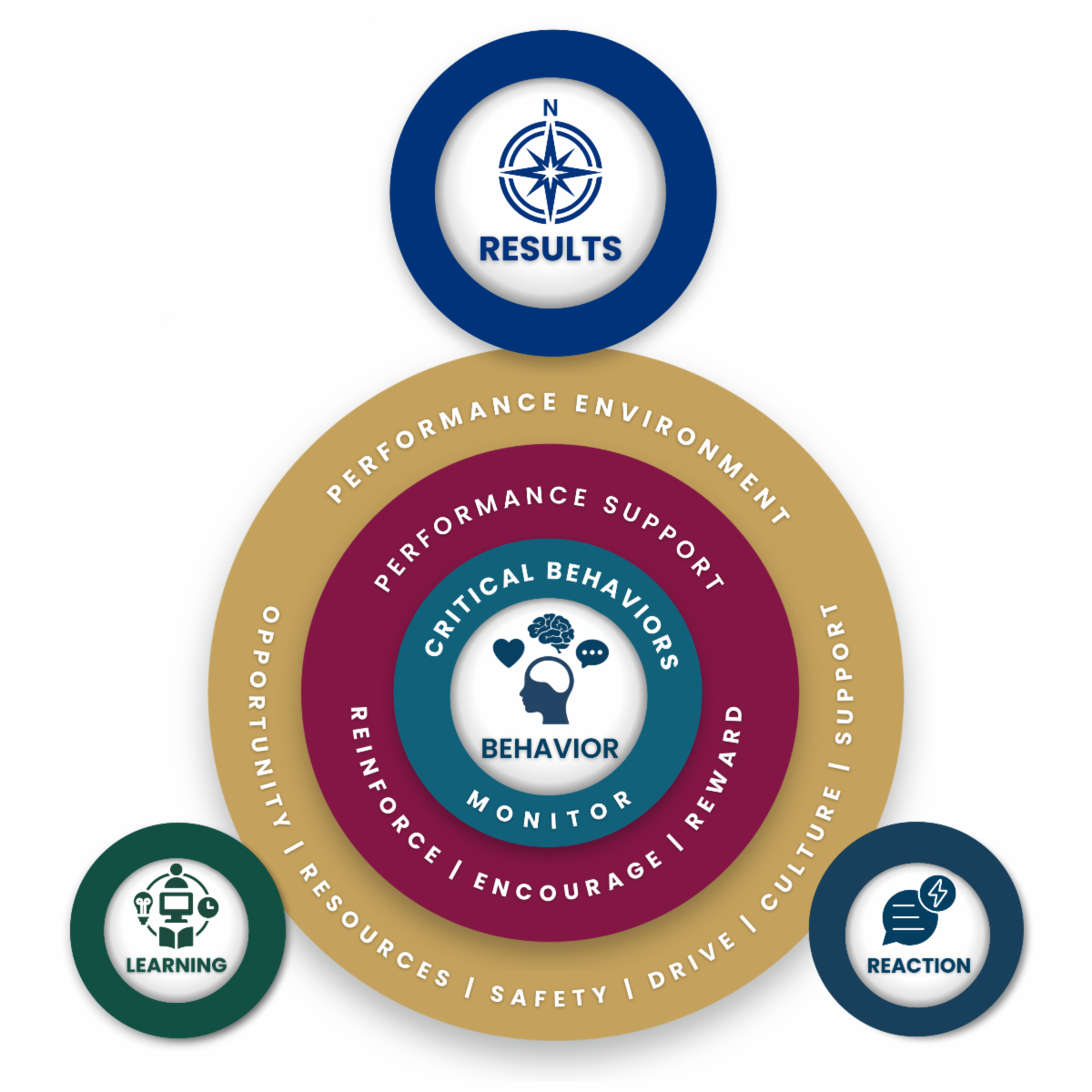
Why this white paper matters Many organizations are familiar with the four levels—Reaction, Learning, Behavior, and Results—but fewer use the model to guide real decisions about performance, investment, and impact. This paper reframes the Kirkpatrick Model to reflect how performance actually works today:
- Results are influenced by multiple factors
- Behavior depends on the performance environment
- Evidence must support judgment, not false certainty
- Evaluation should inform action, not just document outcomes
The result is a practical, modern view of evaluation that supports leaders before, during, and after initiatives are launched.
What You’ll Learn In this white paper, you’ll explore:
- The Kirkpatrick Model as an integrated system
- How the four levels work together—cyclically, not linearly—to support continuous improvement.
- The critical role of the performance environment
- Why learning alone does not drive results, and how systems, leadership, and support determine whether behavior changes.
- Behavior as the bridge to results
- How focusing on critical behaviors and performance support strengthens Level 3 and drives meaningful outcomes.
- Beyond ROI: measuring what matters
- Why Return on Expectations (ROE), Return on Performance (ROP), and contributive ROI provide more credible, decision-ready insight than traditional ROI alone.
- From measurement to management
- How evaluation shifts from a retrospective report to an ongoing management practice that guides priorities and investment.
Who This Paper Is For This white paper is designed for leaders and practitioners who are responsible for performance and outcomes, including:
- Learning and development leaders
- Talent and performance professionals
- HR and people analytics teams
- Executives and senior leaders
- Government, military, and nonprofit decision makers
If you’re being asked to show impact, improve alignment, or move beyond activity metrics, this paper provides a clear starting point.
What Makes the New Kirkpatrick Model Different The New Kirkpatrick Model builds on decades of use while addressing common misapplications. It emphasizes:
- Planning from results, not starting with activity
- Contribution over isolated causation
- Evidence that supports judgment, not oversimplification
- Integration of learning, behavior, environment, and outcomes
This evolution expands the model beyond training evaluation to support organization-wide initiatives and performance improvement efforts. |