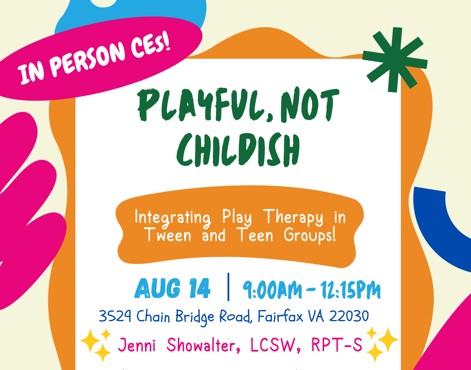
| Working with older children and adolescents requires a different approach than both traditional child centered play therapy AND cognitive-based “talk” therapy. While tweens and teens may resist activities that feel “childish,” they still benefit from playfulness, creativity, movement, and experiential learning. This play-based training explores how to create engaging, developmentally appropriate group experiences that balance therapeutic goals with meaningful playful connection that feels authentic to their phase of development. Participants will learn how to use expressive arts, collaborative play activities, games, and creative play therapy interventions to increase participation, strengthen group cohesion, and support social-emotional growth without sacrificing clinical depth.
Objectives:
- Differentiate between play therapy and developmentally inappropriate (“childish”) interventions when facilitating therapy groups for tweens and teens.
- Identify and implement at least three expressive arts and experiential play therapy group interventions designed to increase engagement, emotional expression, and peer connection among adolescents.
- Apply play-therapy based strategies to promote group cohesion, skill development, and therapeutic participation while addressing common barriers such as resistance, self-consciousness, and low engagement.
Participants will participate in and leave with a toolkit of ready-to-use play therapy interventions designed to promote connection, self-expression, skill development, and therapeutic engagement with tweens and teens. Ideal for play therapists, mental health clinicians, school counselors, social workers, and professionals facilitating therapeutic groups for children and adolescents. Schedule: 9:00-10:00 Discussion on why and how to incorporate play therapy into tween and teen groups 10:00-11:30 Will engage in interactive, experiential play therapy interventions and identify how to strategically select interventions to increase adolescent comfort and participation 10:30-10:45 break 10:45-12:15 Will process and review benefits of engaging as a group in play interventions, why the use of play strengthens group cohesion, and how play interventions with teens can support social-emotional growth without sacrificing clinical depth
|