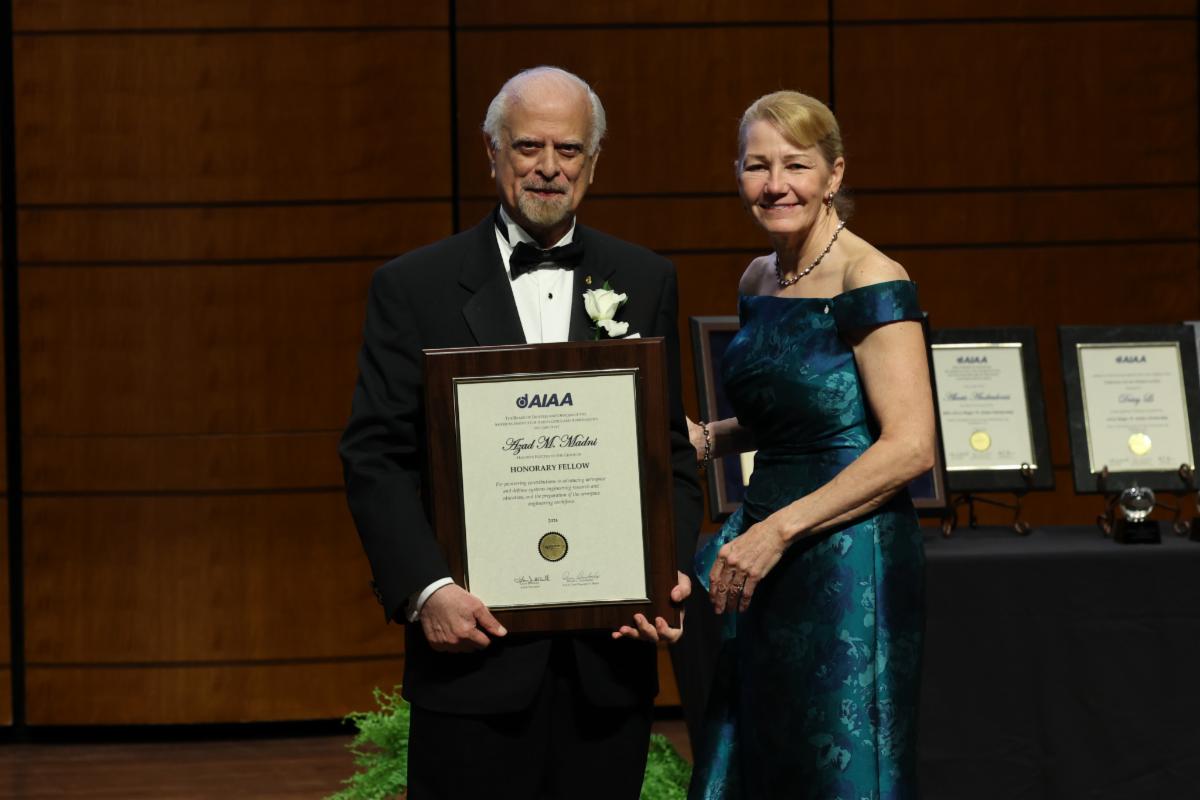
| Dr. AZAD M. MADNI, NAE AZAD M. MADNI is a University Professor of Astronautics, Aerospace, and Mechanical Engineering in the University of Southern California’s Viterbi School of Engineering. The University Professor designation honors the university’s most accomplished, multi-disciplinary faculty, who have significant achievements in multiple technical disciplines. He is the holder of the Northrop Grumman Fred O’Green Chair in Engineering and is the Executive Director of USC’s Systems Architecting and Engineering Program. He is also a Professor in USC’s Keck School of Medicine, where he is a faculty affiliate of the Ginsberg Institute for Biomedical Therapeutics. He also has a courtesy appointment in USC’s Rossier School of Education. He has a Courtesy Distinguished University Professor appointment in Computing and Information Sciences at Florida International University, and is a Distinguished Affiliate Faculty in the Department of Systems Engineering and Operations Research at George Mason University. He is the founder and CEO of Intelligent Systems Technology, Inc., a R&D company specializing in transdisciplinary approaches for tackling complex sociotechnical systems problems. He is the Chief Systems Engineering Advisor to The Aerospace Corporation and serves on the Advisory Board of the London Digital Twin Research Centre. He is a member of the Phi Kappa Phi honor society, and Omega Alpha Association, an international systems engineering honor society. Azad Madni is a member of the National Academy of Engineering and recipient of the prestigious 2023 NAE Gordon Prize for Innovation in Engineering and Technology Education. A Life Fellow of IEEE, he is also the recipient of the 2023 IEEE Simo Ramo Medal. He is an Honorary Fellow of AIAA and Honorary Member of ASME. He is a Life Fellow/Fellow of AAAS, INCOSE, IISE, AIMBE, IETE, AAIA, SDPS, and the Washington Academy of Sciences (WAS). He is the recipient of approximately 100 prestigious international and national awards from eleven different professional societies. These include the AIAA/ASEE John Leland Atwood Award for excellence in aerospace engineering education and research, the IEEE Aerospace and Electronic Systems Pioneer Award, the IEEE AES Judith A. Resnik Excellence in Space Engineering Award, the INCOSE Pioneer Award, Founders Award, Benefactor Award (only the second person in 31 years), Outstanding Professional Service Award, and Lifetime Achievement Award, the ASME CIE Lifetime Achievement and Leadership Awards. He has 420+ publications comprising authored and edited books, book chapters, journal articles, peer-reviewed conference publications, and research reports. He has given more than 100 keynotes and invited talks. He is also the recipient of the WAS Distinguished Career Award. He is a member of NAE Lifetime Giving Societies: the Marie Curie Society and the Albert Einstein Society. He pioneered the field of transdisciplinary systems engineering and wrote an award-winning book, Transdisciplinary Systems Engineering: Exploiting Convergence in a Hyperconnected World (Springer, 2018) that presented the founding principles of transdisciplinary systems engineering. He is also the creator of TRASEE™, a new engineering education paradigm based on principles from transdisciplinary systems engineering and the learning sciences. He is also the co-author of Tradeoff Decisions in System Design (Springer, 2016), Co-Editor-in-Chief of the Springer series on Systems Engineering Research, and co-author of Deep Learning: Design, Development, and Deployment (Springer, 2023). He is also the Co-Editor-in-Chief with Norm Augustine of the Handbook on Model Based Systems Engineering (Springer, 2023). He transformed USC’s Systems Architecting and Engineering Program based on TRASEE and provided a blueprint for other graduate engineering programs to follow. Under his leadership, the program has graduated 3200+ students and is recognized as a top graduate engineering program in the country. He has served as Principal Investigator on 101 R&D contracts and grants totaling more than $100M. His research areas are Augmented Intelligence, Digital Twin-enabled Model Based Systems Engineering, and Green Learning. Previously, he was the Executive Vice President for R&D and the Chief Technology Officer of Perceptronics Inc., a defense contractor specializing in simulation-based training and applied AI for aerospace and defense. Prior to that, he was a lead simulation engineer at Rockwell International, where he led the development of a cost-effective model-based testing approach for NASA’s Space Shuttle navigation system performance testing. He received his Ph.D., M.S., and B.S. degrees in Engineering from UCLA. He is also a graduate of AEA/Stanford Executive Institute. |