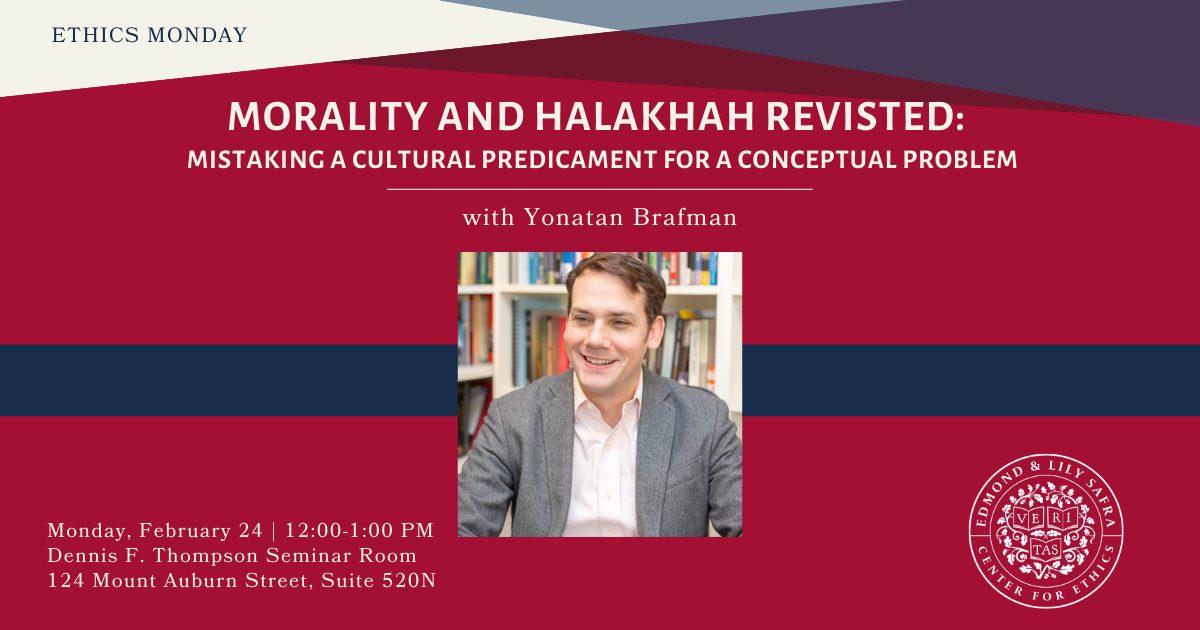
| About the Topic: The relation between morality and halakhah (Jewish law) is a perennial topic of debate within modern Jewish communities committed to Jewish observance. It may also be taken as an instance of the general conflict between morality and religion. In the Jewish context, it ranges over issues of private life, like gender and sexuality, as well as public concern, like economic justice and the ethics of warfare. In a typical case, some halakhic norm conflicts with a moral duty. Either it prescribes what morality forbids, or it prohibits what morality requires. For example, the seeming moral prohibition on impinging on another person’s bodily integrity without his consent conflicts with the apparent halakhic prescription of male infant circumcision. Or the seeming halakhic prohibition of anal sex between men conflicts with the apparent moral value of sexual expression or even moral prohibition against discrimination. Despite these real and raw clashes, this talk offers a contrarian argument: a conflict between halakhah and morality is not inevitable, arising from the nature of morality and halakhah, or reason and revelation, or Athens and Jerusalem. It rather emerges only when specific conceptions of halakhah and morality are adopted. There are, moreover, reasons not to hold them. Indeed, it suggests that, from a formal perspective, morality both supports the normativity of halakhah and constrains its content. Once the contingency of a conflict between halakhah and morality is appreciated, a diagnosis of why it presently seems unavoidable is possible. It concludes that thinking that a conflict between halakhah and morality is inevitable mistakes a cultural predicament for a conceptual problem.
About the Speaker: Yonatan Y. Brafman is an assistant professor of Modern Judaism in the Department of Religion at Tufts Univeristy, with a secondary appointment in the Department of Literary and Cultural Studies, as well as a member of the Program in Judaic Studies. He is also an affiliated scholar at the Brodie Center for Jewish and Israeli Law at Yale Law School.
He is a scholar of modern Jewish thought and a philosopher of religion. His research focuses on the intersection of Jewish thought, Jewish law, and contemporary moral, legal, and political philosophy. He also studies the implications of religious ritual for critical social theory and praxis.
His current research project, tentatively entitled, The Order of Jewish Laws: Text, Object, System, assesses the conditions and consequences of understanding Jewish texts, norms, and practices as constituting a discrete object—Jewish law—that could be separated from other discourses and areas of life, and subsequently systematized.
He is the author of Critique of Halakhic Reason: Divine Commandments and Social Normativity (Oxford University Press, 2024). He is the editor, with Suzanne Last Stone, of Jewish Law: New Perspectives (De Gruyter, 2024) and, with Leora Batnitzky, of Jewish Legal Theories: Writings on State, Religion, and Morality (Brandeis, 2018). He has published articles in several journals, including Journal of Religious Ethics, Jewish Studies Quarterly, and Diné Israel, Studies in Halakhah and Jewish Law.
Previously, he was assistant professor of Jewish thought and ethics and the director of the Handel Center for Ethics and Justice at the Jewish Theological Seminary of America. He has held fellowships at the Hebert D. Katz Center for Advanced Judaic Studies at the University of Pennsylvania (2022 - 2023), in the Department of Religion and Program in Judaic Studies at Princeton University (2017 - 2018; 2014 - 2015), the Tikvah Center for Law and Jewish Civilization at New York University Law School (2012–2013), and the Center for Jewish Law and Contemporary Civilization at the Benjamin N. Cardozo School of Law, Yeshiva University (2008–2010). He holds a PhD in Philosophy of Religion and Jewish Thought from the Department of Religion at Columbia University, where he also received his BA, MA, and MPhil. |