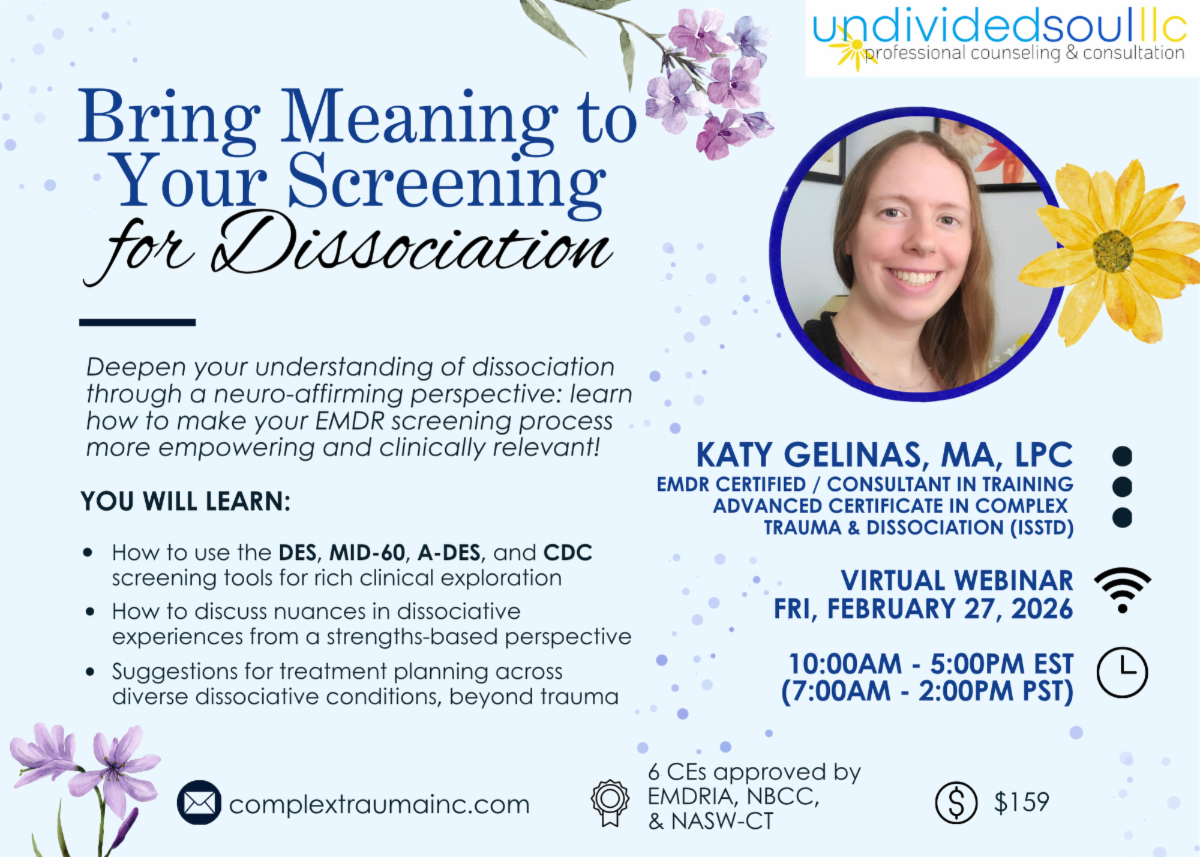
| Being Meaning to Your Screening: Exploring the Clinical Relevance of Dissociative Experiences 6 Hour Webinar Sponsored by Complex Trauma Inc Friday, October 10, 2025 11am - 6pm EDT
Kathryn (Katy) Gelinas, MA, LPC - Undivided Soul LLC, Waterbury CT www.undividedsoulcounseling.com EMDRIA Consultant-In-Training ISSTD Advanced Certificate in Complex Trauma & Dissociation
Brief Description “Dissociation” can be a confusing term with many different meanings, from daydreaming to depersonalization to identity switching. Learn how to use four dissociation screening tools, acquire accurate strengths-based language to educate clients, and explore treatment planning for diverse dissociative experiences that you will encounter in EMDR or trauma work.
Full Description Many EMDR therapists, especially those newly trained, feel overwhelmed and confused about dissociation and EMDR therapy. In some ways, dissociation has become a “buzzword” - and it can sometimes be difficult to acknowledge the gaps in our understanding when “everyone” seems to be talking about it!
This webinar will explore the diverse ways that different forms of dissociation can present across clinical presentations. You will gain useful language to more accurately describe dissociative experiences and help your clients gain common-sense understanding to demystify confusion and settle their (and your!) uncertainties.
There are many wonderful training programs about dissociative identity disorders (DID/OSDD), and many EMDR clinicians know to be cautious about “high scores” on screening instruments. Less attention is given, however, to other expressions of dissociation and how they might impact EMDR, especially when screening scores are moderately elevated but “not high.” We will spend considerable time discussing absorption, fantasy, and depersonalization/derealization, as well as somatization and amnesia, and how we might approach EMDR differently when these experiences are present- and how some dissociative experiences can even be resourceful.
Four different screening tools will be discussed, including the DES (Dissociative Experiences Scale), the MID-60 (60-Item Version of the Multidimensional Inventory of Dissociation), the A-DES (Adolescent Dissociative Experiences Scale), and the CDC (Child Dissociative Checklist). In addition to administration and scoring, you will learn how to use each one to have meaningful conversations with your clients.
We will look at more than 20 types of distinct dissociative symptoms and explore how various screening items from the screening tools may highlight these experiences. This will give you practical, applicable knowledge to empower you during your screening process to know which symptoms your client may be experiencing and, subsequently, the potential implications for their clinical presentation.
We will consider how to approach treatment planning based on what we learn about our clients’ relationship with dissociation. Our goal is to improve screening/assessment and to identify when to make such modifications; therefore, treatment recommendations (such as specific protocols or modifications) will be referenced, but not taught in depth. We will discuss Plurality/dissociative identities, however, this introductory webinar will not teach specific in-depth treatment strategies for complex dissociative conditions. Plentiful recommendations for further training and study will be made available.
This webinar will be presented from a strengths-based, Plural-affirming perspective. Survivors with lived experience of dissociation have been consulted in the development of this webinar.
Who Is This Webinar For? This introductory-level webinar is intended for those newer to working with dissociation, and will be most beneficial for trauma/EMDR therapists who are interested in increasing their competence around understanding, screening for, and explaining dissociation across diverse clinical presentations (including non-trauma-related conditions). The content has a low likelihood to cause distress (no severe trauma details will be discussed). Those with extensive knowledge and experience working with dissociative conditions may find much of the content to be repetitive of previous learning.
If you have any special needs, please email _________ with your request so that we can provide a great learning experience.
Previous Participants Have Said: “I feel more confident in my ability to screen for and educate clients on dissociation after the training.”
“I loved all the detailed explanations of very complex issues related to dissociative screening tools. It helped me organize a very big and ambiguous topic.”
“This webinar has given me greater appreciation for the complexity of DI [Dissociative Identities] and the need to learn more about it.”
“Amazing training! Very informative and interesting with so many practical uses!”
Learning Objectives
- Identify at least 3 distinct ways that dissociation can be experienced.
- Compare the basic properties and intended uses of at least 2 dissociation screening tools.
- Discuss how to assess and explore details about clients’ personal experiences with dissociation.
- Demonstrate methods to provide psychoeducation to clients about various forms of dissociation.
- Discuss at least 2 ways in which clients’ unique dissociative experiences can affect EMDR treatment planning.
- Identify at least 3 approaches or strategies that can support treatment with clients with various dissociative presentations.
Presenter Bio Kathryn (Katy) Gelinas, LPC is an EMDRIA Certified EMDR therapist and Consultant-In-Training working with Farnsworth Lobenstine LICSW. She has a private practice offering psychotherapy and clinical consultation in Waterbury, CT, specializing in working with trauma survivors with complex PTSD and dissociative conditions. She holds an Advanced Certificate in Complex Trauma and Dissociation from the International Society for the Study of Trauma & Dissociation Professional Training Program and has completed Level II Training in Clinical Hypnosis through the American Society for Clinical Hypnosis. In addition to EMDR, ego state therapy, and clinical hypnosis, Katy practices within a relational therapy framework informed by psychodynamic and person-centered principles. Katy believes in amplifying the perspectives of survivors with lived experience in learning about trauma and dissociation, and celebrating the diversity of human experience in a neuro-affirming approach with openness and curiosity.
Katy is a facilitator and moderator for Farnsworth’s and Paula Merucci’s “Weekend Webinar: EMDR, Polyvagal, and Parts Work” practicum-based training for EMDR therapists and has co-taught trainings about dissociative identities with Farnsworth and colleagues.
|