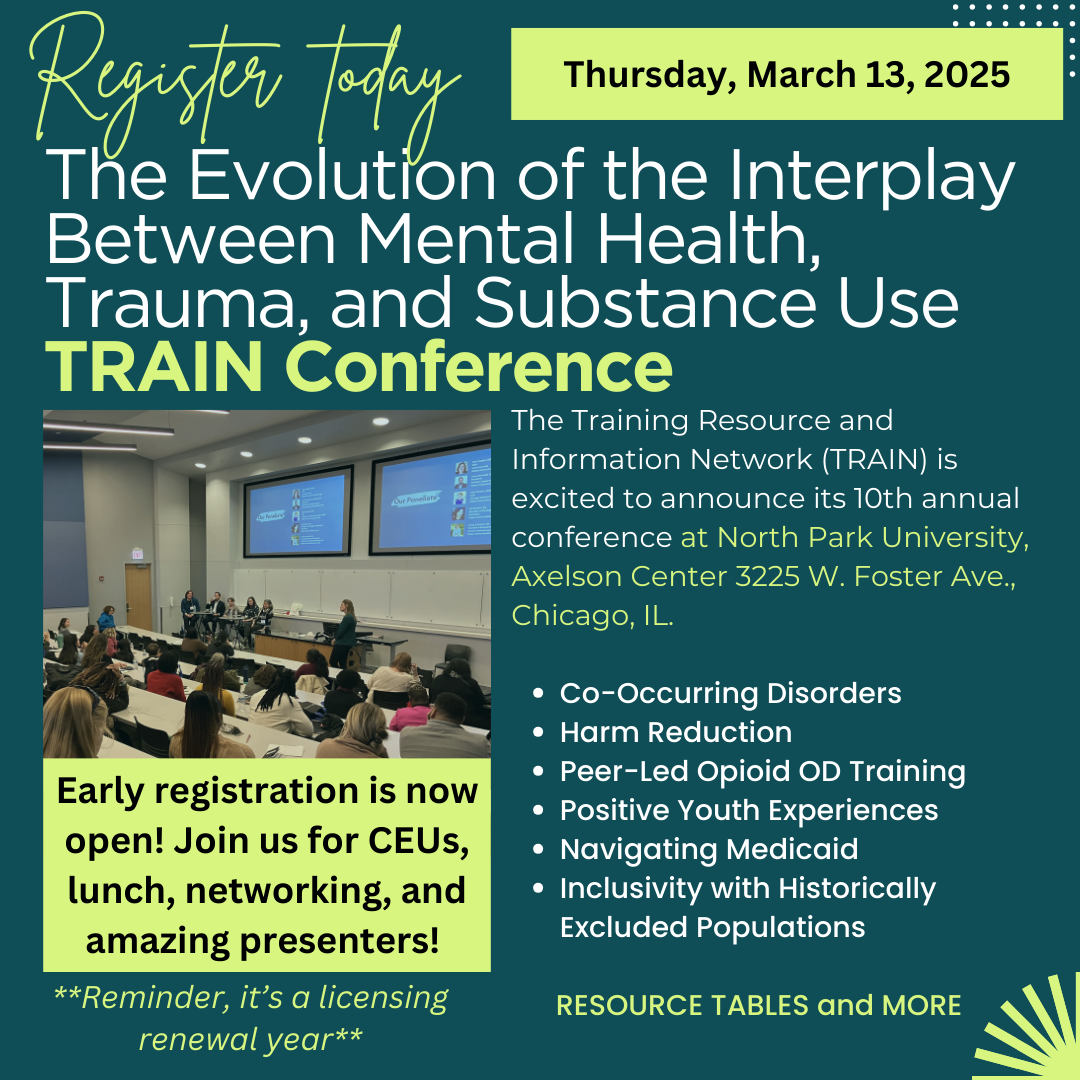
The Evolution of the Interplay Between Mental Health, Trauma, and Substance Use Click here for the full brochure! 10th Annual TRAIN Conference Brochure Final.pdf
The Training Resource and Information Network (TRAIN) is excited to invite you for its 10th annual conference on March 13, 2025 at North Park University's Axelson Center. This year’s focus is on The Evolution of the Interplay of Mental Health, Trauma and Substance Use and how these areas are deeply intertwined, which can create a vicious cycle. We have an incredible lineup of presenters, each bringing a wealth of knowledge across diverse disciplines. Please join us. Continuing education credits will be provided for LSW, LCSW, LPC, LCPC, PsyD., CADC.
Meet Eileen Tull, charismatic, engaging and filled with life. Eileen will kick us off with how she was addressing her own journey with alcohol and substances, and how she’s found joy, hope, and perseverance through the past sober 11 years.
Dr. Timothy Devitt, Psy.D., PPLC will follow as he opens up with integrating clinical practices to help people with co-occurring mental health and substance use disorders, work toward achieving the 4 dimensions of recovery (per SAMHSA). This session will include clinical practices that comprise of Integrated Dual Disorders Treatment (IDDT, including assertive outreach, stage-based approach to addressing substance use, harm reduction, motivational interviewing, health care access, and family psychoeducation), Individual Placement and Support (IPS), Permanent Supported Housing (PSH) and mutual aid group facilitation. Participants will be invited to share and reflect on real-world situations and barriers to implementation, as well as steps for moving forward.
MORNING BREAKOUT OPTIONS
A1: Navigating Medicaid Provider Enrollment and Compliance: A Practical Guide for Organizations Ellie Feldmann, LCPC, REAL Solutions 4U Becoming a Medicaid provider offers organizations the opportunity to expand access to vital services for underserved populations. This breakout session will guide attendees through the essential steps of enrolling as a Medicaid provider, understanding the regulatory landscape, and implementing effective compliance strategies. Participants will gain insights into common challenges, learn actionable strategies to maintain compliance, and leave with tools to sustain their organization’s credibility and eligibility.
A2: Inclusivity: Support for Staff Working with Historically Excluded Populations Cecilla (Cec) Hardacker, MSN, RN, CNL, Howard Brown This workshop will explore the dynamics of trauma on the mental health of LGBTQ+ populations with an emphasis on substance use and coping behaviors within these communities. Objectives will include understanding anti-oppressive approaches and trauma-informed care in creating a safe space, incorporate introductory gender-inclusive language, and creating a safe space for LGBTQ+ communities within your organizational culture. Additional focus will be on learning patient-centered frameworks of care with an emphasis on harm reduction, cultural humility and intersectionality, and analyzing how intersectionality impacts various patient experiences.
A3: Positive Childhood Experiences Gary Pate, LCSW, YouthCare A lot of attention and research have focused on the impacts of Adverse Childhood Experiences, or ACEs, in recent years. Understanding the negative impact on a child's overall development and even into adulthood is important, but equally important is understanding what can be done to prevent or mitigate the effects of ACEs. This training will offer learners an introduction to Positive Childhood Experiences (PCE's) and how they can implement strategies to improve outcomes for children and families.
AFTERNOON BREAKOUT OPTIONS
B1: Taking it to the Streets: How Peer-led Opioid Overdose Training Helped Build Community Collaboration, Lee Rusch, West Side Heroin/Opioid Task Force This workshop will cover the hiring, training, and support of individuals with lived experience who provide assistance to community residents, particularly those facing Opioid Use Disorder (OUD), Substance Use Disorder (SUD), homelessness, and other challenges. The workshop will place a special emphasis on developing effective warm hand-off processes that connect individuals to services, including medical stabilization, housing, Medication-Assisted Recovery, and other treatment modalities. B2: Harm Reduction: Prevention of Harm, Improvement of Health, & Enhancement of Well-Being for Individuals and Communities Robert Banks and Lauretta Ekanem Omale, Community Outreach Intervention Projects, University of Illinois at Chicago The Community Outreach Intervention Projects (COIP), a center within the School of Public Health, at the University of Illinois Chicago has been providing harm reduction services to Chicago’s communities for over 35 years. Founded in 1987, COIP addresses the specific needs of people who use drugs, including wraparound services to support whole-person centered health, delivered by mobile units and at brick-and-mortar sites. COIP utilizes a peer-based model of service provision, which trains people with lived experience of substance use, to deliver interventions tailored to the needs of the communities we serve. These include: HIV/hepatitis C counseling and testing, safer use supplies (syringes, snorting and smoking kits), overdose prevention and education, peer recovery support, medications for opioid use disorder (MOUD) and other clinical services, drug checking, and street outreach. Harm reduction is an approach focused on reducing the negative consequences of risky behaviors, especially those related to substance use. It emphasizes practical strategies to prevent harm, improve health, and enhance the well-being of individuals and communities. This session will discuss methods and approaches to harm reduction, overdose prevention, peer-model approaches, and will close with a demonstration on how to reverse and opioid overdose with naloxone. Resources to incorporate harm reduction into participant’s organizations will be provided. B3: Motivational Interviewing Across Disciplines Amanda Norris, M.A., President & Founder, Sustainable Mental Wellness, Inc. Rooted in substance use treatment since the 1980s, Motivational Interviewing (MI) techniques have increasingly been adapted across healthcare, education, and other employment settings. Hone in on your MI skills and explore which techniques you can leverage from one role to the next in your everyday life. Explore why this modality for communication is effective in multiple spaces and can support leaders and family members alike, in building rapport and positive relationships. Get ready to elevate your own success with this easy to follow guide and in the moment practice. Learning objectives include: 1. Learn practical and evidence-based motivational interviewing techniques that work between different settings and individuals. 2. Identify potential barriers to implementing motivational interviewing with different identified groups in personal and professional settings and workshop creative ways to counteract these challenges. 3. Create a personalized plan for integrating motivational interviewing techniques into your professional practice and personal life. |