| Tuesday, August 26ᵀᴴ 5:00 - 6:30 pm Grand Room, Posner Hall, CMU
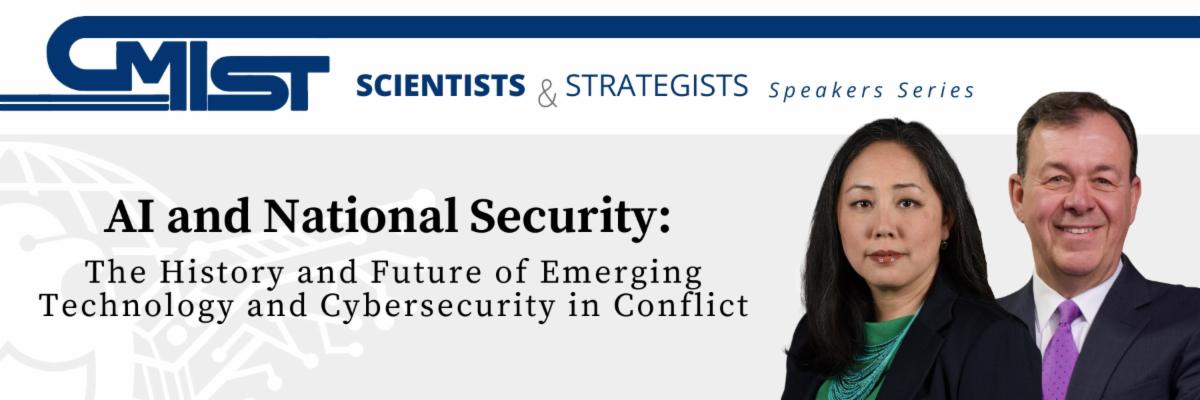
Join us for an important conversation on artificial intelligence and security with two leading experts. "AI and National Security: The History and Future of Emerging Technology and Cybersecurity in Conflict" will feature Brigadier General (retired) Greg Touhill, director of the CERT Division at CMU's Software Engineering Institute and the first Federal Chief Information Security Officer. He will be joined by Mieke Eoyang, a leading executive in policy research and the former top cybersecurity official for the Department of Defense. With their extensive backgrounds in military, government, and policy, these speakers will offer a unique perspective on this critical topic. This event will be moderated by CMIST Director, Audrey Kurth Cronin.
Overview: The Department of Defense (DoD) is one of the world's largest developers, shapers, and purchasers of disruptive and emerging technologies—a massive enterprise charged with simultaneously mastering cutting-edge capabilities while defending against the weaponization of similar capabilities by adversaries. This unique dual mandate forces DoD to approach transformational technology from both directions: as a wielder seeking strategic advantage, and as a defender protecting against actors who can rapidly adapt these same tools for nefarious purposes. DoD's extensive history with previous technological revolutions—from nuclear weapons to precision munitions to cyber capabilities—offers crucial lessons about establishing guardrails, scaling and fielding innovations, and managing unintended consequences. Yet artificial intelligence also presents fundamentally new challenges that will require both institutional wisdom and innovative thinking. How can the military leverage its hard-won experience while recognizing where AI breaks from historical patterns? How can it maintain decisive advantage while ensuring responsible use? And how can an organization of such scale move with the speed and agility that the AI era demands? These questions sit at the heart of modern defense strategy, and will shape the future of national security.
|