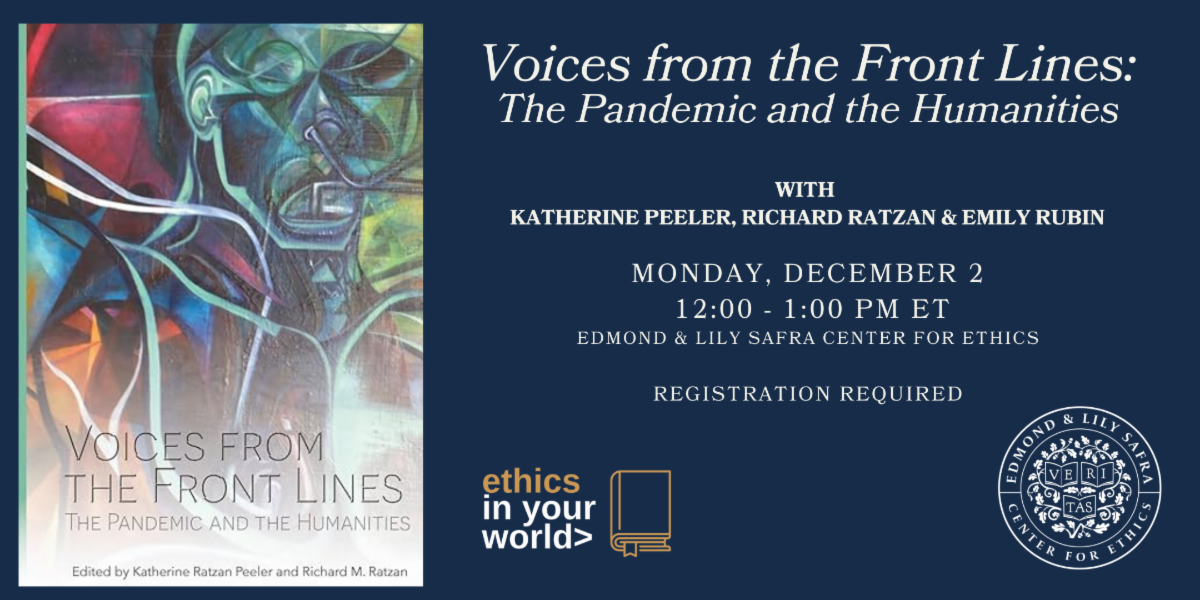
| The COVID-19 pandemic profoundly disrupted our practice of, approach to, and thoughts about care. Longstanding ethical questions and concerns about health care were suddenly emergent and ubiquitous. To understand how these questions were experienced daily on the medical front lines in the U.S., and thought about from well-versed medical humanities experts, Drs. Peeler and Ratzan created their book Voices from the Front Lines: The Pandemic and the Humanities. In this collection, 45 contributors ranging from physicians to respiratory therapists to clergy performing last rites to hospital executives to historians, ethicists, and anthropologists wrangled with bioethical and societal questions of how to live, and assist others, in the world-altering pandemic that was COVID-19.
The Edmond & Lily Safra Center for Ethics invites you to the next installment in our Ethics in Your World Series, where co-editors (and daughter and father!) Katherine Ratzan Peeler and Richard M. Ratzan, along with book contributor, Emily Rubin, will discuss their experiences on the front lines of the COVID-19 pandemic. They will reflect on their experiences from the perspective of the humanities, and on why collections such as this one are necessary at this 5-year anniversary of the start of the pandemic and for years to come.
About the Authors: Katherine Ratzan Peeler is an Assistant Professor of Pediatrics, Global Health and Social Medicine, and Bioethics at Harvard Medical School (HMS) and a former ELSCE Initiative Fellow. Her writings frequently center on the intersection of human rights, bioethics, anthropology, and health.
Richard M. Ratzan is a medical humanities writer and retired emergency medicine physician. He is the author and editor of numerous articles and books, including Imaging Vesalius: An Ekphrastic, Scholarly, and Literary Celebration of the 1543 De Humani Corporis Fabrica of Andreas Vesalius.
Emily Rubin is a pulmonary and critical care physician at the Massachusetts General Hospital and a co-chair of the hospital’s ethics committee. Her areas of expertise include conflict resolution, the intersection of intensive care and palliative care, decision-making in patients with serious illness, and allocation of resources. During the Covid-19 pandemic, she served on Massachusetts state expert advisory panels regarding allocation of scarce critical care resources and therapeutics and has led the development of multiple allocation protocols within the Mass General Brigham health system. She has a medical degree from Dartmouth Medical School, a law degree from the University of Virginia and a Masters of Science in Health Policy Research from the University of Pennsylvania.
|