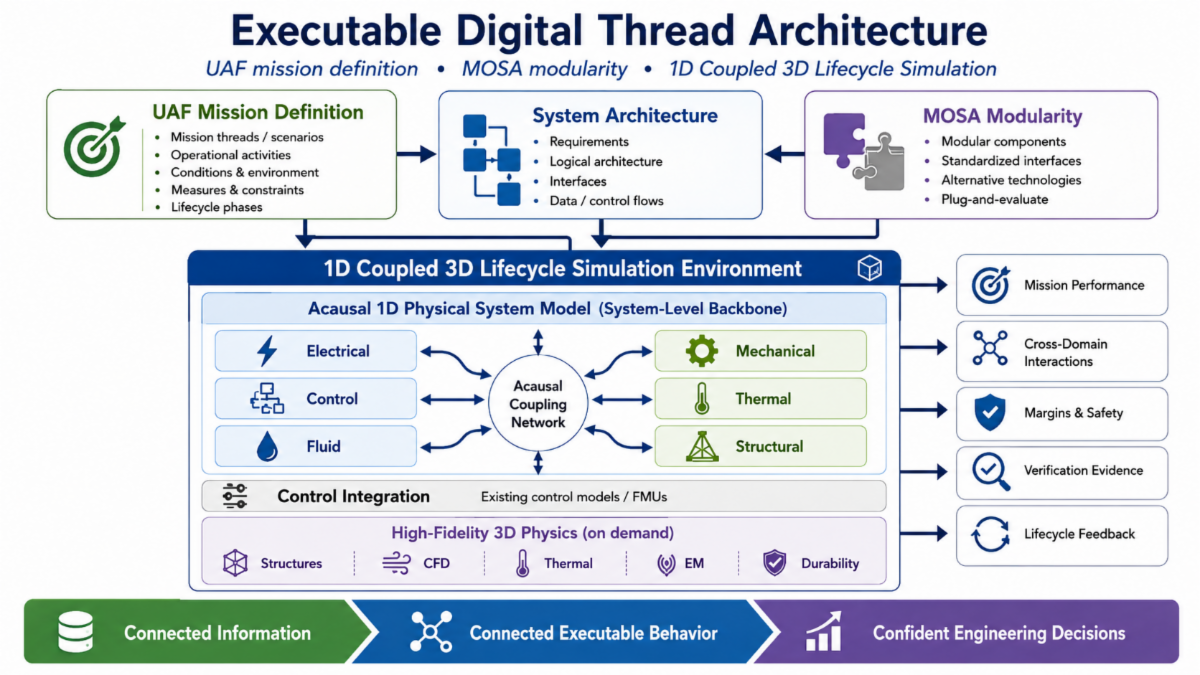
| Digital engineering has made significant progress connecting requirements, architecture, design, simulation, and test. Yet engineering organizations must divide the problem among disciplines while the product operates as one physical system. How do we preserve the evolving interactions between those disciplines throughout a mission and across the product’s life? Building on the introductory speaker meeting, this hands-on workshop explores 1D Coupled 3D Lifecycle Simulation through a guided engineering scenario. Participants will connect mission objectives and requirements to an executable multidomain physical model, work with supplied components and existing control logic, and incorporate supplied 3D-derived behavior where additional fidelity is needed. They will investigate how changing operating conditions, component degradation, and modular component alternatives affect the complete system while retaining existing architecture, controls, simulation, and test investments. Participants will leave with a practical understanding of how to translate a mission into simulation conditions, recognize how physical consequences propagate across disciplines, and compare baseline, degraded, and alternative configurations against common requirements. Through a guided component substitution, they will explore how simulation may support a Modular Open Systems Approach (MOSA) evaluation. Followed by several examples where cross domain and multi-physics issues have plagued complex programs. The point is to provide the attendees with and open for discussions on past issues within their own organizations where this approach could provide useful engineering evidence or future assurances. No specialized simulation experience is required. The workshop will be held virtually to enable participation by members throughout the INCOSE Los Angeles Chapter and beyond! |