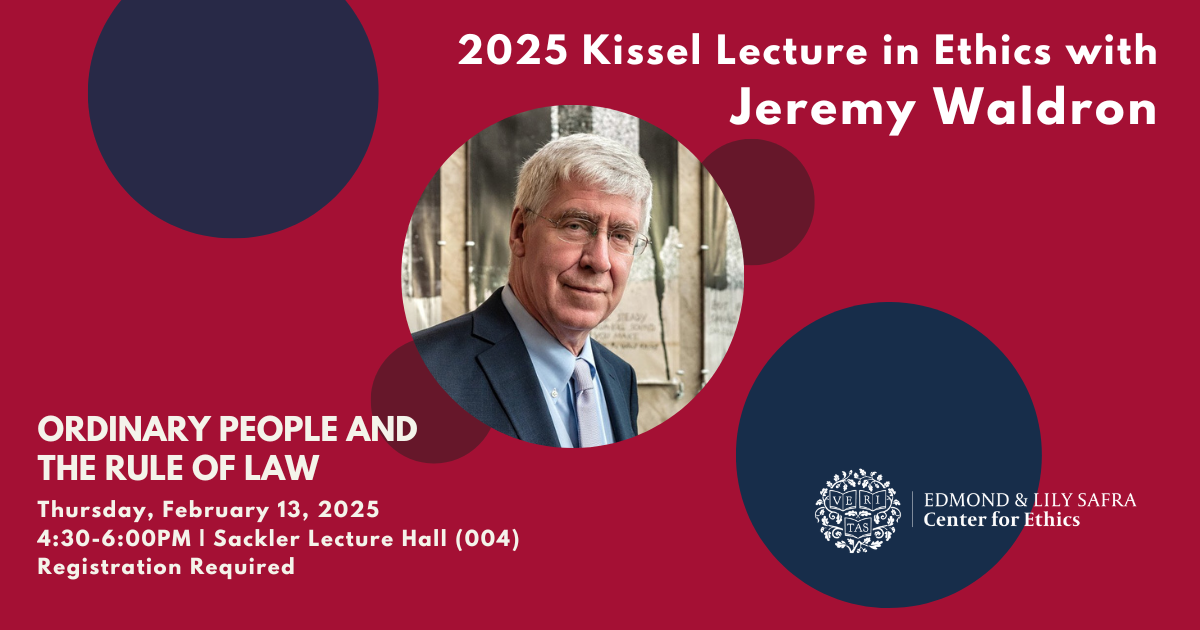
| About the Lecture The rule of law is a doctrine that affects the way political power is exercised. With its leading principle that no one is above the law, it directs itself at the upper echelons of society and ensures that presidents, legislators, judges, agency heads, and other officials are bound by law in the exercise of the powers entrusted to them. But what does the rule of law require of ordinary citizens? Does it require anything more than law and order—basic compliance with ordinary legal obligations? That in itself is worth further investigation in the context of moral and political disagreement: the obligation to comply with laws one judges unjust is business as usual for the rule of law. But we also need to consider the ordinary citizen’s obligation not to press for the exemption of high officials from legal constraint and also citizens’ obligations to play their part in keeping the legal system in good shape, fit for the purpose of governing the power of political office-holders. This lecture will argue that citizens’ modes of legal compliance—from the acceptance of political defeat, when it happens, through the self-application of rules and standards with which one disagrees—must provide a model for the sort of constraint we expect officials to submit to, in a system governed by the rule of law.
About Jeremy Waldron Jeremy Waldron is University Professor at New York University School of Law where he teaches legal and political philosophy. He was previously University Professor in the School of Law at Columbia University. Between 2010-2014, he held his NYU position conjointly with the position of Chichele Professor of Social and Political Theory at the University of Oxford (All Souls College).
Waldron was born and educated in New Zealand, where he studied for degrees in philosophy and law at the University of Otago. He was admitted as a Barrister and Solicitor of the Supreme Court of New Zealand in 1978. He studied at Oxford for his doctorate in legal philosophy, and taught there as a Fellow of Lincoln College from 1980-82. From 1982-1987, he taught political theory at the University of Edinburgh, and from 1987-1995, he was a Professor of Law in the Jurisprudence and Social Policy Program in the School of Law (Boalt Hall) at the University of California, Berkeley. He was briefly at Princeton, as Laurance S. Rockefeller University Professor of Politics, before moving to New York in 1997.
He has written and published extensively in jurisprudence and political theory. His books and articles on theories of rights, on constitutionalism, on the rule of law, and on democracy, judicial review, property, torture, security, and homelessness are well known, as is his work in historical political theory (on Aristotle, Thomas Hobbes, John Locke, John Stuart Mill, and Hannah Arendt). His most recent books are “Political Political Theory: Essays on Institutions,”, “One Another’s Equals: The Basis of Human Equality,” and “Thoughtfulness and the Rule of Law,” published by Harvard University Press in 2015, 2017, and 2024. Professor Waldron travels widely and has delivered public lectures all over the world, from Buenos Aires to Jerusalem. He gave the second series of Seeley Lectures at Cambridge in 1996, the 1999 Carlyle Lectures at Oxford University, the Wesson Lectures at Stanford in 2004, the Storrs Lectures at Yale Law School in 2007, the Tanner Lectures at Berkeley in Spring 2009, the Holmes Lectures at Harvard Law School in 2009, and the Gifford Lectures at Edinburgh in 2015. He was elected Fellow of the British Academy in 2011 and he became a Member of the American Academy of Arts and Sciences in 1998. He is also a member of the American Philosophical Society, and In April 2011 he was awarded that society’s prestigious Phillips Prize for lifetime achievement in jurisprudence. |