|
|
Cones and Chaos Rain: 2025 Cone Collection Season at a Glance By Ruby Beauchamp |
| Every fall, a quiet yet colossal effort unfolds in the forests. It’s not a spectacle most people ever see — no ribbon cuttings, no headlines — but for those involved, it’s an undertaking that tests grit, stamina, and patience. Cone collection season is underway in the overstory. This year alone, more than 48 collections have been coordinated across the state on behalf of government agencies, non-profits, and private industry foresters, drawing in an impressive lineup of partners: CAL FIRE, the USDA Forest Service, Bureau of Land Management, American Forests, Sierra Pacific Industries, Sierra Cone, SEGI Reforestation and a whole host of independent cone hunters. Together in our effort to strengthen statewide seed banking efforts, these specialists form the backbone of California’s reforestation pipeline. |
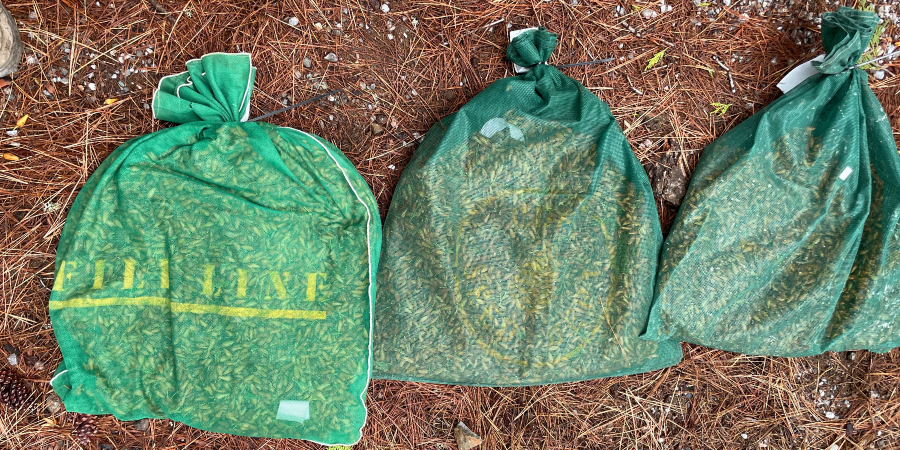
Photo by Kelli Oelrichs, American Forests, featuring three bushels of Incense Cedar cones collected from La Tour Demonstration State Forest at the 5,000 feet elevation band. |
| The Arc of the Season As it does year after year, California’s cone collection season started quietly in the heat of summer. In early July, foresters across the state scanned the treetops, noting which conifer tree species carried crops at various elevations, and which stands met the ideal criteria for collection. Surveying gradually turned into monitoring. Foresters identified superior tree stands and sampled cones from canopies to determine the seeds’ maturity.
In cone collection, timing is everything…
Then came the key turning point — the moment when conditions aligned, and cones were declared ‘ripe’. Overnight, the first ripe cones dried out and flared open to begin spreading the seeds within. With this change, the collection season ignited. Calls went out and crews mobilized. Climbers and “groundies” navigated to select stands and collections began. From then on, it’s been all hands on deck: scouting trees, testing cones, working ropes, bagging and tagging bushels, and transporting cones to seed extractories. At its best, it’s organized chaos, where everyone involved knows their role, yet no day is predictable. |
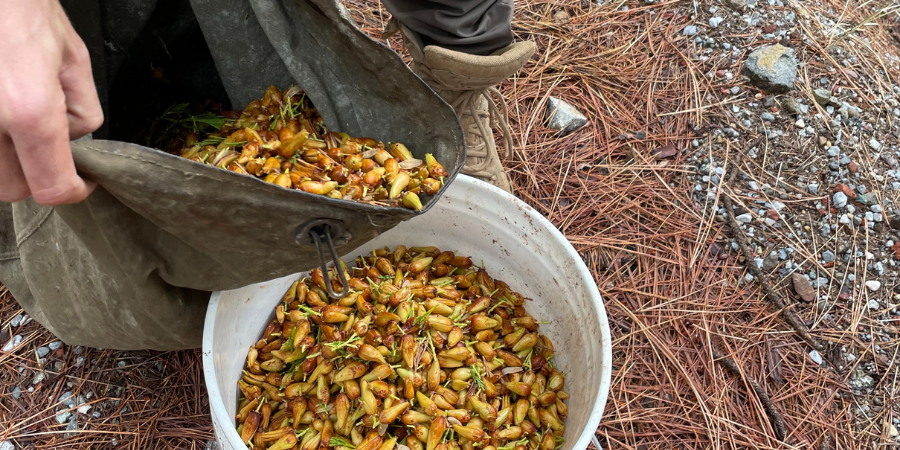
Photo by Kelli Oelrichs, American Forests, featuring Incense Cedar cones being measured into a 5-gallon bucket by Bob Ross, Sierra Cone ground crew. |
The Year of the Incense Cedar Every season has its story, and 2025 will be remembered as the year of Incense Cedar (Calocedrus decurrens). The crop has been truly abundant — a potential mast year. Mast seeding is a phenological event in which large quantities of seed are produced.
For climbers, this means long days ‘in the saddle’, working in stands where Cedars droop with the weight of clustered conelettes, sometimes spending up to 3 hours in a single tree. Though not as abundant as the incense cedar, Douglas fir (Pseudotsuga menziesii), including Big-cone Douglas-fir (Pseudotsuga macrocarpa), and other mixed pine species were productive in ‘pockets’ as opposed to being widespread across their known range.
While it may not have been this year’s star species in terms of cone quantity, there were a number of Big-cone Douglas-fir collections that were monumental. Native only to Southern California, Big-cone Douglas-fir is often planted for the specific purpose of watershed and habitat restoration, yet it is especially threatened by large, extreme wildfires occurring at higher frequency. On one collection, completed by Sierra Cone, Spencer Lachman, the collection coordinator and environmental scientist at the CAL FIRE Lewis A. Moran Reforestation Center, recounted, “when the time came to collect the crop it was a marathon two-day event that yielded 45 bushels of Big-cone Douglas-fir cones. CAL FIRE and the USFS split the cones 50/50 so these seeds will be able to support reforestation objectives on private and public lands in Southern California.”
Cone collection is work that demands plenty: emotional resilience to roll with delays, weather, and the unexpected; mental focus to be present and safe, and to communicate effectively with crew members; and physical strength to climb trees and support collection efforts on the ground. In one day alone this season, two different collection crews were evacuated from nearby fires, an additional two were delayed by rain, and one crew was paused for lightning. Meeting these natural interruptions with enduring perseverance is no small feat.
The patient protagonists of this story are many as the cone season is truly a tale of personalities and partnerships. Each cone hunter, from foresters to climbers, comes to the collection site with varying levels of experience and their own distinct style. Each collection requires collaboration between land owners and collection partners, between private industry and public agencies, between climbers and ground crew, and between veteran cone hunters and the new generation learning the ropes. |
Photo by Kelli Oelrichs, American Forests, featuring Bob Ross, Sierra Cone ground crew, measuring Incense Cedar cones. |
Cones, Chaos and Beyond It would be easy to see cone collection as just one more technical step in forest management — a backwoods operation that few outside the field will ever think about. But in truth, it’s the seed of California’s reforestation mission. Without these collections, the entire pipeline falters.
The seeds gathered this fall will one day become seedlings. Those seedlings will have a chance at growing into forests that shade rivers, house winged and legged friends, build soils, stabilize riverbanks, store carbon, and protect communities while also providing for their recreational enjoyment. That future depends on the messy, exhausting, collaborative work happening in the trees right now.
The real beauty of cone season reminds us that the health of our forests is not the responsibility of any one agency, company, or nonprofit. The responsibility belongs to all of us. Year after year, engaged forest stewardship tests us. Year after year, we rise to meet the challenge.
In the end, cone collection is about more than cones. It’s about commitment — to each other, to the land, and to the future generations who will walk in the understory of our trees. |
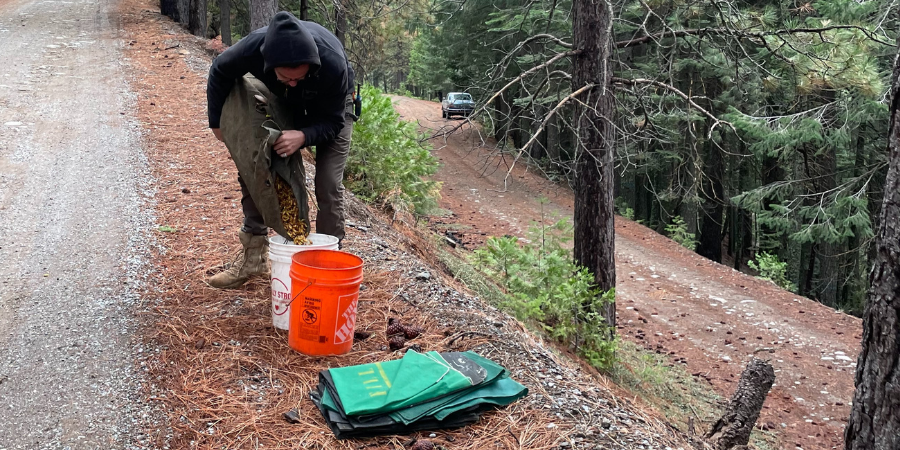
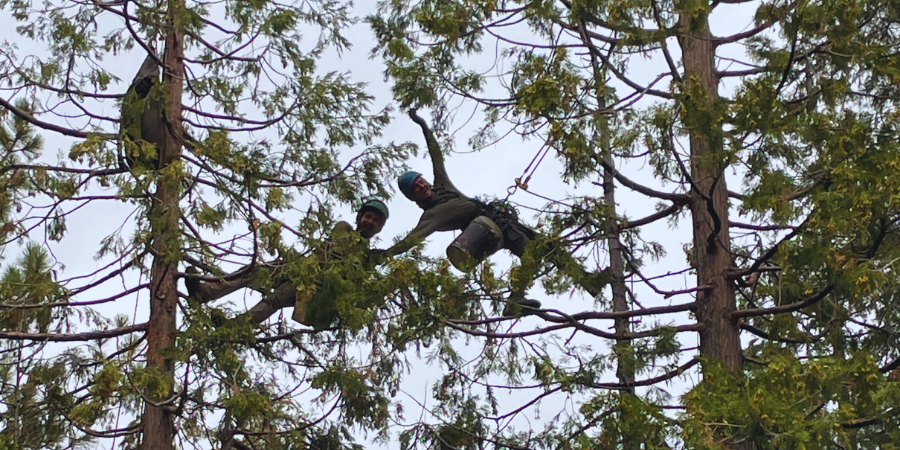
Photo by Kelli Oelrichs, American Forests, featuring climbers Miles Ryan and Chris Henkel, Sierra Cone, collecting Incense Cedar cones from La Tour Demonstration State Forest. |
|
|
|
|
|
About the Author
Ruby Beauchamp is a 2025-2026 fellow with the Sierra Nevada Alliance Sierra Forestry Corps serving with American Forests as the Reforestation Pipeline Partnership Coordinator. With five years of climbing and cone collection experience, she brings boots-on-(and off)-the-ground experience to the conifer seed supply chain. |
|
|
|
|
|
|