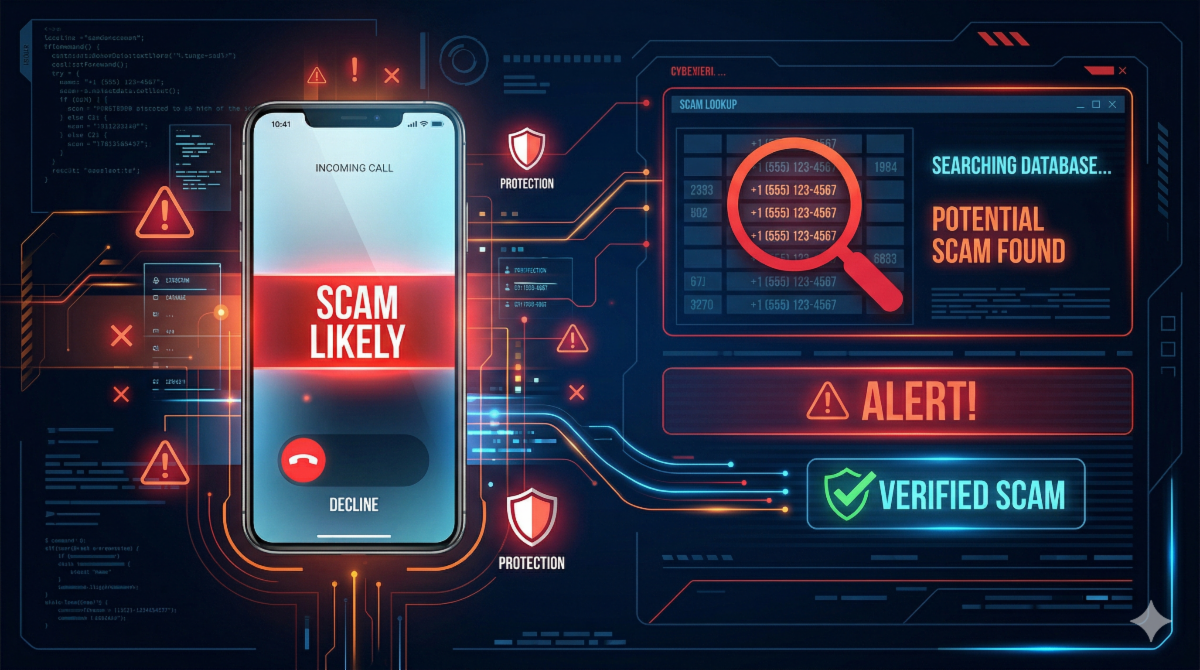
| How to Do a Reverse Phone Lookup Step by Step Let's say you just got a call from a number you don't recognize. Here's exactly what I'd do. Step 1: Don't call back right away. Seriously. Calling back an unknown number can sometimes confirm that your number is "active" to scammers — which just leads to more calls. Wait until you know what you're dealing with. Step 2: Google the number first. Takes 10 seconds. Just paste it in. See what comes up. If nothing useful shows up, move to step 3. Step 3: Run it through Truecaller or WhoCalledMe. These two together cover a lot of ground. If the number has been flagged before, you'll know quickly. Step 4: Check the area code. This won't definitively tell you it's a scam, but it's useful context. Some area codes are heavily associated with spoofed scam calls. If you got a call from an unfamiliar area code at an odd hour, that's a red flag. Step 5: If it was a scam, report it. Go to reportfraud.ftc.gov. Takes about two minutes. It genuinely helps protect others. Red Flags That a Call Is a Scam (Even Before You Look Anything Up) Sometimes you don't even need a lookup tool. The call itself tells you everything. Watch out for:
- Urgency and pressure. Real agencies and companies don't demand immediate action. Scammers do. If someone says "you must act NOW or face arrest," that's a scam.
- Requests for unusual payment. Gift cards. Wire transfers. Cryptocurrency. No legitimate organization asks for these.
- Threats. "Your account will be closed." "You'll be arrested." "We'll report you." These are scare tactics.
- Spoofed numbers. If a call looks like it's from your bank but something feels off, hang up and call the official number on the back of your card.
- Asking for personal information. Social Security numbers, bank account details, passwords. A real bank won't ask for these over the phone unsolicited.
- Robocalls with a pre-recorded message. Many scam operations use automated calls as a first step.
My rule of thumb: if the call made you feel scared or rushed... something's wrong. Legit businesses and agencies don't operate that way. They give you time. They have real contact info. They don't threaten you. What Scammers Don't Want You to Know About Phone Number Spoofing Here's something that trips a lot of people up. A scammer's apparent phone number — the one that shows on your caller ID — is often completley fake. They use technology called VoIP spoofing to make any number they want show up on your screen. Your neighbor's number. Your doctor's office. Your bank's 800 number. They can fake all of it. So when you do a reverse phone lookup on the number that appeared on your caller ID, you might find out it belongs to some random business or person who has nothing to do with the scam. They're victims too — their number was used without their knowledge. This doesn't mean phone lookups are useless. They're still valuable. But it does mean you shouldn't automatically trust a number just because it looks familiar or local. Some things to know about VoIP and spoofing:
- VoIP numbers are incredibly cheap to set up and easy to abandon
- Scammers cycle through numbers constantly to avoid being blacklisted
- International scam operations can make it look like they're calling from your own area code
The technology to completely stop spoofing doesn't fully exist yet, though carriers have made progress with systems like STIR/SHAKEN, a verification framework that the FCC has been rolling out. Your phone might even display "Verified" next to some calls now because of this. How to Block Scam Calls on Your Phone Looking up a number is reactive. Let's talk about being proactive. On iPhone:
- Go to Settings > Phone > Silence Unknown Callers. This sends all calls from numbers not in your contacts straight to voicemail.
- You can also report and block individual numbers by pressing the "i" icon next to a recent call.
On Android:
- Open the Phone app, go to Settings > Blocked Numbers, and add any number you want to block.
- Google's Phone app has built-in spam detection that flags suspicious calls automatically.
Third-party apps worth trying:
- Nomorobo — blocks robocalls and telemarketers. Has both free and paid versions.
- Hiya — caller ID and spam detection. Well-rated and widely used.
- RoboKiller — actually answers spam calls with an AI "bot" to waste the scammer's time. Kind of satisfying, honestly.
Register with the Do Not Call Registry. Go to donotcall.gov and register your number. It won't stop all calls — scammers don't care about legal registries — but it does reduce legitimate telemarketing calls. And if you still get telemarketing calls after registering, those calls are illegal, and you can report them. Real Stories: What Happened When People Actually Looked It Up I've talked to quite a few people about this, and the pattern is pretty consistent. The people who got scammed were the ones who didn't pause to check. A friend of mine — I'll call her Diane — got a call last year from someone claiming to be her grandson. He was "in jail" and needed bail money sent via wire transfer. Diane almost did it. What stopped her was her daughter, who walked in and said "wait, let me look up that number first." Thirty seconds on WhoCalledMe showed the number had been reported dozens of times for the exact same scam. Another guy I know — mid-50s, pretty tech-savvy — got a call from someone claiming to be from Microsoft. His computer supposedly had a virus. They wanted remote access. He was actually in the process of giving it to them when something felt off. He Googled the number. Top result: a massive scam operation that had been hitting people for years. The pause. That's what saved them. And the lookup gave them the confidence to hang up without second-guessing. Reporting Scam Numbers: Why It Actually Matters A lot of people think reporting a scam number is pointless. Like, what's the government gonna do, right? More than you'd think, actually. When you report a scam number to the FTC, that information goes into a database used by:
- Law enforcement agencies at the state and federal level
- Phone carriers who use the data to block numbers proactively
- Consumer protection organizations
- Researchers studying fraud patterns
The more reports that pile up on a specific number or scam operation, the more likely it is that something gets done. Big fraud rings have been busted partly because enough individual consumers took five minutes to file a complaint. Where to report:
- FTC: reportfraud.ftc.gov
- FCC: consumercomplaints.fcc.gov (especially for robocalls and spoofing)
- Your state attorney general's office — many have their own consumer fraud hotlines
- AARP Fraud Watch Network: 1-877-908-3360 (especially helpful for older adults)
Protecting Elderly Family Members From Phone Scams This is important and I want to spend a minute on it. Older adults are disproportionately targeted by phone scammers. Not because they're less intelligent — but because they're more likely to be home, more likely to answer the phone, and often more trusting of authority figures like government officials or doctors. If you have a parent or older relative, here are some practical things you can do:
- Set up a spam-blocking app on their phone for them. Don't just recommend it — actually do it.
- Have a code word. If a "family member" ever calls asking for money, they should have to provide a pre-agreed code word before any action is taken.
- Talk about it openly. Scams work partly because victims feel ashamed. Normalizing the conversation helps.
- Remind them: hang up is always OK. They don't owe any caller a conversation. Hanging up is not rude. It's smart.
Conclusion Look, phone scams are not going away. If anything, they're getting more common and more convincing. The technology scammers use keeps improving, and they're running these operations at massive scale from all over the world. But you're not helpless. A quick scammer phone number lookup takes less than a minute and can save you — or someone you love — from a very bad situation. The tools are free. The process is simple. And once you get in the habit, it becomes automatic. The next time an unknown number calls and something feels off, don't second-guess yourself. Hang up. Look it up. And if it's a scam, report it. That's it. That's the whole thing. Frequently Asked Questions (FAQs) Q: Can I look up a scam phone number for free? Yes, absolutley. Google, Truecaller, WhoCalledMe, and 800notes are all free to use. You can identify most scam numbers without paying anything. Some services like Spokeo and BeenVerified have free basic searches but charge for detailed reports. Q: What if the number shows up as a local number — could it still be a scam? Yes. Scammers use spoofing technology to make any number appear on your caller ID, including local numbers. A local-looking number is not a guarantee of legitimacy. Q: Should I call back an unknown number? Generally, no. Calling back can confirm to scammers that your number is active, resulting in more calls. If you're concerned it was legitimate, Google the number first and call back using a verified contact number from the company's official website. Q: How do I know if a call is spoofed? You often can't tell just by looking at the number. But if the caller is pressuring you, asking for unusual payment methods, or claiming to be from a government agency, be very suspcious regardless of what number appears on your screen. Q: Does the Do Not Call Registry stop scam calls? It reduces legitimate telemarketing calls but does very little to stop actual scammers, who don't follow the law anyway. Scam call blocking apps are more effective for that purpose. Q: What should I do if I already gave information to a scammer? Act fast. Contact your bank immediately if you shared financial information. Put a fraud alert on your credit with the three major bureaus (Equifax, Experian, TransUnion). File a report with the FTC at identitytheft.gov. The sooner you act, the better. Q: Are phone scam lookups different from reverse phone lookups? They're basically the same thing. A reverse phone lookup gives you information about who owns a number. When used to identify scam calls, people often call it a scam phone number lookup. Same tools, same process. Q: Can law enforcement actually trace scam calls? Sometimes, yes. Especially for domestic operations. International scams are harder to prosecute, but major operations have been shut down through cooperation between the FTC, FBI, and international agencies. Reporting your experience always contributes to these efforts. |