|
DAVE: Hi Clare! It’s good to see you again! How are you? CLARE: Hi Dave, I’m doing well thanks!
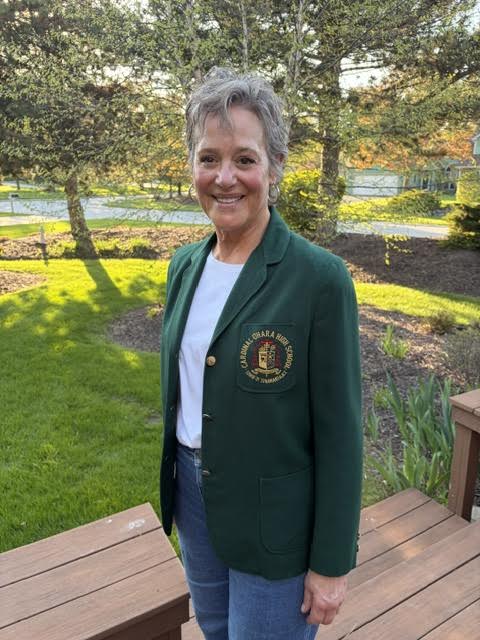
I have to tell you that after you called me about doing an interview, I started looking through my O’Hara yearbooks - taking a walk down memory lane. It was fun! (Photo left: Clare still rockin' her O'Hara blazer from 1969!)
DAVE: I appreciate that you actually prepared for this! (Laughs)
CLARE: I also wanted to tell you that I really enjoyed a previous article you wrote about Candy Hennessey from the Class of 1965.
DAVE: Candy had been chosen for induction into the COHS Distinguished Alumni Hall of Fame but was too sick to attend the ceremony. After she passed, I called her husband, John, and wrote that article.
CLARE: Candy and I became acquainted in Milwaukee, Wisconsin. Our paths crossed occasionally through professional circles. We both worked in the healthcare industry. Candy was President and CEO of Curative Care Network in Milwaukee. We discovered that we were both from Buffalo but I didn’t realize she went to O’Hara until I read your article.
In the article, her husband mentioned the great influence the Sisters of St. Mary of Namur had on Candy. Well, the same held true for me. The Sisters helped shape my world-view and set me on a course of choices that informed my career decisions and how I’ve lived my life.
DAVE: Wow. That was a great “set-up,” Clare! Thank you! (Both laugh)
GROWIN’ UP DAVE: We’ll start with an easy question. Where did you grow up?
CLARE: I grew up on Grayton Road in the Town of Tonawanda. It was the only home that I had until I got married. I have many happy memories of growing up there.
I would describe growing up in the 1960s as a “wholesome” experience. In the summer, I’d start most days on my bike and encounter friends throughout the day. Sometimes, I didn’t arrive home until dinner. It was a very different time back then.
Our family belonged to St. Amelia Parish as did many families in our neighborhood.
My mom and dad, Rita and Karl, were very involved at St. Amelia. It was a huge part of our life. Mom was a gifted pianist and played piano for holiday events at the school such as Christmas and St. Patrick’s Day. Dad was a member of the Holy Name Society. (Photo above: Karl and Rita Reardon with Clare - COHS graduation)
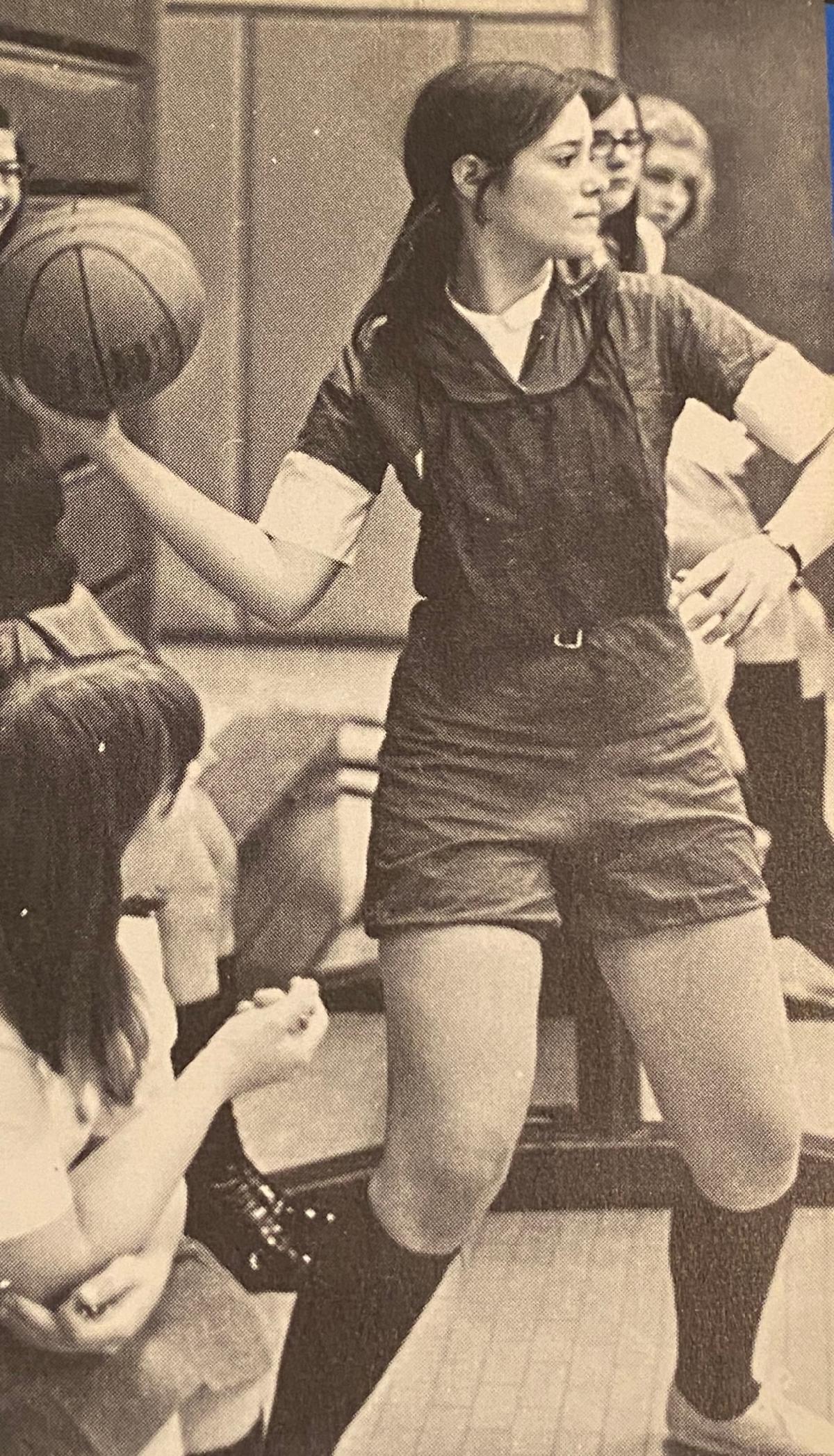
My mom was also an extraordinary athlete. She and Joan O’Hanrahan coached my 7th and 8th grade basketball team. They both still had children in diapers while they coached our team. How they did it – I’ll never know! (Laughs)
Siblings DAVE: The Reardons were a typical Catholic family back then - with lots of children!
CLARE: (Laughs) There were seven of us – two girls and five boys.
I was the oldest followed by Sue ’75, Tim ’76, Mike “Max” ‘79, John '82, Rich and Matt ’88. Rich graduated from Kenmore East while the rest of us graduated from O’Hara.
(Photo above: Clare and assorted Reardon at the 2025 COHS Golf Tournament)
THE BIG DECISION
DAVE: How was it that you ended up at Cardinal O’Hara High School?
CLARE: Many of my friends from St. Amelia’s were going to Kenmore East, but, for me, the choice was between the Mount and O’Hara. Early on, my first choice was Mt. St. Mary’s.
Throughout the process of deciding, I had conversations with my folks about the pros and cons of the two schools. I remember one conversation when my dad, quite purposefully, said, “Clare, when you grow up and enter the work-world, you’re going to have to work with men. It is important for you, in high school, to learn how to interact with boys and have conversations with them to develop your leadership skills with boys and be able to apply that when you are in college and beyond.”
His point was that I‘d likely receive a broader “educational experience” at O’Hara, one with more “real-life” experiences than I would have at the Mount. That resonated with me.
DAVE: How prescient of your dad.
CLARE: It was very forward-thinking on his part - especially from someone of that generation.
Also, tuition at the Mount was higher than it was at O’Hara, so, that may have had something to do with it. (Both laugh) LOOKING FOR PATHWAYS
DAVE: Your high school career was unusual in that you enrolled at O’Hara twice – for your first two years and then your senior year! (Both laugh)
CLARE: Throughout high school, when I thought about my future, I used to wonder if I would be prepared for college and beyond. Essentially, I was looking for pathways to get me where I wanted to go.
I knew that academics were important but I also figured that growing socially was important. All of my school experience was with people who were just like me - Catholic kids from large families. I decided to transfer to Ken-East for my junior year to be exposed to different people with different world-views and maybe a different academic environment.
At Ken-East I maintained my solid “B” average. There, I learned I could fail Chemistry just as readily, had I stayed at O’Hara. (Both laugh)
I made some interesting friends at Ken East but I still hung around with my O’Hara friends. That actually made it easier to return to O’Hara for my senior year. All in all, I don’t regret going to Kenmore East for my junior year - but I was happy to return to O’Hara for my senior year.
FAVORITE TEACHERS
DAVE: Who were some of your favorite teachers?
CLARE: Sister Catherine Marie is right up there. I had her for Latin my freshman year. She was awesome in every way! She used to come in to class literally bouncing on her toes. She had such great enthusiasm for – well, everything! She was just so full of joy.
Another teacher my classmates and I still talk about is Mrs. Gil.
Did you have her, Dave?
DAVE: I had Mrs. Gil, as a freshman. To this day I cannot believe the school never burnt down because of our misuse of Bunsen burners.
CLARE: (Laughs) We were knuckleheads in that class, too. Mrs. Gil had a very wry way of delivering insults or compliments – it didn’t matter which. (Both laugh) I really enjoyed Mrs. Gil.
Sister Angelica was also a favorite. I had her for Typing my senior year.
I was a lousy typist. However, Sister Angelica gave me an “A” for my final grade because she found out I was going on a mission after high school with the Sisters of St. Mary Namur. She pulled me aside one day after hearing about my upcoming mission year and said I deserved an “A” because I was a “good girl.” (Both laugh)
GETTING INVOLVED
DAVE: Were you involved in after-school activities?
CLARE: I was in a handful of clubs and activities over the years. Some I did for just one year. I wanted to give them a try.
I participated in student government as a Student Council member and Class Vice-President my sophomore year.
In my senior year I tried out for, but did not make the varsity volleyball team. I played basketball as a freshman and sophomore. To be honest, I would describe myself as a “lousy” athlete. I spent a lot of time on the bench – where I belonged. (Both laugh)
Even though I wasn’t that good, I really enjoyed the experience of being on the teams.
Many of the girls on the O’Hara teams I played on were my teammates from St. Amelia’s softball and basketball. Peggy, Patti, and Kathy O’Hanrahan, as well as, Mary Jo Hartmayer and Cheryl Gress were great athletes and so much fun to be around.
I was in Chorale and the musical Guys and Dolls as a senior - but I wasn’t much of a singer. My singing skills were on par with my athletic skills. (Laughs). But again, I really enjoyed participating.
Forensics
My favorite extracurricular activity was forensics. I loved forensics. I only did it my senior year. Sister Mark, a Felician sister, was the moderator of the club.
DAVE: Just to clarify, by “forensics” you mean competitive speech and debate.
CLARE: That’s right. Years before, Forensics was called “Debate Club.”
We competed against other schools. I loved going to those competitions. There were three competitive categories: extemporaneous speaking, debate, and oratory. At least I think those were the three categories. (Laughs) It’s been a while. My niche was extemporaneous speaking.
In the competition, you were given a question about a topic and had only 30 minutes to prepare a speech on that topic - usually a current event - crafted from a particular point of view.
DAVE: How were you judged?
CLARE: You were judged on a number of criteria including: oration skills, speech organization, and use of sources, all while delivering an engaging, professional delivery. And that was before the Internet! We only had library books and periodicals to use for sources.
FAVORITE HIGH SCHOOL MEMORIES Dances
DAVE: What are some of your favorite memories of high school?
CLARE: On the social side, I used to love going to the dances at Canisius High School.
I went to the O’Hara and St. Joe’s dances too, but I really enjoyed the ones at Canisius. They really packed kids into their gym. And they had great music.
God’s Peace Corps My most profound high school experience was participating in a program called God’s Peace Corps. The program was run by the Sisters of St. Mary of Namur – the religious order that once taught at O’Hara.
God’s Peace Corps was designed to get students involved in apostolic outreach. Girls who participated in the program were placed in local parish communities in Western New York – usually in low-income neighborhoods.
In my case, I got involved working at a parish day camp on the West Side of Buffalo for a week or two. It got me thinking about whether a religious vocation might be an option for me.
The Sisters of St. Mary of Namur were a joyful community of women. They didn’t just see us as students in their classrooms. The Sisters cared about us as “whole” people, and cared about our journey through life.
KINGSTREE, SOUTH CAROLINA
DAVE: After graduating from COHS, instead of going to college, you decided to do a year of service with Sisters of St. Mary of Namur.
CLARE Right.
My year of service with the Sisters meant that I put my college plans on hold. I moved to South Carolina for a year to assist in their mission by helping out in a pre-school and community center they ran.
People may think of the Sisters of St. Mary of Namur primarily as teachers. However, they also had missions in the southern United States, Mexico and in Africa.
DAVE: Where in South Carolina did you go?
CLARE: Kingstree. It was, and still is, in the middle of nowhere. My sister, Sue Stamp and I went there in 2023 to revisit at 50 years later, as part of a South Carolina trip we took together.
The Sisters had been in that community since the early 1950s. They chose Kingstree because it was so impoverished. The town was built around tobacco and cotton farming and had a small paper mill. (Photo left: Main St., Kingstree)
Many of the families that we worked with had been sharecroppers or had come from families of sharecroppers. Often, the older children missed school because they helped their families in the cotton and tobacco fields or they strung tobacco (hanging the leaves to dry) in the fall.
DAVE: How many Sisters were with you?
CLARE: Three. So, there were four of us who lived and worked together. We lived in a teeny, tiny house in Kingstree. It was our ‘convent.’
I joined that mission figuring it would be a period of discernment for me. I wondered whether a religious life might be a pathway for me. During that time, I applied to colleges, knowing my commitment was only for a year.
DAVE: Did you take any vows?
CLARE: No. I did not take religious vows. I didn’t “join” the order.
At that time, most young people interested in joining a religious community were advised to go to college and get a degree before entering an order.
We had formal prayer three times a day. Our local priest came to the convent to celebrate daily Mass. I took my turn setting up our chapel for liturgies.
DAVE: Were you assigned a particular role at the school?
CLARE: Yes, I was an assistant in the pre-school. I also helped with the teen group at the community center and did some home visiting.
My year of service was a remarkable experience for me. I grew up a lot during the time I was down there.
DOROTHY AND THE HOLY CARDS
DAVE: I bet you have a million stories about that experience.
CLARE: I do. In Kingstree, I worked with a fifteen-year-old girl named Dorothy. I was 18 – so I was not much older than she was. Dorothy rarely, if ever, went to school. She had to help her family in the field or babysit her five younger siblings. As a result, she couldn’t read or write. I don’t think I did much to help her literacy, but I sure learned a lot about life through her’s.
I still think about Dorothy and wonder what happened to her. (Photo right: The "convent" where Clare lived with the three Sisters. That's Dorothy standing near the front door.)
On a lighter note…
I turned 18 while I was in Kingstree. Had I been living in New York on my birthday, I would have gotten a Sheriff’s Card to prove my “legal age” and would have probably enjoyed an adult beverage on my birthday. Instead, of getting a Sheriffs Card on my birthday, the Sisters gave me holy cards.
BACK TO BUFFALO
DAVE: You returned to Western New York after your year in South Carolina.
CLARE: When I returned home, I enrolled at UB for Communications. (Photo left: U.B. Main Street Campus)
I also worked during college. I had some great jobs as a college student. And honestly, I enjoyed my jobs more than I enjoyed my time in class.
I worked for WADV, add that time, and FM jazz radio station in downtown Buffalo. I wasn’t an “on air” personality. Mostly, I did administrative and community relations work.
I also worked for a student travel agency at UB run by my dear COHS classmate, Liz (Betty Kieffer) Sahlman. . Both of Liz’s parents were from Europe. One summer break, we visited her extended family in France and spent about six weeks in Europe. It was so much fun! A CAREER IN COMMUNICATIONS
DAVE: As it turned out, you had a long and distinguished career in the field of communications. How did your career begin?
CLARE: After leaving UB in 1978 I got married and soon began a family. So, for quite a while, I was more or less a stay-at-home mom to our three children. And, due to my former husband’s career, we moved around a lot. As a result, it wasn’t until 1992, after we moved to Milwaukee, that I began a full-time career.
Prior to 1992 I did some part-time work in communications and fund development.
For example, when we were living in Western New York, I worked part-time work for Artpark in Lewiston, where I did event management and got pretty good at grant writing. I also did some work for the American Cancer Society when we lived in Pennsylvania.
Communications Specialist – Milwaukee Regional Medical Center (1992 – 1996)
DAVE: What happened in 1992 that “enabled” you to begin a full-time career?
CLARE: In 1992 we relocated to Milwaukee. Our youngest was in third grade and I re-entered the work force as Communications Specialist for the Milwaukee Regional Medical Center (MRMC) (Photo right: Aerial view of the Milwaukee Regional Medical Center) DAVE: Tell us a little bit about that position, Clare.
CLARE: The MRMC is a huge medical campus that, at that time, had four hospitals, the Medical College of Wisconsin, a rehab facility and a blood research institute. Several thousand people worked there then, with many more visitors, patients and students.
The MRMC is not unlike Buffalo’s Medical Corridor with Buffalo General, Children’s Hospital and the University of Buffalo School of Medicine integrated with those facilities.
I worked in the consortium office that supported the MRMC members. My main focus was on communications: writing and editing newsletters as well as managing some collaborative committees among all the entities.
Our consortium office also ran “Flight for Life,” the air ambulance program for the region, similar to “Mercy Flight” in Buffalo. I often served as the “patient” being off-loaded from the helicopter in training videos.
Community Development Coordinator - Wisconsin Organ Donor Network (1996 – 2000) One of the entities that I staffed at MRMC was an organ transplant collaborative group.
Because of my work there, I was recruited by the Wisconsin Organ Donor Network – the organ procurement organization for the eastern half of Wisconsin.
That was a very meaningful job. Our customers were grieving families who suddenly and unexpectedly lost a loved one and most often, but not always, made the decision to donate a loved one’s organs.
My job was to promote awareness of organ donation to the general population with a particular focus on multi-cultural coutreach. Promoting the concept of organ donation goes way beyond language differences. It also involves religious and cultural beliefs.
An initiative I started, of which I remain very proud, is that I recruited and trained a team of over 200 volunteers to promote organ donations and transplants awareness. organ donations and transplants awareness. Most of the people were either organ recipients or donor family members. They were very grateful for the opportunity to tell their stories and we’re our very best ambassadors.
There’s no way you can work in a job like that without coming away from it with a deeper appreciation of life.
Director, Strategic Communications and Public Relations, North America – ManpowerGroup (2000 – 2002)
DAVE: Your next position was with ManpowerGroup – the global staffing agency.
CLARE: I went from a “High-Touch” position to a “High-Tech” one.
I can laugh about it now but I was completely unqualified for the job when I was hired. (Laughs) Have you ever heard the expression, “Fake it ‘til you make it?” That describes me when I first started with Manpower. The good thing though is that I “knew what I didn’t know” so at least I wasn’t completely clueless! (Both laugh)
DAVE: Clare, I find that hard to believe! Secondly, I’m sure you got the hang of things quickly.
CLARE: Milwaukee is the global headquarters for Manpower. I learned so much in that job and am very grateful for a wide variety of people that I got to work with. While working there, I came to realize that my professional “sweet spot” was in public relations, speaking and writing.
DAVE: What were your responsibilities?
CLARE: I was in charge of strategic communications and public relations for North America – but mostly the U.S. At times we had 1,100 field offices across the country.
I managed internal communications, media relations and a small publication staff. Manpower is a Fortune 500 company so we dealt with news outlets such as the Wall Street Journal, the New York Times and business trades.
DAVE: How long were you with the ManpowerGroup?
CLARE: I was with Manpower for two and a half years.
I learned a lot about the business world at Manpower, but I really missed health-care. I missed working with people who worked closely with patients and who made a meaningful difference in the lives of real people.
So, I reached out to contact some former colleagues who were still at the medical campus where I had worked previously.
Director, Strategic Initiatives, Office of the President - Froedtert Health (2002 – 2010)
As it turned out, I landed a job with a regional health care system – Froedtert Health, located on the MRMC campus. (Photo: Froedtert Hospital)
I was there for a total of 13 years, and completed my MBA during that time.
For the first eight years I was Director for Strategic Initiatives in the office of the president. I was part of the executive team and functioned as the president’s Chief of Staff.
In that role, I coordinated or staffed a variety of management groups for Froedtert Health/Froedtert Hospital and supported strategic programs in partnership with the Medical College of Wisconsin. I also served as the Interim Executive Director of the Froedtert Hospital Foundation.
In 2007, my CEO, along with four other health system CEOs in Milwaukee did something remarkable. They put aside their competitive instincts to work collaboratively to provide better health care access for low-income and uninsured patients.
They created a consortium of 13 health-care entities in 2007 called the Milwaukee Health Care Partnership (MCHP). I was a “loaned” executive from Froedtert to the consortium providing communications and fund development leadership.
I remain very proud of that initiative. It is now almost 20 years old and has received significant national acclaim for achieving sustained collaboration despite market competition among health care providers – and it has created innovative programs that have improved health and medical care for vulnerable populations. Executive Director, Community Affairs - Froedtert Hospital (2010 – 2013) In 2010, I transitioned to the position of Executive Director for Community Affairs at Froedtert.
In that role, I directed Froedtert Hospital’s community benefit strategies, programs and reporting. I worked closely with community partners and Medical College of Wisconsin leaders to advance urban health, community and workforce development initiatives.
Director, Organizational Advancement - Milwaukee Health Care Partnership (2013 – 2022)
CLARE: In 2013, I left Froedtert to work full-time for the Milwaukee Health Care Partnership (MHCP). In that role, I led the consortium’s communications and fund development efforts. Like previous roles, I worked across many member organizations to advance shared interests. I was no longer a “loaned executive” but part of a small team working with over 100 health care leaders every day to improve health care coverage, access, care coordination and community health for low-income and uninsured individuals in Milwaukee County. It was the best work of my life.
During the COVID crisis, I served as a communications lead for Milwaukee’s health-care sector, working with public health and government entities as part of the region’s COVID response. It was a wild time, it was a stressful time but in the end we were able to achieve an effective response due to the MHCP’s collaborative framework. Advancement Advisor - Milwaukee Health Care Partnership 2022 - 2023 I provided strategy and project management for select MHCP initiatives. After the COVID crisis, I started to ramp down my hours toward the goal of retirement. We hired my successor in 2022 and I spent about a year as an “advisor.” That’s just a fancy title which meant “still on the payroll but almost gone.” I retired in 2023.
IT’S PERSONAL Children, “Bonus” Children and Grands
DAVE: You mentioned earlier that you have three children.
CLARE: I have three children and they all live near me. Each of them are married to wonderful human beings - so I feel like I have three “bonus” kids.
I am blessed with four grandchildren ages 5, 9,10 and 11. Interests/Hobbies
DAVE: Now that you are retired, I trust that you are finding things to do!
CLARE: That’s not really a problem, Dave. (Laughs) I’m a lap swimmer and I also enjoy hiking.
You may remember, earlier in our conversation, I mentioned that I was not the world’s greatest athlete - but I golf - not very well, but I enjoy it.
In fact, last July, I came up for my sister Sue’s 50-year COHS reunion. I was looking forward to seeing some of her friends and to seeing some of my O’Hara friends too. I ended up playing in the O’Hara golf tournament. It was a blast! There were two Reardon foursomes and I played in one of them. I sure hope more O’Hara golf outings are in my future!
I would like to encourage O’Hara’s female graduates to think about signing up for the golf tournament. It’s not just for the guys – and It was well worth it!
Arts Board
CLARE: I currently serve on the board of the Sharon Lynne Wilson Center for the Arts here in Brookfield, Wisconsin. (See photo)
I’ve been on a number of boards here - some related to the Arts. I think working in the arts is a good complement to having worked in healthcare for so long. The arts are important to our health. The ability to enjoy or be engaged in creative expression, especially for children, is just as important as the air we breathe and the food we eat.
I’ve also recently gotten involved with the League of Women Voters. I was a poll worker for a number of years. I’m excited about my work with the League because it is non-partisan. It has a 106-year legacy of voter outreach and education to support free and fair elections.
50-YEAR REUNION
DAVE: The class of ‘73 had their 50-year reunion two years ago. What did you think?
CLARE: I had so much fun!
I didn’t quite know what to expect at the reunion but the event exceeded whatever expectations I had. I really enjoyed it. I think everyone did. People were just happy to be there. The conversations I had with former classmates were so easy and unforced. It was interesting to hear everyone’s stories.
I still feel very connected to my O’Hara “family” even though I’ve lived out of the area for 34 years. (Photo: Class of '73 Reunion - Sue McArdle Valint, Clare, Celeste Privitera Freeman, Cheryl Mueller Wasson, and Peggy Overbeck Kelley)
TALKIN’ PROUD
DAVE: I always like to ask the out-of-town alumni what they miss about Buffalo.
CLARE: I will tell you that I am very proud of my hometown for a number of things, including the economic progress that the Western New York area has made.
I would also add that I am proud of Buffalo’s reputation in the medical research field. The UB School of Medicine is highly regarded and Roswell Park Cancer Center has international status.
As far as what I miss…I’d have to say Buffalo pizza. Any Buffalo pizza would be right near the top of the list! (Both laugh) by Dave Lovering '74
|