|
|
| HeartMind e-News: Teach, Learn, Lead A monthly publication dedicated to trauma-informed, compassionate school practices that help educators, students, and families move toward a sense of wholeness and well-being
FEATURED ARTICLE Striking a Balance: The United Arab Emirates' Journey Towards Work-Life Harmony Fathima Rihana Azmie, CEI Intern, and Christine Mason, CEI Founder and Senior Scholar |
|
| Note: CEI is interested in the well-being of school staff – teachers, support staff, and school leaders. In this article, we explore conditions in the UAE, including factors that negatively impact educators, as well as recent advances that show promise for the UAE and have implications for education in other countries as well.
The United Arab Emirates (UAE) stands as a beacon of ambition and rapid development, drawing global talent to its shores. Education in the UAE has improved significantly over the past decade, with data reflecting measurable gains in student achievement, graduation, and reading proficiency. However, these gains were accompanied by significant pressure and stress on educators. Thankfully, in recent years there’s been a purposeful focus on educator well-being, developing concrete frameworks, measurement, and public accountability initiatives.
Academic Gains
Before turning to the primary focus of this article--educator well-being, let’s review some of the substantial educational gains that have occurred in the UAE:
- Student achievement: UAE students' performance in international assessments has shown impressive improvement. In the 2023 Trends in International Mathematics and Science Study (TIMSS), an international assessment that measures the math and science achievement of fourth and eighth-grade students, Grade 4 mathematics scores improved by 17 points and science by 22 points compared to 2019, while Grade 8 students increased scores by 15 points in mathematics and 14 in science. The UAE ranks first in the Arab world and is now above the global average in these subjects (Ministry of Education UAE, 2025; Emirates News Agency, 2022). Between 2019 and 2023, many countries saw stagnation or declines, partly linked to COVID-19 disruptions, while the UAE’s upward trend indicates system resilience and successful post-pandemic recovery measures.
- Reading proficiency: Between 2016 and 2021, UAE students increased their average score on the Progress in International Reading Literacy Study (PIRLS) by 33 points, with a 7% rise in those achieving advanced/high levels of reading and a 7% decline at the lowest level (Ministry of Education UAE, 2023). This assessment provides a global standard for tracking reading literacy trends and informing policy to improve reading education.
- Graduation rates: The number of graduates from colleges and higher education reached an all-time high of 26,040 in 2017, up from just 2,407 in 1994 (World Bank, 2025; CEIC Data, 2017), a 981% increase in 23 years, compared to a roughly 120% increase globally.
The most significant educational shift began in the mid-2000s, when the UAE launched sweeping education reforms focused on international benchmarking, accountability, and quality assurance. The Abu Dhabi Education Council (ADEK) led early initiatives in 2006 by establishing public-private partnerships, aimed at rapidly improving teaching quality, local educator capacity, curriculum implementation, and school leadership capacity by pairing government schools with internationally accredited private education providers and introducing continuous school improvement mechanisms, including lesson observation cycles, performance monitoring, and data-informed planning.
This set the stage for nationwide changes. In addition, from the late 2000s to mid-2010s, government-led external inspection audits (introduced by both federal and Emirate-level regulators) raised expectations for documentation, school self-evaluation, continuous improvement, and innovation.
The Accompanying Pressure on Educators
Yet, this remarkable progress has intensified performance pressures across schools and universities, making institutional accountability a defining feature of professional life. Work-life balance expectations in rapidly changing institutions are heightening the need for systemic, not merely individual, solutions (OECD, 2021). The transition to today’s high-pressure system hit new heights in the early 2020s as reforms accelerated. The pressure further increased with mandatory standardized assessments (CAT4, PIRLS) and public ranking systems for schools, crystallizing around 2022–2025 with major reform waves: adoption of AI curricula, new assessment strategies, and expanded project-based learning. |
| Today UAE schools are evaluated not only for academic results, but also leadership quality and staff/student well-being indicators. Teachers face growing demands for immediate parent communication, curriculum adaptation to reforms, and participation in professional development. Increasing emphasis on documentation, quality assurance, and reporting amplifies the administrative burden and reduces planning time.
There is a growing professional dilemma in the UAE’s education field—one marked by long hours, administrative overload, and minimal institutional flexibility. What appears to be a personal struggle is in fact emblematic of a national challenge that demands systemic attention. Studies highlight that faculty in the UAE, similar to their counterparts worldwide, navigate rising expectations for research output, student satisfaction, and compliance with institutional quality frameworks.
Retaining teachers is challenging in this environment. Herrera and Proff (2022) drew attention to the importance of leadership, community, and work–life balance in retaining K-12 educators. Supportive institutional cultures that recognise academic boundaries, encourage autonomy, and foster a sense of belonging offset burnout and turnover. In contrast, rigid administrative cultures accelerate disengagement.
The UAE’s Well-being Turn: From Rhetoric to Architecture
Yet there is a glimmer of hope dancing on the horizon. In recent years, the UAE has moved from basic wellness rhetoric to concrete frameworks, measurement and public accountability—shifting teacher well-being from “nice-to-have” to a system requirement:
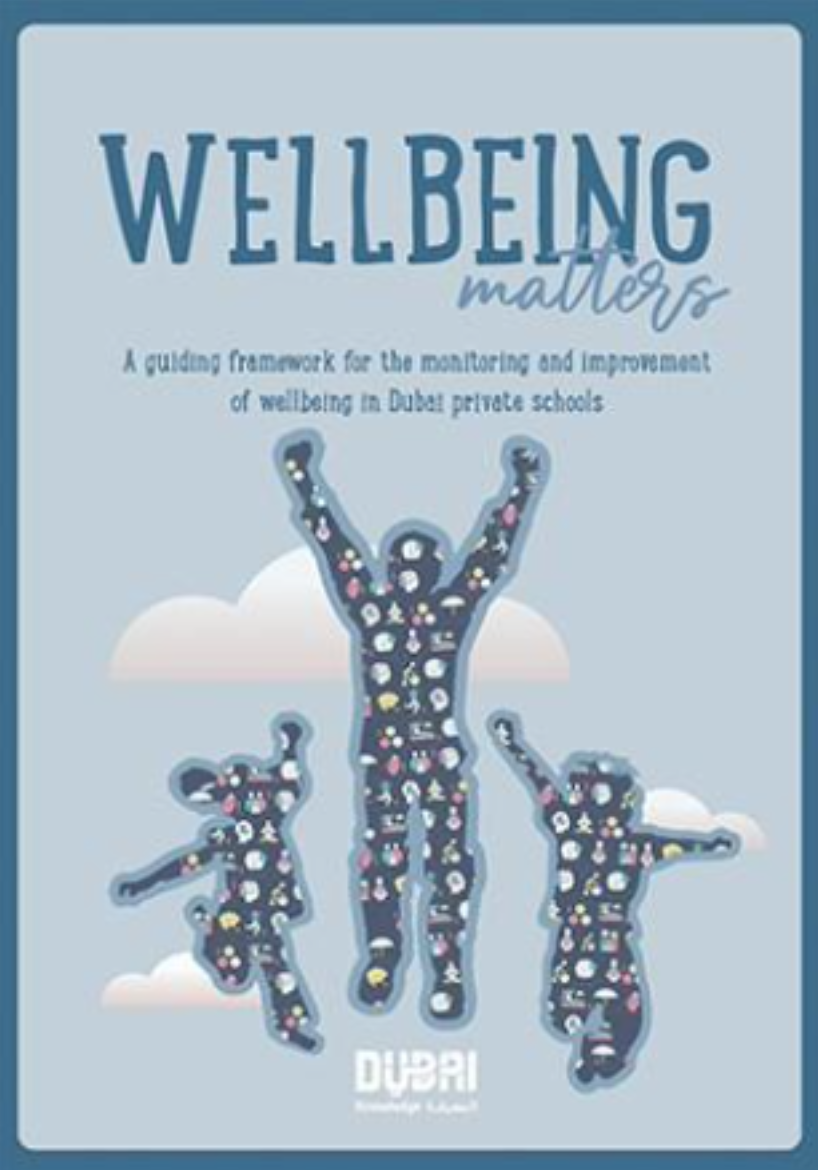
- KHDA’s Wellbeing Matters (Dubai) - The Knowledge and Human Development Authority, which oversees private education in the UAE, launched a framework in December 2022 that defines what ‘good’ looks like for well-being in Dubai private schools and emphasizes fostering a well-being culture, listening to staff, and embedding policies that support people (KHDA, 2022). Well-being is now a whole school responsibility, and each school must publish a well-being evaluation alongside inspection reports. Since 2017, KHDA has run the Dubai Student Well-being Census (DSWC) - a multi-year population survey of students' happiness, engagement, relationships, and school climate. KHDA's 5-year summary shows positive trends. KHDA's Adults@school survey (2018 onward) measures teacher and staff well-being (thriving, struggle, burnout) to inform school action.
|
- Sharjah’s 4-day school week (SPEA). In 2022, Sharjah, the third most populated city in the UAE, pioneered a three-day weekend for the public sector, including education. The results were striking: a 95% increase in student attendance, with 91% of teachers reporting improved work-life balance and schools noting higher academic performance and stronger student social skills (Khaleej Times, 2023; Gulf News, 2023).
- Federal policy scaffolding. The National Programme for Happiness & Wellbeing and the National Strategy for Wellbeing 2031 embed well-being across government—with workplace guidance and a national framework of strategic objectives that cascade into education (UAE Government, 2024a; 2024b).
- Practice-level recognition. In May 2025, one of the largest private school groups in the UAE, Taaleem, was named a Best School to Work Certified Group by T4 Education, an independent global education organization known for its international school and teacher awards, based on strong anonymous staff feedback—evidence that human resource systems and culture can translate policy into lived experience (Kelly, 2025).
Practical Strategies |
While policy reforms are critical, educators and leaders can act now to initiate transformative change immediately: |
|
|
All Educators can:
|
Leaders can:
|
- Set firm boundaries around working hours and avoid constant connectivity.
|
- Prioritize balanced workloads and protect teachers’ planning/marking time.
|
- Prioritize their own well-being, including finding time for mindfulness, exercise, and other strategies to reduce their stress.
|
- Find ways to support their own stress reduction and to help reduce the stress and anxiety among staff and students. This might include mindfulness activities before, after, or during the school day.
|
- Use shared resources and collaborative planning to reduce duplication.
|
- Minimize unnecessary administrative tasks and streamline reporting processes.
|
- Practice ‘switch-off rituals’ after school—exercise, hobbies, or family time.
|
- Foster a robust well-being culture: celebrate staff, host wellness events, and provide counselling services.
|
- Lean on colleagues for co-planning, sharing marking, and emotional support.
|
- Provide clarity around expectations and discourage out-of-hours communication.
|
|
|
| Looking Ahead
In the ever-evolving tapestry of the UAE, the quest for work-life balance is ongoing, rich with both challenges and opportunities ahead. As the nation continues to pursue world-class education, it must balance ambition with the well-being of the educators who are the very architects of this vision.
For many, the dream is to thrive in both career and personal life, without one eroding the other. If systemic reforms, cultural shifts, and supportive school practices align, the UAE could become a beacon of a new professional symphony; one where excellence and balance coexist, enriching both the individual spirit and the nation’s soul. |
|
|
References ADEK. (2022). Irtiqa’s inspection framework for private schools. Abu Dhabi Department of Education and Knowledge.
CEIC Data. (2017). United Arab Emirates – Number of graduates: Colleges and higher education (persons). CEIC Data.
Emirates News Agency. (2022, June 23). Emirates National Schools celebrates graduation of 778 students. WAM – Emirates News Agency.
Gulf News. (2023, October 1). Sharjah’s shorter work week boosts productivity and family time.
Herrera, L., and Proff, J. (2022). Staying to teach in the UAE: A phenomenological case study of teacher retention in Ras Al Khaimah. Athens Journal of Education, 10(2), 129–152.
Kelly, R. (2025, May 1). UAE school group sets global benchmark for teacher satisfaction standards. The National.
KHDA. (2017). The Dubai student wellbeing census: Overview & methodology. Knowledge and Human Development Authority.
KHDA. (2020). Adults@School: Wellbeing survey results 2020 (Infographic). Knowledge and Human Development Authority.
KHDA. (2021). Dubai student wellbeing census: Five-year summary (2017–2021). Knowledge and Human Development Authority.
KHDA. (2022). Wellbeing matters: A guiding framework for the monitoring and improvement of wellbeing in Dubai private schools. Knowledge and Human Development Authority.
KHDA. (2023). Adults@School: Staff wellbeing survey – Technical summary & toplines. Knowledge and Human Development Authority.
Khaleej Times. (2023, January 10). Sharjah’s 3-day weekend helped boost attendance. SPEA.
Ministry of Education (UAE). (2025). TIMSS 2023 national results summary (Grades 4 & 8).
Ministry of Education (UAE). (2023). PIRLS 2021 national report/press release.
OECD. (2021). OECD review of well-being policies and practices in Dubai’s private school sector. OECD Publishing.
Sharjah Private Education Authority. (2023). Impact of the four-day school week in Sharjah: Year-one findings.
T4 Education. (2025). Best School to Work™ certification – Taaleem Group (UAE). T4 Education.
The National News. (2025, May 1). UAE school group sets global benchmark for teacher wellbeing: Taaleem named ‘Best School to Work’ certified group.
UAE Government. (2024a, June 6). National programme for happiness and wellbeing.
UAE Government. (2024b, January 16). National strategy for wellbeing 2031. UAE Ministry of Education. (2015). UAE school inspection framework (cycle 1). Ministry of Education.
World Bank. (2025). Tertiary education, graduates (number) – United Arab Emirates. World Bank DataBank. |
|
|
|
|