[[trackingImage]]

Topics covered on this page:

  • Budget 2025: My reaction
  • UN Tax Convention


Budget 2025: My reaction

Last updated November 2025

I came into politics fairly late in life after a long career in the automotive industry. There are a number of reasons why I made this leap, but one was witnessing the devastating impacts that years of austerity were having on Warwick and Leamington. The Budget in November has been one of the surest signs that we are finally turning the corner on this era.


Here are just a few of the highlights of the Budget:

  • Scrapping the two-child benefit cap (more on that below)
  • Cutting energy bills by £150 on average
  • Freezing prescription charges and rail fares
  • Increasing the state pension by 4.8%
  • Raising the national minimum and living wages


Following the Budget, I made a speech in Parliament about a range of issues, from the local automotive industry through to national security. Below is a short clip in which I welcomed some of the ways that the Budget was tackling the cost of living:


Two-child benefit cap

For me, the abolition of the two-child benefit cap was a real highlight of the budget - a long overdue move, which will lift 450,000 children out of poverty. I know that this announcement has caused a great deal of debate, and many people have contacted me to share their thoughts, so let me set out my views on this issue directly.


The imposition of the cap by Theresa May's government in 2017 needlessly plunged thousands of children into poverty, affecting more than 1,500 children in Warwick and Leamington. As well as being wrong on a human level, this policy was also misguided economically - child poverty costs the UK economy £39 billion a year.


To be frank, I have been dismayed to see some of the stereotypes about parents and families that have been reignited in response to this change. The narrative that the majority of those who will benefit from this change are out of work is simply untrue - 60% of households hit by the two-child benefit cap are in work. And as far as the other 40% are concerned, none of us know when we will need to rely on welfare - redundancy and ill health can affect us all, however hard we work and however many children we have.


Even if you disagree with me on this, children don't decide to be born, and I strongly believe that they shouldn't be punished for simply existing. Every child, whatever their familial circumstances, deserves real chances in life - child poverty is a trap that prevents young people from reaching their potential.


It is for all of these reasons that I have long advocated, both in public and in private, for the removal of this cap.


Tax changes

The Budget did include certain tax changes, including an increase in tax on income from property and investments and the so-called 'mansion tax' on properties worth over £2 million. The Chancellor also had to make some difficult trade-offs, not least being unable to uprate personal tax thresholds, which would have cost up to £8 billion.


Equally, I appreciate that some constituents who were hoping for the introduction of a dedicated tax on wealth may be disappointed. However, I would like to make the case that this Budget was progressive in nature nonetheless, with the wealthiest earners being asked to shoulder more of the burden.


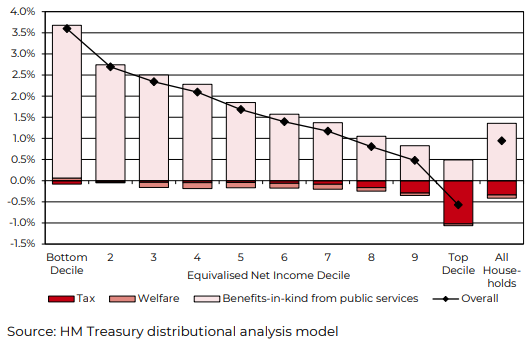
The Treasury graph below shows the impacts of the Budget on household income from the lowest-income (bottom decile) to highest-income (top-decile) households this year in percentage terms:


To my mind, this highlights three key points:

1. All but the very richest will be better off because of the Budget.

2. Households on the lowest incomes will see the greatest benefit.

3. The impacts of the Budget are progressive, with lower earners benefiting more.


As such, while we can debate the detail of the Budget, what is clear is that it marks a substantial change from budgets under the previous Government. The years of squeezing low-income households to fund tax cuts for the wealthiest are over, and those with the broadest shoulders will be the people who pay more to fund our public services.


UN Tax Convention

Last updated February 2026

As you may know, in November 2023, the UN General Assembly Economic and Financial Committee approved a draft resolution calling for a legally binding UN Framework Convention on International Tax Co-operation. Then in November last year, it approved a further resolution adopting the terms of reference for this UN Framework Convention.


One of the key principles that guides the work that I do is fairness. It is also a core principle of any Labour government. In practice, it means that policy - including tax policy - should stop a minority unfairly benefiting at the expense of the rest of us.


Tax base erosion and profit-shifting – where multinational corporations use tax avoidance strategies to shift profits to low- or no-tax locations - is deeply unfair. It tilts the playing field away from smaller independent businesses (or, indeed, larger businesses simply trying to do the right thing), and costs us money that could be used to fund public services from which everyone benefits.


This is an international problem, so it requires an international solution. This means we must work with all stakeholders to ensure inclusive and effective international tax co-operation. I welcome, therefore, that the Government has been actively engaging with negotiations over a UN Framework Convention on International Tax Co-operation.


At the same time, I believe that for a UN Tax Framework Convention to be able to make progress on international tax co-operation, it needs to have clear aims, avoid repeating work already taking place elsewhere and ensure that it seeks the broad support and participation of member states. It must also not undermine existing tax rules.


Unfortunately, I am concerned that, as the UK’s Ambassador highlighted during consideration of this issue at the UN in November, the resolution and the terms of reference for the UN Framework Convention do not provide sufficient reassurance on these issues. If we don't reach consensus, and the framework ends up not being implemented equally across the board, there will be gaps which corporations will exploit.


I nevertheless welcome that the UK will continue to engage constructively on the UN Framework Convention in support of key principles for strengthening international tax co-operation. I can assure you that I will continue to follow developments on this issue, keeping in mind the concerns you highlight, as work on this continues at the UN.