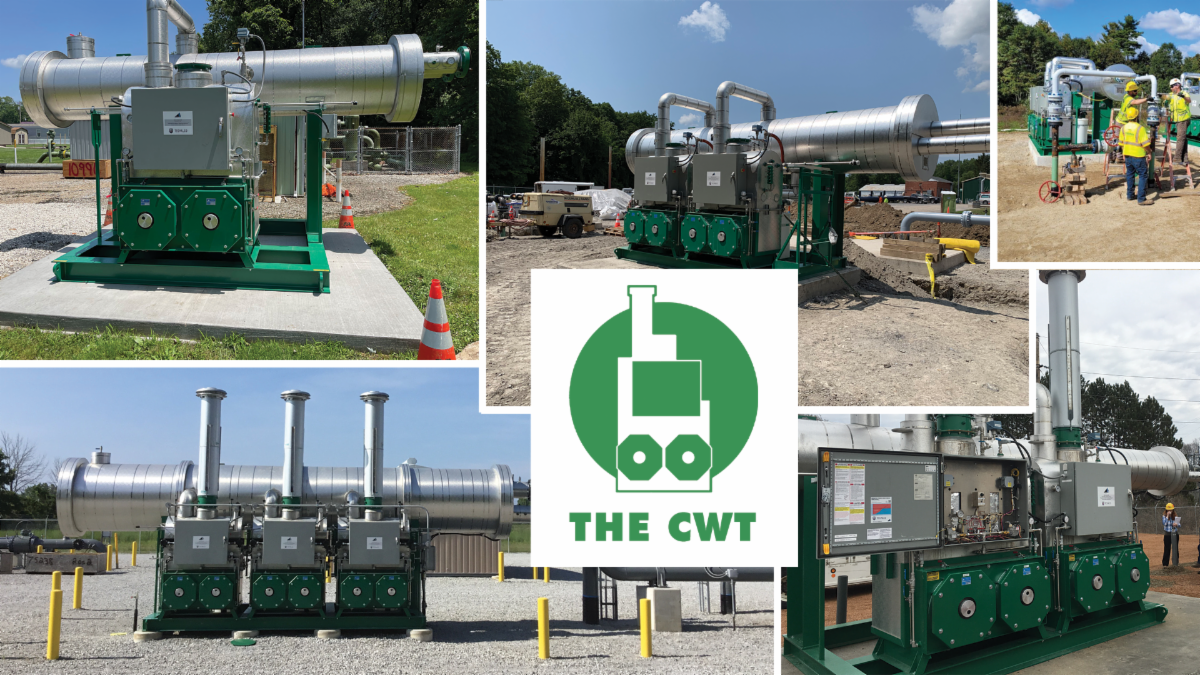
| What is the CWT?
- CWT Natural Gas Dry Line Heaters use low pressure, low temperature steam to quickly heat natural gas at town border stations or other facilities, economically and with less greenhouse gas emissions as well.
- Millivolt controls are supplied by power from thermopiles charged by a standing pilot. This means no power required on site. The low volume of glycol, and the familiar off-the shelf safety and fuel supply components lead to ease of use, inspection and repair.
Efficiency
- The CWT line heater has a thermal efficiency of between 70-75%. This means 75% of our energy goes into the process of creating the steam and heating the coil gas. The remainder of heat, as is typical, is lost up the stack and although our insulation and cladding is fantastic, there is still some heat loss.
- A conventional water bath efficiency is significantly lower. This is due to many reasons, but primarily it’s because a fire tube is used and more fuel is burnt and more heat lost up the stack.
Reduced Fuel Consumption/Emissions
- CWT is controlled by a temperature controller located just after the final cut at a station. The temp controller is set just above freezing. The heater will only fire if gas temp through the station is below our temp set point. Meaning, CWT is similar to an “instant on” water heater. It only heats when required and will shut down when set temperature is met.
- Operators can expect fuel consumption and resulting emissions reductions of 50% compared to conventional water bath.
- The CWT has been tested at approximately 55-57 dB sound readings. This is comparable to a normal human conversation. Because it is so quiet, CWT can be placed in urban areas, and other sound sensitive locations such as schools or hospitals.
Operating under a vacuum
- The CWT is shipped to site with a minimum -26inHg vacuum. Under a vacuum we create steam at approximately 125°F and we create it very quickly.
- CWT can reach optimal heat 22 times faster than conventional water bath heaters.
- Internal corrosion is minimized or eliminated entirely.
Power requirements
- CWT is a self-energized appliance. No external power is required, thus allowing it to be located in more rural locations.
- Power required, to operate our controls and safeties, is generated by a power-pile system generating 700 mV current using a standing pilot.
Options
- Available upon request:
- Pilot pressure switch(es)
- SCADA junction
- PLC
Maintenance
- CWT is an appliance and does require maintenance. Tecvalco suggests performing maintenance a minimum of once per year. A detail maintenance plan is in our manual. However, maintenance is simple. We suggest cleaning out the flame arrestor, stack(s), fin tubes and burner box. In addition, all gauges and switches should be tested and calibrated and glycol sampled.
- CWT pressure coil should be inspected every 15 years. Because CWT operates under a vacuum, resulting corrosion is negligible. Conventional water baths may require more frequent coil inspection due to potential corrosion, as a water bath is not a sealed system nor does it operate under vacuum. In addition, the fire tube for a water bath is commonly inspected for fire impingement or tube wall thinning.
History, Quantity and Users
- The first natural gas CWT units were introduced in 2003. There are over 1500 CWT units operating in North America serving over 100 natural gas transmission and distribution companies. A users list is available upon request.
Glycol/Containment
- The CWT is a sealed unit. No glycol top ups required as with water bath technology.
- The CWT is shipped complete with glycol/water 50/50 solution already installed.
- Because we use steam as our heat transfer media, we use glycol solely as anti-freeze for our water.
- The CWT uses food grade propylene glycol known as DowFrost 50/50.
- CWT uses less than 10% fluid as compared to water bath heaters. Thus, no containment is required.
Additional benefits
- CWT is third party certified to CSA C22.1:21 and CSA ANSI Z21.13:22/CSA 4.9:22
- CWT turn down ratio leads the industry. E.g. – a 4.6MM Btu unit can operate as minimal as a 385k Btu unit.
- Tecvalco USA is a nationally certified women owned business.
- CWT controls and safeties are considered non-incendive.
- Boilers are designed and evaluated to ASME BPVC Section 4.
More Information CANADA - www.tecvalco.com/industries/gas UNITED STATES - www.tecvalcousa.com/industries/gas |