| Thailand's Path to 30x30 - Strategies, Collaboration, and Progress in Biodiversity Protection
Thailand is advancing key strategies to protect 30% of its terrestrial and marine areas by 2030. As part of its 5th National Biodiversity Strategy and Action Plan (NBSAP), the country is focusing on three main areas: strengthening conservation efforts by expanding protected areas and safeguarding critical habitats and species; promoting the sustainable use of biodiversity resources across sectors like agriculture, forestry, tourism, and fisheries; and integrating biodiversity considerations into national policies and development initiatives. These actions are supported by the necessary tools, financial resources, and legislation, with progress being closely monitored to ensure effective implementation.
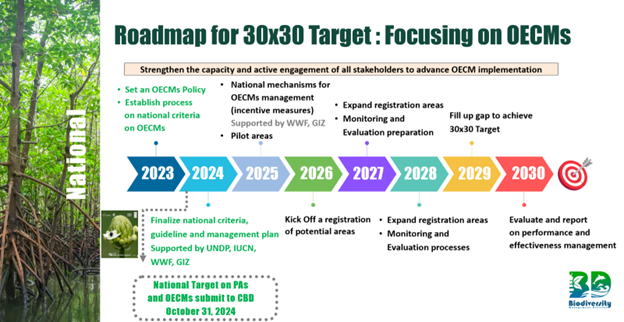
Thailand has also laid out a detailed roadmap to achieve the 30x30 target, with a strong focus on Other Effective Area-Based Conservation Measures (OECMs). The plan begins in 2023-2024 with the establishment of an OECMs policy, the finalization of national criteria, and the submission of targets to the Convention on Biological Diversity by October 2024. From 2025 to 2027, pilot areas will be launched, incentive mechanisms developed, and the registration of potential OECM sites expanded. In the final phase, from 2028 to 2030, Thailand will scale up conservation areas, strengthen monitoring systems, and evaluate the effectiveness of these measures to meet the 30x30 target. This roadmap is supported by organizations such as UNDP, IUCN, WWF, and GIZ, and emphasizes stakeholder engagement, sustainable management, and biodiversity preservation.
Local communities, Indigenous peoples, and other stakeholders play a vital role in achieving the 30x30 goal, particularly in the management and protection of biodiversity areas. In addition to Protected Areas (PAs), OECMs are helping expand the responsibility for biodiversity management beyond government agencies, involving NGOs, businesses, academic institutions, and local communities. These communities are crucial to the success of conservation and restoration efforts, as they are key to maintaining biodiversity conservation areas at the local level. Currently, Thailand is piloting collaborations with the private sector and local communities in select areas, with plans to expand these efforts in the future. To date, Thailand has made significant progress toward the 30x30 target by setting national goals to increase protected areas to 23% and OECMs to 15% for both terrestrial and marine areas. OECM areas, such as community forests, privately conserved biodiversity areas, and local marine-managed areas (LMMAs), are central to the strategy.
Key opportunities for enhancing implementation include improving resource and biodiversity management, fostering cross-sector collaboration, and linking OECMs to global issues like climate change and sustainable development. However, challenges remain, including limited recognition of OECMs, complex legal and regulatory frameworks, unclear governance mechanisms, and the need for Free, Prior, and Informed Consent (FPIC) in OECM designation. Overcoming these challenges will require clearer definitions, more effective coordination, and greater stakeholder awareness.
Interview with Mr. Wanlop Preechamat, Director of Policy Implementation and Mechanism, Office of Natural Resources and Environmental Policy and Planning, December 2024 |