| MY PLEDGE New Jersey’s Commitment to Community We Are Not Going Back |
|
| New Jersey has made significant progress in advancing inclusion, independence, and community-based support for individuals with intellectual and developmental disabilities (IDD).
NJACP is committed to building on this progress by strengthening Home and Community-Based Services (HCBS) and ensuring that individuals with IDD have the opportunity to live, work, and participate fully in their communities.
The NJACP Commitment to Community Pledge calls on New Jersey legislators and policymakers to continue the bipartisan commitment to protecting individual choice, promoting independence, and expanding access to high-quality community-based services. |
|
|
| CAMERAS FOR GROUP HOMES FACTS MATTER. Safety matters. Funding matters. Staffing matters. Choice matters. |
|
|
|
 |
|
- Choice, Consent & Privacy
- Prevention Comes First
- Costs Are Real
- Liability Is Real
- Quality Is More Than Cameras
- A Constructive Solution
|
|
|
| With the Legislature back in session, A-2705, which would mandate cameras in certain group homes, continues to receive attention.
NJACP recognizes that the bill's sponsors and supporters are motivated by concerns about the safety of people with intellectual and developmental disabilities (IDD). However, a statewide camera mandate is neither person-centered nor consistent with a person-centered system of community-based services.
NJACP does not oppose cameras. In fact, approximately 40% of NJACP members already use them where appropriate, based on individual needs, family preferences, human rights review, and DDD approval. Many of our members installed cameras when there was additional funding in the system during the COVID-19 pandemic. Today, twin threats of federal Medicaid funding and new requirements in New Jersey to fine providers and the rise in the costs of so many expenses that homeowners also face will threaten quality. Inflation in the last decade rose 32% but provider across the board rate increases totaled 3.25%. Agencies have been covering these costs increases as best as possible, parallel with all New Jersey residents.
Our concern is also with the provisions in the legislation and a mandate when there is already a process in place. |
|
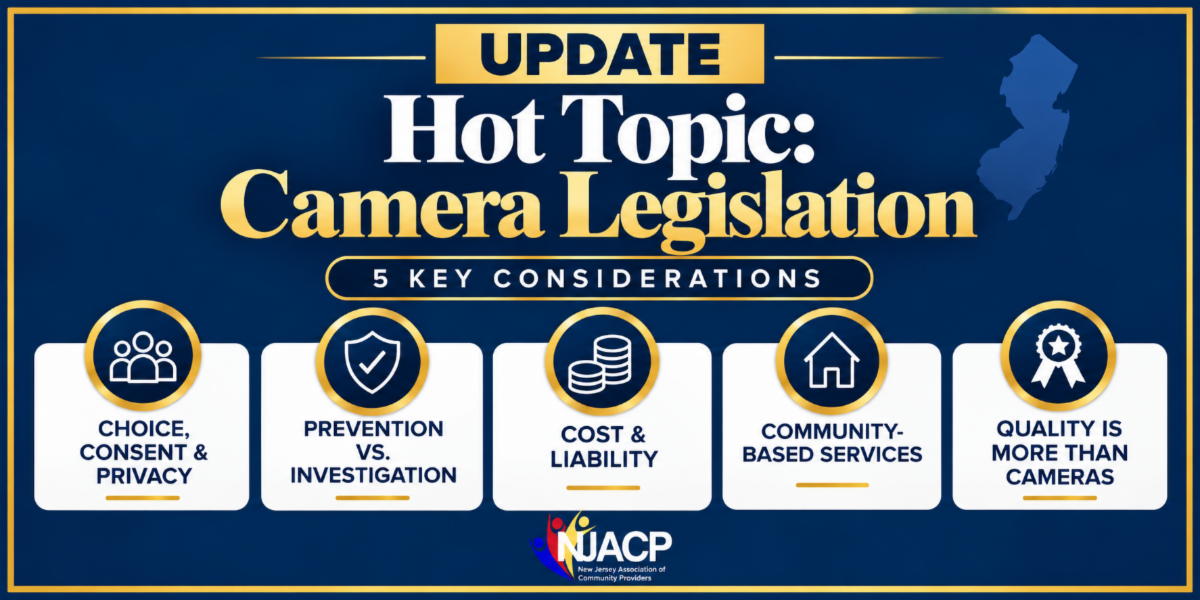
- Choice, consent, and privacy: Individuals and families who want a home with cameras can already choose one. A mandate risks removing meaningful choice and must be considered alongside CMS requirements for consent, privacy and person-centered HCBS.
- Prevention vs. investigation: Members using cameras consistently report that cameras can be valuable investigative tools, but they do not prevent abuse or neglect. Our system must remain focused first and foremost on prevention.
- Cost and liability: Camera systems require significant investment in equipment, IT, licensing, maintenance, footage retention, additional staffing and regulatory compliance. Installation alone can cost 15,000-25,000 per home, with substantial ongoing costs.
- Community based services are not institutional services: Comparisons to camera use in nursing homes are misplaced. Group homes are intended to support individuals living integrated, person-centered lives in the community.
- Agency quality cannot be measured by cameras: The suggestion that only "good" providers use cameras ignores the individualized nature of IDD services and the regulatory responsibilities providers already meet.
|
|
NJACP believes camera footage should not be distributed directly by provider agencies to families or individuals. Any required release of footage should occur through the appropriate state agency to protect privacy, confidentiality and providers from unnecessary liability. |
|
| NJACP Testifies on Camera Bill NJACP CEO Libby Vinson testified in opposition to A-2705, the “camera bill,” during a recent Assembly Health Infrastructure Committee discussion. The bill would require certain group homes to install electronic monitoring devices in common areas. No vote was taken. NJACP has opposed this legislation for more than a decade and continues to advocate for changes that protect choice, consent and the resources needed to provide quality services. |
|
Key concerns raised in testimony: |
|
| Consent: The bill does not address situations where an individual does not consent to cameras or protect individuals from retaliation. Without those protections, people who have lived in their homes for decades could potentially be forced to leave. These are homes, not institutions.
Choice: If cameras become the norm across the system, individuals’ ability to choose a home with or without cameras could disappear. More than 30% of group homes already have cameras, and that number is growing when budgets permit and in line with person-centered care. Cost: Installation can cost $15,000–$25,000 per group home, making cameras unaffordable for some providers. In a fee-for-service Medicaid system, providers cannot simply increase rates to cover new costs. Without state funding, resources could be diverted from services and programs, particularly affecting smaller and specialized providers.
Medicaid uncertainty: These concerns are especially significant given the fiscal uncertainty surrounding anticipated federal Medicaid cuts.
Safety: Cameras alone do not prevent abuse or neglect. They should be considered as one tool within a broader approach to safety, prevention and accountability. |
|
| NJACP will continue working with sponsors and legislators in both houses to address funding, consent, retention and other critical issues as the legislation moves forward. The Ask: Members who have not yet provided cost estimates for camera installation, retention, and contracts required, please submit to mshea@njacp.org. |
|
| NJACP Policy Priority: Protecting the Flexibility Providers Need to Serve People with IDD NJACP remains committed to ensuring providers have the financial flexibility necessary to deliver high quality, sustainable services for people with intellectual and developmental disabilities (IDD). Recent legislative proposals to impose administrative spending caps threaten that goal. A one-size-fits-all administrative cap ignores the realities of community-based service delivery and limits providers' ability to grow, innovate, and respond to changing needs. At a time when thousands of New Jersey residents remain on waiting lists, providers need the flexibility to expand services, not new restrictions that could reduce capacity. NJACP urges policymakers to reject arbitrary administrative caps and support funding approaches that recognize investments in administrative tasks, for instance, funding for technology, health and safety, homes, facilities, compliance and other costs that support quality services as essential to quality care and expansion depend on this funding. Each agency is unique as are the services and supports required for quality care depends on a provider’s ability to deliver person-centered care. New Jersey's ongoing commitment to helping individuals with IDD live and thrive in their communities.
|
|
|
HOT TOPIC ISSUE: CAMERAS
The New Jersey Legislature returns to the Statehouse in September, and there will be no shortage of issues affecting people with intellectual and developmental disabilities and the providers who support them.
One issue NJACP continues to monitor is legislation that would mandate cameras in group homes. S-1172/A-2705 would require cameras in group homes and annual notification to residents that they may request cameras in their homes.
NJACP understands the intent of the legislation. We also recognize that cameras can be a useful tool in investigations and that many providers already use them. However, NJACP does not oppose cameras in group homes but also does not support a mandate.
There are important questions that still need to be addressed, particularly around consent, individual choice, privacy, implementation, and cost. Camera systems can also be expensive, with installation, retention, and maintenance potentially costing 15,000–20,000 or more per group home.
Importantly, there is already a system that allows individuals and providers to determine whether cameras are appropriate for a particular home. Many NJACP members have voluntarily installed cameras based on the needs and preferences of the people they support, as well as their operational and financial realities. NJACP's Recommendation: Rather than mandating cameras, NJACP is recommending that the State incentivize voluntary installation through a grant program, with appropriate parameters governing camera use. This approach would allow camera use to expand based on individual need and demand, while providing resources to agencies and avoiding provisions that could potentially pit residents' preferences against one another. NJACP has developed policy papers and recommendations on the use of cameras in group homes and will continue working with policymakers.
We want to hear from you. If you have experience with cameras in your homes, concerns about the legislation, or thoughts on NJACP's recommendations, please share them with Maureen at mshea@njacp.org. More to come as the Legislature returns in September.
|
|
Why Is Budget Advocacy So Critical for People with Intellectual and Developmental Disabilities?
Decisions made in Trenton directly shape the daily lives of individuals with IDD and their families. The state budget determines whether people can live with dignity in their communities — with proper staffing, housing, and essential support services. For NJACP, budget advocacy is not optional — it is central to our mission. When funding reflects community priorities, individuals thrive. When it falls short, families face isolation, workforce shortages intensify, and opportunities shrink
|
|
▶ Watch Maureen break down the NJ budget timeline and key engagement windows. |
|
▶ Watch Maureen explain why late-stage advocacy is pivotal. |
|
▶ Watch Maureen outline the 3% COLA request and what it means for families. |
|
▶ Watch and Learn how Members, Family and Friends can take Action Today. |
|
▶ Watch Maureen’s closing message to NJACP members. |
|
|
|
|