|
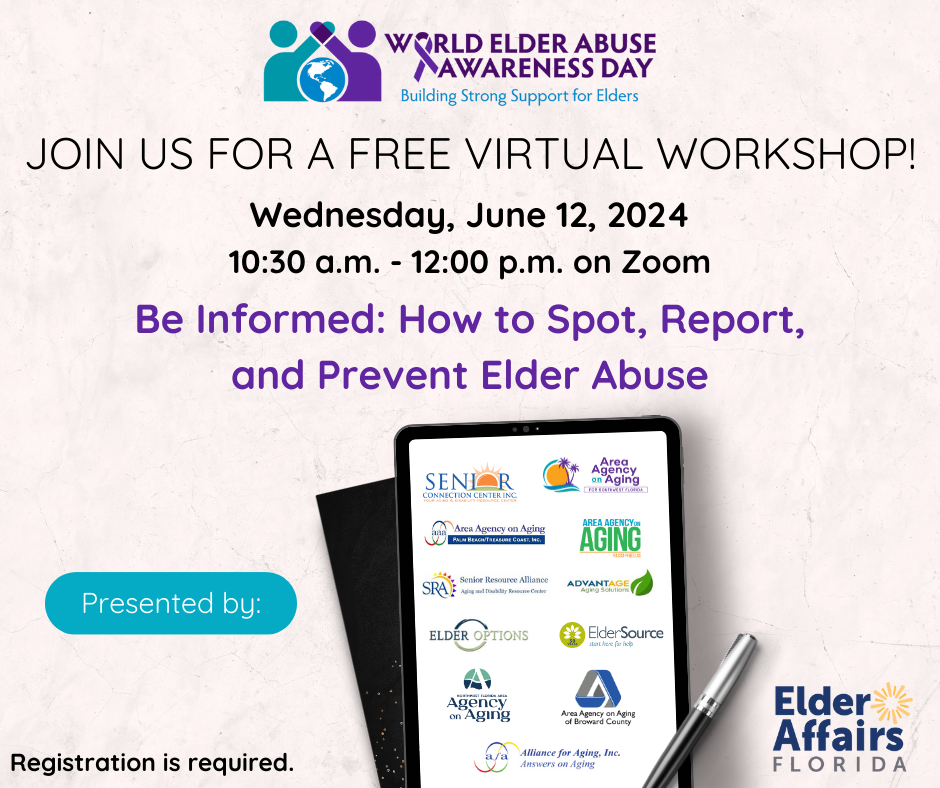
World Elder Abuse Awareness Day (WEAAD) 2024 Join Us on June 12, 2024 as we Recognize World Elder Abuse Awareness Day Launched by the International Network for the Prevention of Elder Abuse and the World Health Organization at the United Nations, World Elder Abuse Awareness Day (WEAAD) is observed annually on June 15. The purpose of WEAAD is to provide an opportunity for communities around the world to promote a better understanding of abuse and neglect of older persons by raising awareness of the cultural, social, economic and demographic processes affecting elder abuse and neglect. In recognition of World Elder Abuse Awareness Day (WEAAD), Area Agencies on Aging around Florida will be hosting an educational webinar on June 12, 2024 at 10:30am. Professionals in the field of elder rights will present on how to spot, report and prevent Elder Abuse. This event is open and free to the public; however, we ask that you register to participate. You can register for the webinar by clicking on this link: https://us02web.zoom.us/meeting/register/tZ0udOirqzsoGtDFjBaAeMAQ00QwswHWZOcW#/registration
Prioritizing Dignity, Safety, and Wellbeing for Older Survivors of All Identities The National Clearinghouse on Abuse in Later Life (NCALL) team is reflecting on how the growing diversity of the older adult population impacts our work with older adults and survivors of abuse in later life and elder abuse. By now, you’ve likely heard that the U.S. population is rapidly aging. The year 2024 marks the beginning of the Peak 65® Zone, which is the largest surge of older Americans turning 65 in our nation’s history. Approximately 4.1 million Americans are turning 65 this year and every year through 2027. This means from 2024-2027, nearly 11,200 adults will celebrate their 65th birthday each day. By 2034, older adults will outnumber children for the first time in U.S. history and by 2060, nearly one quarter of the U.S. population is predicted to be aged 65 years or older. This is important, because as our country ages, the older population is also becoming more racially and ethnically diverse. U.S. population estimates predict that by 2040, the population of older adults from racial or ethnic minorities will increase by 105% (compared to a 26% increase of older white, not Hispanic, adults) and that older adults from racial or ethnic minorities will account for 34% of all older adults in the US. Ethnic health disparities are also expected to play a greater role in shaping the overall health of the U.S. older population. Further, projections show that there will be more older adults from traditionally marginalized communities such as individuals who are LGBTQIA+ or disabled. As America ages, the rates of abuse in later life will undoubtedly increase. These demographic trends reinforce an urgent and critical need to prioritize measures that ensure the dignity, safety, and quality of life of all older adults and make certain that services are accessible to older survivors of all identities. On this WEAAD, we invite you to join NCALL in developing a personal understanding of intersectionality and deepening your awareness of systemic oppressions that harm older survivors and impede healing and justice. begin to understand areas of personal growth related to using an intersectional lens when working with older adults. We encourage you to further your exploration and learning, by visiting NCALL’s WEAAD syllabus with several resources for your review. While these resources don’t all explicitly address abuse in later life, they offer opportunities to learn about some common systemic barriers faced by older survivors of abuse as well as hear from the voices and perspectives of those most marginalized. Our intent is to share with you our journey to learn and unlearn so that we may become better attuned to the needs of a growing and increasingly diverse older adult population. Resources: https://www.ncall.us/2024/05/16/weaad-2024/ https://s3-us-east-2.amazonaws.com/ncall/wp-content/uploads/2024/05/16104512/WEAAD-Syllabus-2024.pdf
|