[[trackingImage]]

CFI NOTAMS: (Items Commonly Missed By CFIs)

Legal Interpretations for the Savvy CFI (or pilot)

There are lots of questions asked of CFIs regarding specific regulations and interpretations. Not every question can be answered by referring to the regulations or FAR/AIM. The FAA "Letters of Interpretation" often guide the trickier interpretations (what actually counts as an "instrument approach" for the purposes of currency. This article by Mark Kolber in IFR Magazine is a good start to your search for clarity for lots of "commonly confused" questions.

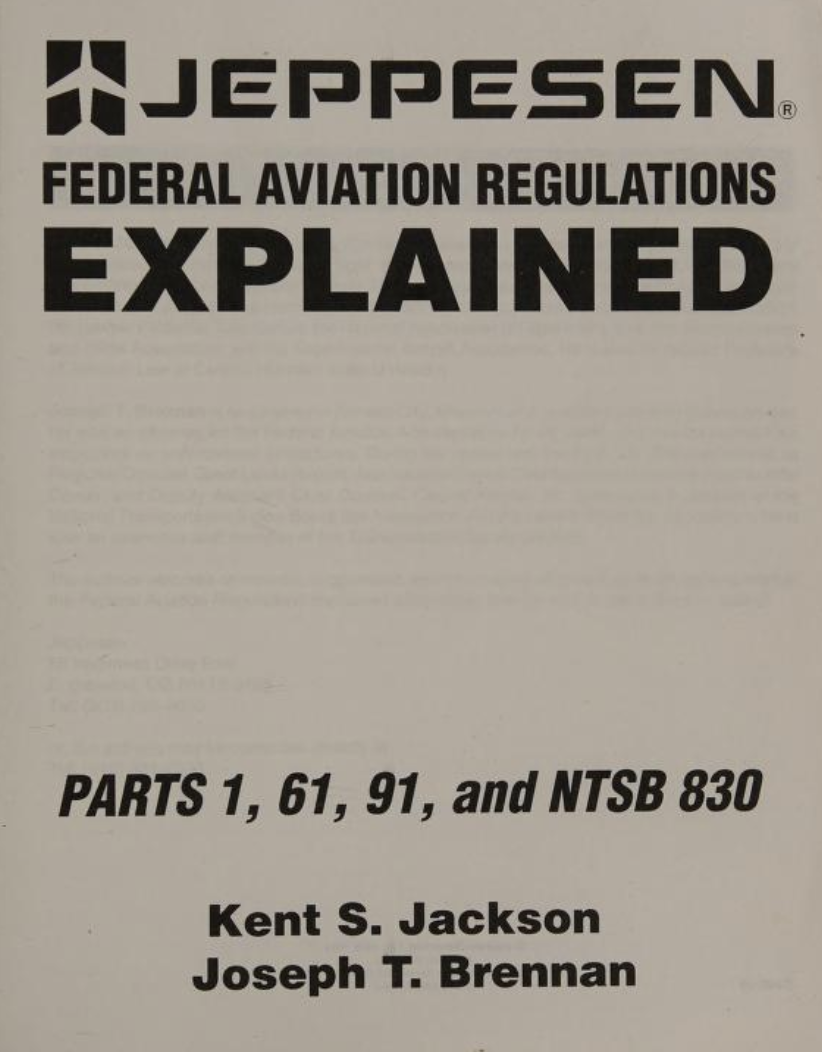
This compilation from SAFE or this one from Academic Flight provide sources for late night reading to improve your understanding of how the FAA regulations are meant to be applied. Jeppesen also publishes a book called the "FARE" (Federal Aviation Regulations Explained) which cites case law and law judge rulings on various questions. Be the expert at your flight school.

The "Meta-Endorsement" on Every Flight Test: CFI 61.39!

One of the most commonly missed endorsements when recommending an applicant for a flight test is the required 61.39 endorsement attesting to the required dual flight in the last 2 calendar months and the correction of the areas found to be deficient on the knowledge test. This "meta-endorsement" is often not pre-printed in older student logbooks and can easily be forgotten by the recommending CFI.


There are two parts in AC 61.65, the recent dual experience and also the correction of incorrect questions. I personally combine these two endorsements into a single signed endorsement (see the SAFE Toolkit App.) but you may want to consult your DPE here. Follow AC 61.65 if you are uncertain. DPEs are now required to "customize" each applicant's flight test to cover the "questions found to be deficient," so a comprehensive review is critical to applicant success on the evaluation.

1/5 of FAA Flight Test Applicants are "Unqualified!"

36 senior DPEs gathered with FAA AFS 650 managers Trey McClure and Karen Lucky at #OSH22 to discuss DPE issues. The shocking consensus among the participating senior DPEs was that 1/5 of pilot applicants for flight tests were unqualified due to incomplete training (insufficient experience), incomplete endorsements, or other administrative problems. This means the flight test never gets started and the appointment time is wasted. We are throwing away 20% of DPE testing opportunities.


As CFIs we obviously need to do better with flight test preparation. Every CFI needs to double-check their applicant preparation. See today's SAFEblog for more on this, use our SAFE Toolkit App and check the SAFE CFI NOTAMS to stay current on common problems with "applicant qualification."


Private Pilot Endorsements/Verification Instrument Pilot Endorsements/Verification Get the free SAFE Toolkit here.

Just BTW: Most endorsements we accept (and some DPEs don't) are technically illegal since a printed name is also required (see AC current FAA 61.65). That usual signature scribble most CFIs cram onto a page does not tell anyone who actually endorsed the pilot; a printed name is legally required by the FAA!

IFR Requirement For Commercial Pilot

"An IFR rating on a pilot certificate is enough to satisfy the training requirements for commercial pilot" NOPE!!

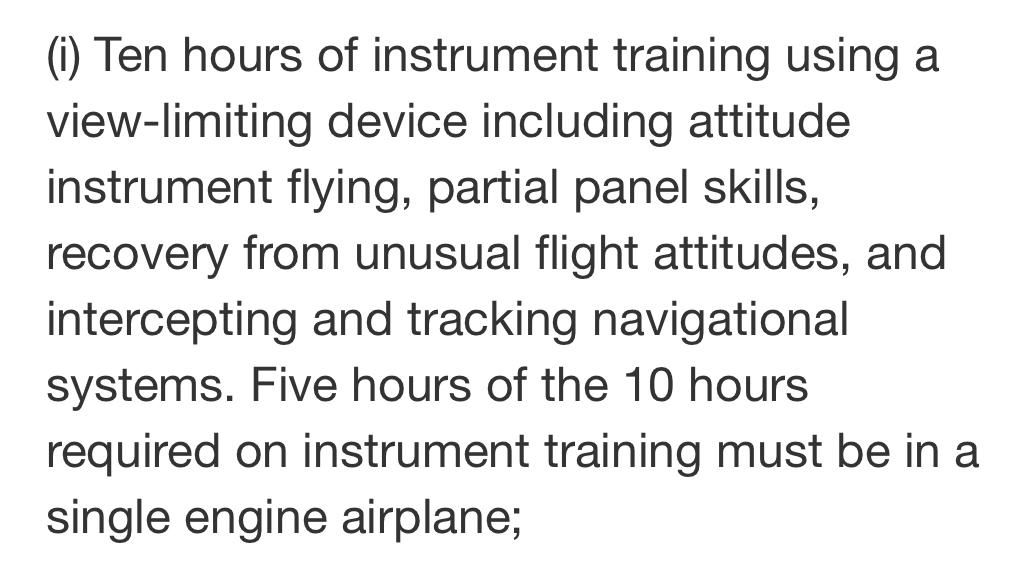
The training received for the instrument rating *MIGHT* be usable for the commercial pilot certificate *IF* the time was logged as both 61.65 training and also § 61.129( c)(3 )(i) Commercial pilot training is more focused on "aircraft control by reference to instruments" just like the time required for private pilots. Unlike private level though, this training must be given by an instrument instructor (another common problem). The ruling Letter of Interpretation (LOI) is the Dr. Jablecki letter The clarification below in the Oord Letter


The FAA highlighted that the training conducted pursuant to these two paragraphs are not invariably equivalent because § 61.129( c)(3 )(i) contains specific training criteria not found in§ 61.65(e).


Another common endorsement problem with § 61.129( c)(3 )(i) is 5 hours must be in category and class of aircraft for rating sought (SEL?). The airplane time must be with a "view-limiting device" since that is how the reg is written (it cannot be obtained in actual instrument conditions). The other 5 hours can be in "something else" like an approved sim. or different category.


Get the free SAFE Toolkit here.

CFI-NOTAM: Solo Endorsement for a Pilot

in a new Category/Class

When a pilot is adding a new category or class they are not rated in, it is necessary to endorse them correctly (with appropriate limitations) to convey the privileges for solo (multi-engine, glider, etc). Most DPEs require a multi-comm. (or other category/class) applicant to be solo-endorsed because they are flying as PIC during the test.


The common 61.87 endorsement is not appropriate since this reg. is for student pilots. You can find this endorsement in the SAFE Toolkit App (screenshot below). Be sure to add limitations and specific category/class. A person with this endorsement can immediately (legally) fly cross country (unless you add limitations) since they are *already a pilot* and do not need that student pilot cross-country training or endorsements.

61.31_d_2pilotEndorsementForSolo.jpg

CFI NOTAM: "Long X-C" for Private


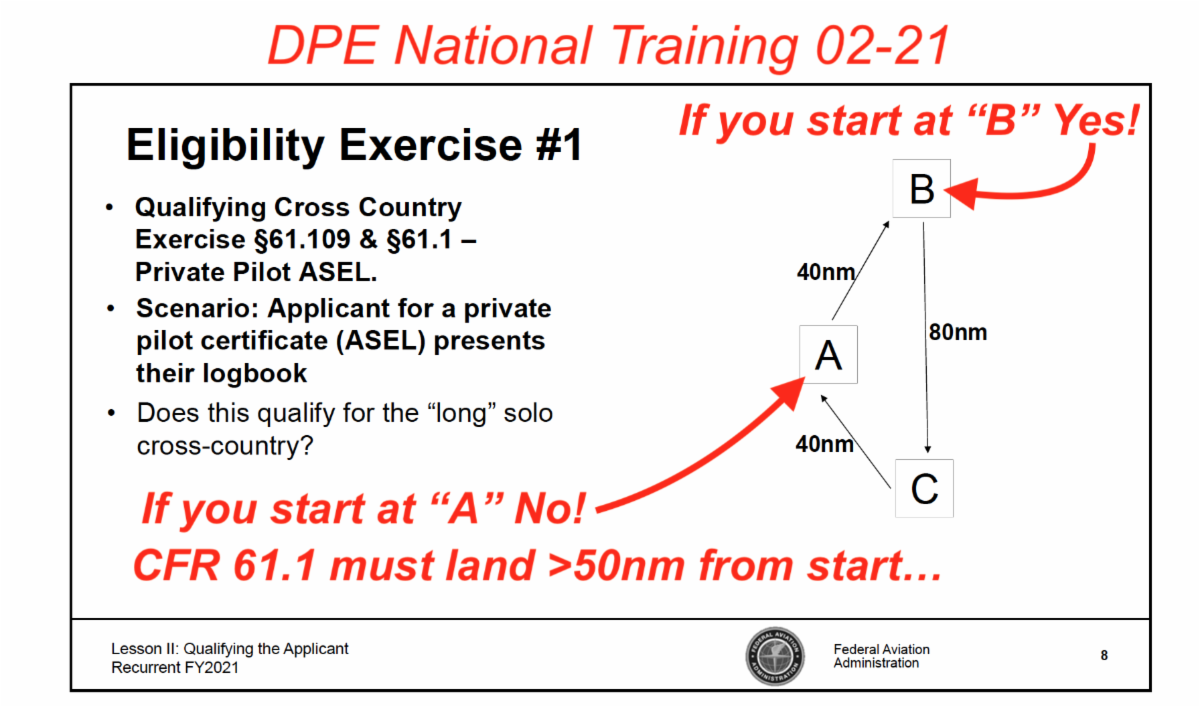
This supplied graphic is pretty much a restatement of the requirements in CFR 61.109(a)5(ii) and consequently, many CFIs (and even a few DPEs) get caught assuming this is a valid "student cross country!" The answer is "no" and consequently, this question was recently added to the national DPE training. If you start at "Airport A" (which is the usual assumption) this flight would not count as a valid student cross-country. If you start at "B" it *IS* a legal X-C (careful out there)!


The legal definitions for all regulations are in CFR 61.1. Here it clearly states that to count as a cross-country flight for (all) pilots in training (except ATP), a X-C flight "includes a point of landing that was at least a straight-line distance of more than 50 nautical miles from the original point of departure." This interpretation is further clarified in the FAA "Keller Letter." Another point often missed by CFIs is that landings on cross-country flights should also be to a full stop; clearly stated in the same regulation: CFR 61.109(a)5(ii) "full-stop landings at three points."


Ironically, if your hypothetical pilot started at "Airport B" this *would* count as a valid X-C since it landed more than 50nm from the point of origination.


Get the free SAFE Toolkit here.

CFI NOTAM: Endorsements

One of the worst things you can do to your learner is to send them to a check ride with a problem in the initial verification stage (usually "no checkride!") Triple-check that all endorsements are correct, and the pilot and plane logs are legal and accurate. SAFE Checkride Ready!™ on the SAFE Toolkit App has very detailed guidance.


For every activity we endorse as CFIs, there are regulatory training requirements to legally convey and exercise that privilege. For the initial solo, there are 15 required training items, a pre-solo test (also endorsed) and an initial solo 61.87(n). And every savvy instructor should add sensible limitations to this solo endorsement! After 90 days an additional endorsement (61.87[p]) is required, *but* the original 61.87[n] must still be there for the original training (otherwise the subsequent solo is not legal - they are both required).


Cross country privileges follow a similar pattern, with an initial endorsement 61.93(c)1&2 from the instructor who conducted the initial training. Each X-C flight can then be signed by *any* authorized instructor who checks the planning. But if the original 61.93 endorsement is not there, the subsequent flights are not legal or valid to use as experience. Tough luck for the student. There have been instances of students flying all their solo and X-C without even obtaining a student certificate...same sad story! Get the SAFE Toolkit App for precise guidance on endorsements (and applicant preparation). Allow "notifications" on the app for aviation news and events like Sun 'N Fun. Most DPEs will gladly consult to answer questions *before* a flight test. This saves stress and aggravation for everyone. Everyone wants the qualification process to go smoothly...

CFI NOTAM: “Supervised”

PIC Time For Commercial


As DPE, I have commercial applicants who flew the 300nm X-C with their instructor and flew their night time and landings solo (by themselves-not under supervision) Mixed time does not meet the regulation; and all of this needs to be logged correctly. This is a hard stop for commercial flight tests. Your applicant will not be qualified.


When the learner is "performing the duties of PIC" (not rated in the airplane):

  • PIC time cannot be logged in the applicant’s logbook. It can be logged in the instructor’s logbook; in both cases counts toward total time.
  • Dual received and dual given cannot be logged because the applicant should be demonstrating proficiency, not receiving training (NOT DUAL)
  • The instructor should note “PIC training per 14 CFR 61.129(b)(4)” in the remarks section of the applicant’s logbook (DPEs should insist on this)
  • On FAA Form 8710-1, it is understood that the application doesn’t have a column to list this flight time. The 10 hours performing the duties as PIC with an instructor on board have to be listed in the "PIC column."

The SAFE Toolkit App has this same guidance and we are adding a "CFI NOTAMS" section to alert CFIs to other common problems that cause a practical test discontinuance. Get the free SAFE Toolkit here.