|
|
| An Inside Look at Cone Camp 2025 By Ruby Beauchamp |
| The road to post-wildfire landscape recovery in California winds through many forests, and this summer, it's taking us from the Jeffrey pines of Mt. Laguna to the giant sequoias of the southern Sierra Nevada range to the valley oaks of Chico, and up to the mixed conifer of the Shasta Trinity region to host Cone Camp. With the journey comes dusty boots, bright eyes, and the sense of an emerging community rooted in care for California's forests. It's Cone Camp season.
Cone Camp is a seasonal two-day field training cooperatively developed by a working group ("huddle") of the California Reforestation Pipeline Cooperative, where the focus is simple but the vision is profound: teach people how to survey, monitor, and collect wild seed from California’s native conifers. Beyond the logistics of a busy agenda, breakout sessions and survey routes, it’s something more – it’s a place to gather and practice land stewardship as a relationship between people and place. |
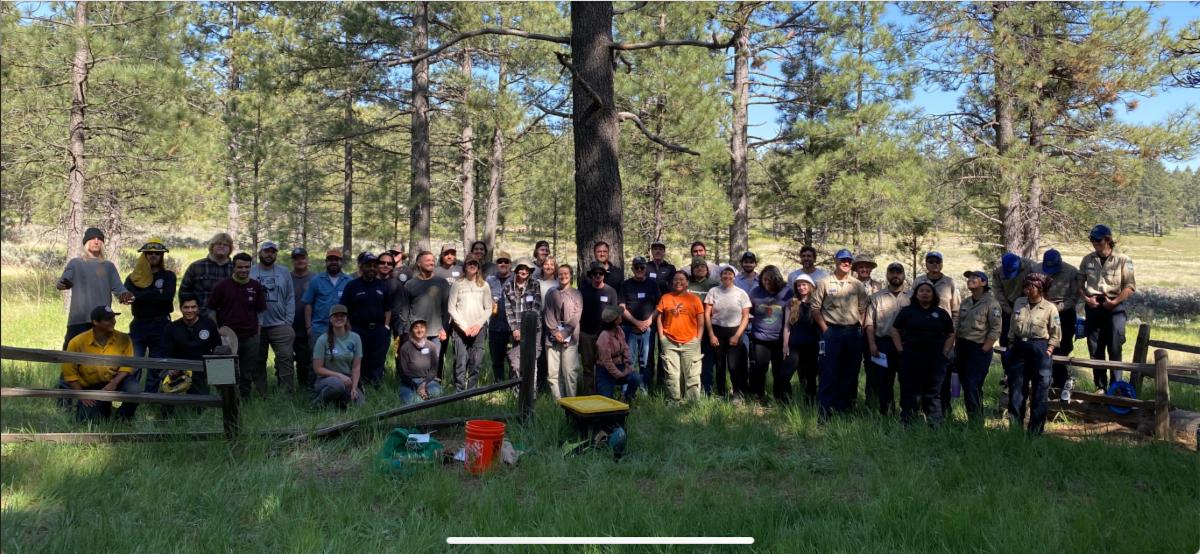
| A Circle in the Pines Early on the first day of Cone Camp SoCal, cars roll into a quiet U.S. Forest Service campsite at Mt. Laguna in what is now San Diego county. Participants are greeted by smiling hosts as they're handed a printed copy of the California Cone Hunter’s Pocket Guide (first edition)-an educational resource co-developed by another RPP Cooperative huddle to attempt to collect recommended practices in quality cone collection. In a tall, aromatic stand of Jeffrey pine, more than 50 people gather, representing ~20 organizations. Foresters, State Parks employees, California Conservation Corps members, delegates from regional Tribes, botanists from a variety of organizations, community volunteers, and arborists alike, all converging to learn and connect on the topic of wild seed.
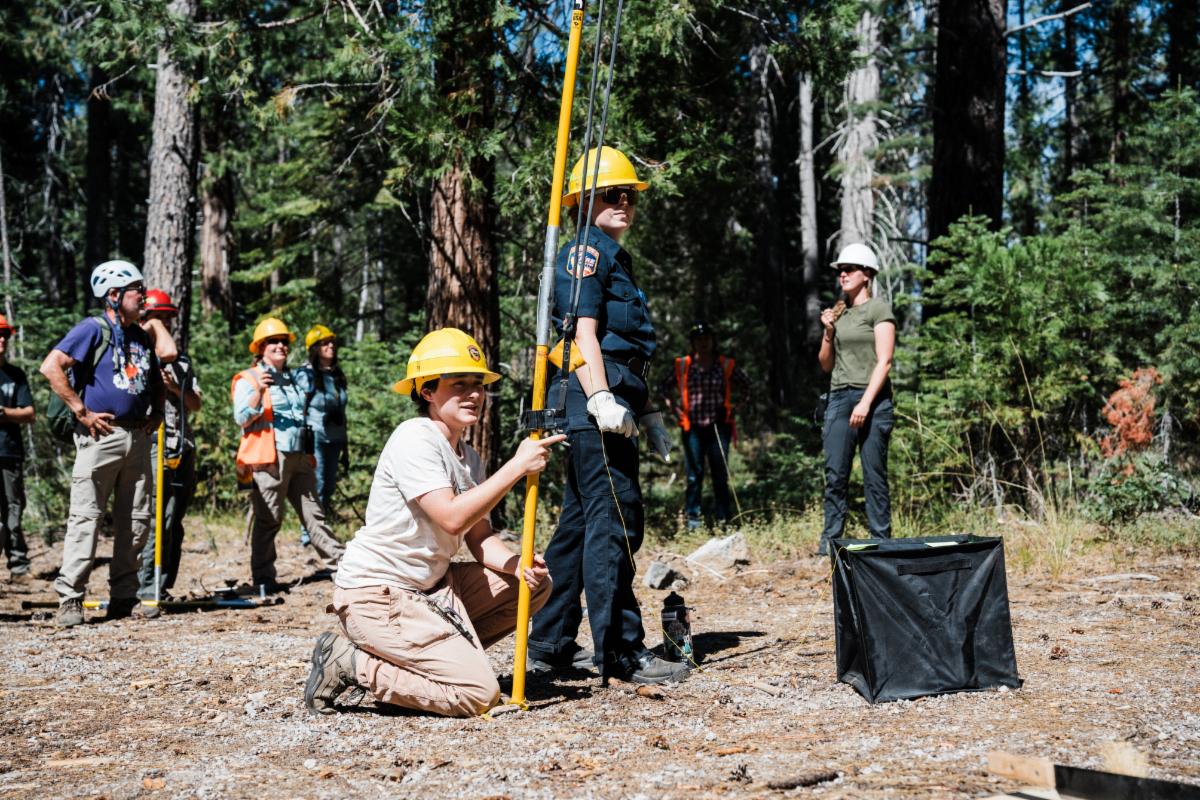
We begin with an ecological orientation to place, grounding our work in the landscapes of what is now the Cleveland National Forest in a place that since time immemorial has served as a seasonal village for the local Indigenous people. Did you know that San Diego County is home to four major Native American cultural groups: the Kumeyaay/Diegueño, Luiseño, Cupeño, and Cahuilla, which are further organized into 18 federally recognized Tribes? We go on to discuss Cone Hunting 101, a new online prerequisite for Cone Camp, and then break out into small groups for rotating station visits. Participants discuss tree identification and cone crop viability, focusing binoculars on distant tree canopies and cutting cones to analyze seed maturity. For everybody’s favorite part of the day, participants take turns launching the Air Powered Tree Access (APTA) device and BigShot Slingshot into treetops, tools used for accessing cone samples important for checking ripeness. |
Maya Hotz and Allison Viega of CAL FIRE Reforestation Services demonstrate the use of the 'Big Shot' at Cone Camp. Photo by Shelley Villalobos for American Forests. |
| On day two, participants ride in small caravans to survey the surrounding forest, looking for cones. They scan branches, compare bushel estimates, assess forest conditions, and complete their first data collection forms on Survey 123, where all are welcome to submit cone observations that can help guide seed collectors to locations in California with developing cone crops.
Upon circling together one last time, Cone Camp closes with participants reflecting on what the forest has to offer and the role of reforestation in maintaining the landscapes we love. One participant points out the bedrock grinding stones in camp as evidence of an Indigenous seasonal village and the ancient relationship between humans and this land. Another adds that modern western forestry practices have tended to be extractive, and invites us all to consider how we as land stewards have the opportunity in current times to change that course and find a balance where economics and ecology don't necessarily have to be mutually exclusive. Participants are sent on their way after a fun raffle with prizes ranging from camp chairs to handmade candle votives donated by Eddie Bauer and Lumbercycle, respectively, with certificates of completion. |
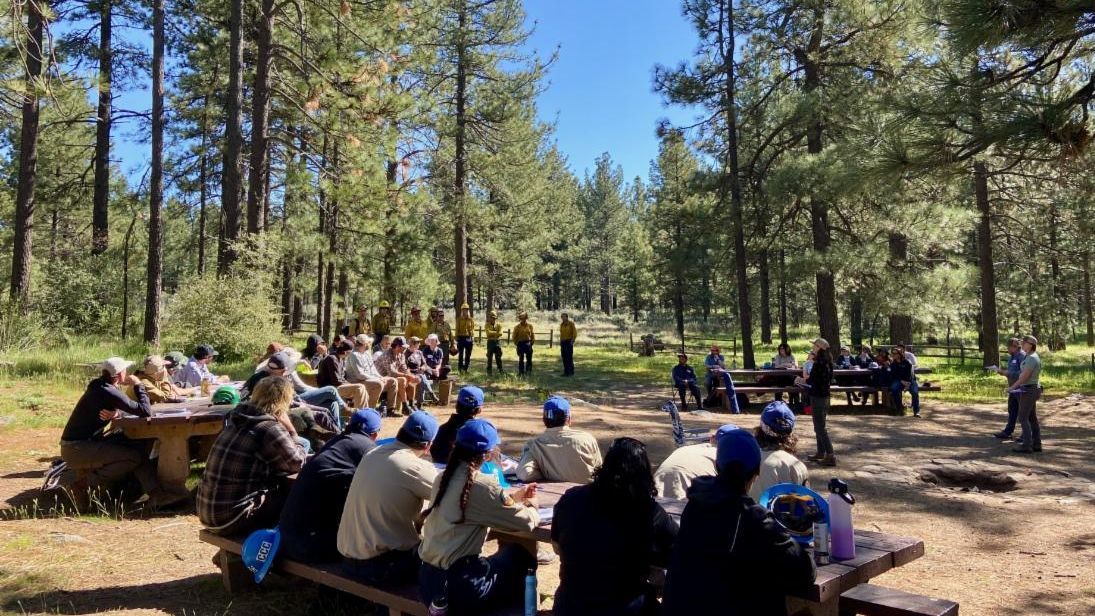
Outdoor classroom at Cone Camp SoCal. May 20, 2025. Laguna Campground, Cleveland National Forest/Kumeyaay/Diegueño homelands. Photo by Ruby Beauchamp for American Forests. |
| Growing More Than Just Trees Since that first circle in the pines, a second Cone Camp occurred in Chico and by the time you read this, the Cone Camp team will be deep in Mountain Home Demonstration State Forest and a fourth training of the year will be held in Shasta June 25 - 26. Registration for NorCal is still open. Click here to register now!
Across these events, a pattern is emerging.
Cone Camp spans generations and frames of mind, bringing together folks of all ages and backgrounds. Many participants are early-career explorers from various conservation corps and community colleges, while others are experienced professionals that bring decades of wisdom to the training as they answer the call of duty in service. Participants are united in their curiosity — for a new kind of future forest, one that is positioned for resilience in the face of rapidly changing conditions.
They’re leaving with a deeper understanding of what reforestation takes and how that effort turns into resilient forests that will stand the test of fire and of time. It doesn’t just take trees, but seeds. Not just seeds, but people. And not just people, but collaboration. All on a finite timeline.
Perhaps most importantly, more folks are beginning to understand that reforestation involves rigorous attention to the landscape and a concerted effort put forth by those involved in the whole "reforestation pipeline" (supply chain). Beginning the pipeline, wild seed offers value that no human-designed operation could replicate and it guarantees critical genetic diversity needed across seed zones. With that, behind all wild seed collections are tree climbers — real people who scurry up tree trunks to gather cones. They are the hidden labor force of the reforestation pipeline and through Cone Camp, we’re seeing a new generation eager to learn that art. |
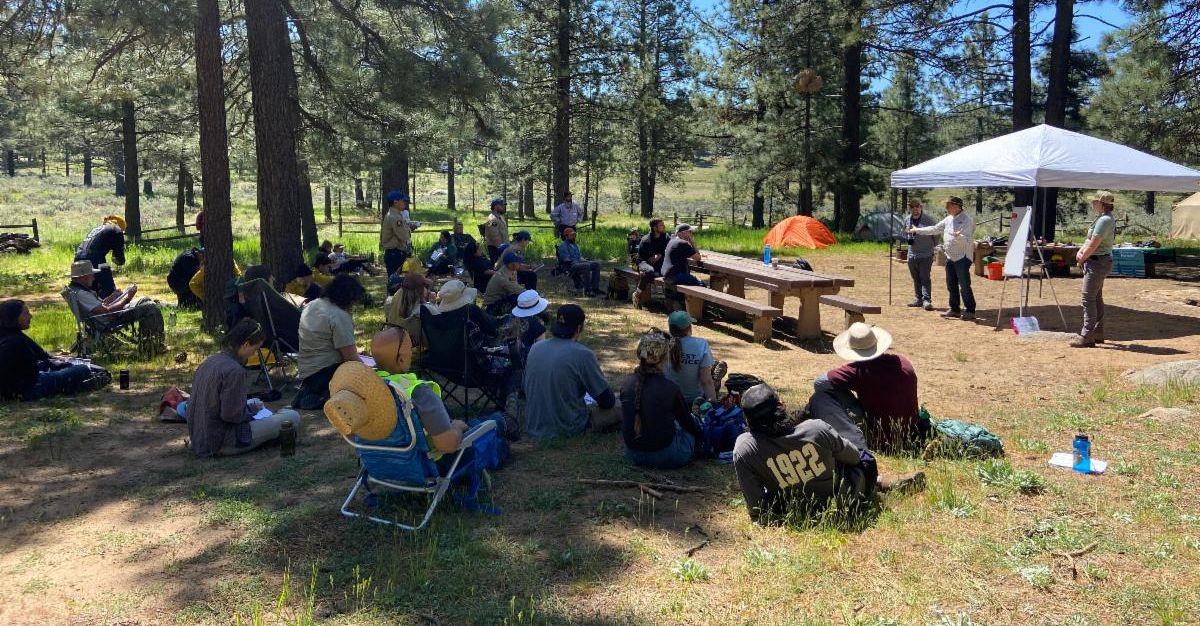
Cone Camp SoCal group photo. May 21, 2025. Laguna Campground, Cleveland National Forest/Kumeyaay/Diegueño homelands. Photo by Shelley Villalobos for American Forests. |
| A Growing Cooperative of Stewards
Cone Camp is growing more than a reforestation skillset. It's growing a community of forward thinking seed strategists and everyday stewards. It’s helping us reimagine what recovery can look like after wildfire, what collaboration means across boundaries, and how we can honor both traditional ecological knowledge and modern science in service of our forests.
To our seasoned colleagues who’ve walked these woods before: thank you for laying the trail. To the fresh faces stepping into the field: we’re glad you’re here. There’s room for us all and work to be done. As we say, the cones are out there.
They are waiting for us to come along together to discover, collect, sow, grow, and steward their future. |
|
|
|
|
|
About the Author
Ruby Beauchamp is a 2025-2026 fellow with the Sierra Nevada Alliance Sierra Forestry Corps serving with American Forests as the Reforestation Pipeline Partnership Coordinator. With five years of climbing and cone collection experience, she brings boots-on-(and off)-the-ground experience to Cone Camp. |
|
|
|
|
|
|