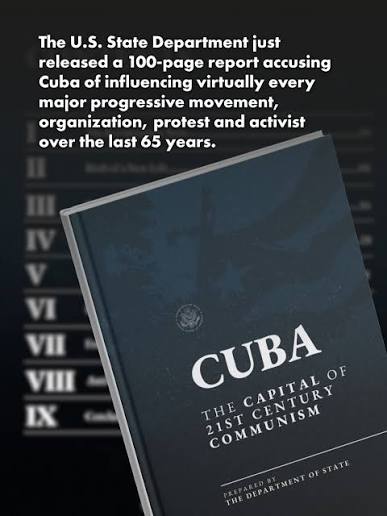
The State Department’s nearly 100-page report, Cuba: The Capital of 21st Century Communism, asks us to believe that a small Caribbean nation—battered by shortages, sanctions, power failures, and more than six decades of American hostility—is the command center of a sprawling conspiracy to undermine Western democracy.
It might be amusing if the consequences of such accusations were not so serious.
The report mixes facts, half-truths, ideological labeling, and guilt by association. It moves from documented espionage to meetings, conferences, travel, political affinities, and expressions of solidarity as if they all constituted subversion. People and organizations are named not because they have been accused, much less convicted, of crimes, but because they have encountered Cuba, criticized American policy, supported Palestinian rights, or participated in movements the report considers threatening.
There is a difference between influence and control, and between dissent and subversion. This report works overtime to erase both distinctions.
Yes, Cuba has engaged in espionage. Ana Belén Montes was the real thing: a highly placed, fully recruited Cuban spy. She joined the Defense Intelligence Agency in 1985, passed sensitive information to Cuba for years, was arrested in 2001, pleaded guilty, and served a lengthy federal sentence. Her case deserves to be taken seriously. But one genuine spy does not convert every activist, scholar, journalist, labor organizer, or elected official who has interacted with Cuba into a Cuban operative or “fellow traveler.”
The report devotes more than three pages to the Democratic Socialists of America, but democratic socialists are not communists. One may disagree with DSA’s policies, tactics, or candidates, but disagreement does not permit intellectual dishonesty. Democratic socialists use elections and democratic institutions to challenge inequality and corporate power. They are not communists, no matter how convenient that falsehood is for this administration.
The report reaches across decades, treating association as evidence. Representative Karen Bass’s youthful travel to Cuba is recycled yet again. Representative Maxine Waters’ 1998 letter concerning an accused Cuban intelligence officer is presented as if it proves something sinister about her politics today. Journalists, labor activists, socialists, racial-justice organizers, and Palestine advocates are tossed into one threatening pile. The insinuation is clear even when the evidence is not.
Secretary of State Marco Rubio’s hostility toward the Cuban government is hardly new. He built much of his political identity in Florida’s anti-Castro Cuban community, although his parents left Cuba in 1956—before Fidel Castro came to power. His feelings may be politically understandable, but they do not justify using the machinery of government to revive McCarthyism or turn ideological disagreement into national-security suspicion.
Nor does the report adequately acknowledge why Cuba holds a special place in the imaginations of many Black Americans. Cuba opposed apartheid and sent troops to Angola, contributing to the defeat of South African forces. It offered refuge to some Black radicals when the United States treated them as enemies. It sent doctors throughout the developing world and offered educational opportunities to students from Africa, the Caribbean, and marginalized American communities.
Black affinity with Cuba does not prove that Black people were manipulated by Havana. It reflects a history of internationalism, anti-colonial struggle, and skepticism about a United States government that has rarely treated Black dissenters fairly.
I traveled to Cuba in May with an all-Black delegation from the Institute of the Black World, led by Dr. Ron Daniels. I did not encounter a revolutionary paradise. I saw shortages, uncertainty, exhaustion, and hardship. A physician broke down while discussing the country’s mental-health pressures. I met a 31-year-old former teacher struggling to find her way and learned of a ten-year-old attending school only two days a week.
But I also saw generosity, dignity, functioning institutions, and people determined to build lives under extraordinarily difficult circumstances. The power went out, but it came back. People criticized their conditions while taking pride in their country. Cuba was neither the utopia its most uncritical admirers imagine nor the conspiracy center this report describes. It was a complicated nation filled with human beings.
Cuba should be scrutinized. Its restrictions on expression, treatment of dissidents, and political structure deserve honest criticism. But scrutiny is not distortion, and criticism is not permission to smear Americans whose politics displease the current administration.
The report tells us at least as much about the United States as it does about Cuba. It reveals a government eager to label dissent, blame domestic protest on foreign manipulation, and revive an old vocabulary of subversion. Today the target is Cuba. Tomorrow it may be anyone who challenges militarism, racial inequality, corporate power, or American foreign policy.
We have seen this movie before. It ruined careers, fractured movements, and made accusation a substitute for evidence. We must not permit a new Red Scare simply because this one arrives with footnotes and the official seal of the State Department.