| Snowbird Atmospheric Water Generators (SAWGs) are self-contained, portable systems engineered to extract potable water directly from ambient air. Utilizing a process similar to that of a dehumidifier, SAWGs draw in humid air via a high-capacity blower and initial sediment filtration, preventing particulate ingress. The air then undergoes a thermal exchange and cooling cycle to condense moisture into liquid form. The collected water is subjected to multi-stage purification, including advanced filtration, ozone treatment, and ultraviolet (UV) sterilization, before being stored in an integrated reservoir. Water is dispensed via spigots for immediate use or routed to external storage containers for deferred consumption.
Three configurations are currently available from Snowbird Technologies: |
|
| Our smallest unit designed for a two-person lift and easy deployment on combat vehicles. With just one compressor system, this unit can produce up to 14 gallons every 24-hour cycle.
|
|
 |
| A lightweight, man-portable unit designed for rapid deployment and vehicle integration (e.g., MRZR platforms). Under optimal environmental conditions, it produces up to 20 gallons of water per 24-hour cycle.
|
|
|
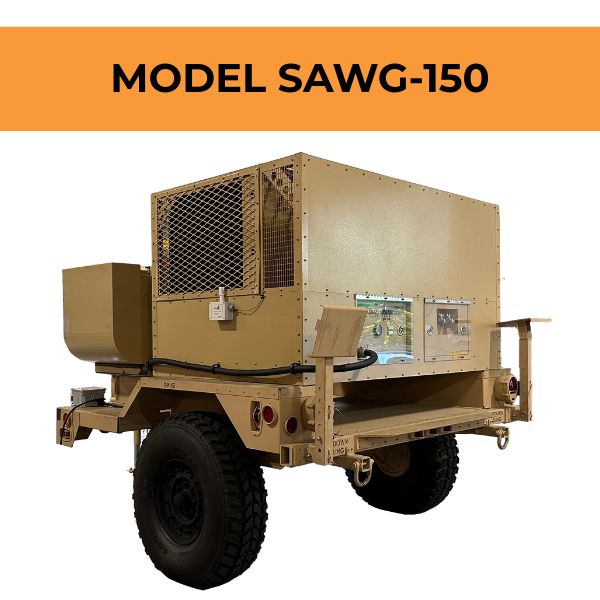
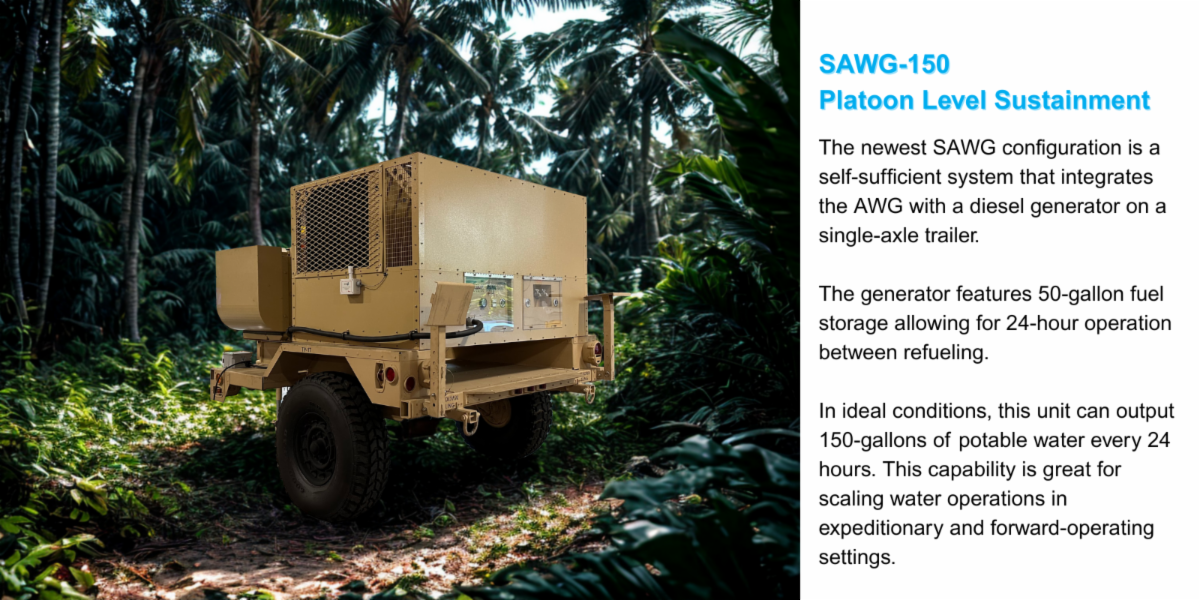
| A higher-capacity system mounted on a single-axle trailer with an integrated power generation module, enabling autonomous field operation. It can yield up to 150 gallons per 24-hour period.
|
|
|
| From a systems perspective, SAWGs function as effectors—technologies that produce a direct and measurable physical output. By converting atmospheric humidity into clean drinking water, they fulfill a critical operational capability in response to environmental conditions and mission requirements. These atmospheric water generators offer a robust alternative to traditional bulk water logistics, particularly in austere, resource-constrained, or contested environments. By reducing dependency on ground-based water sources and eliminating the need for resupply convoys, SAWGs enhance force autonomy, mitigate logistical vulnerabilities, and support sustained operations. Their minimal maintenance profile and rapid deployability make them an ideal solution for forward-operating forces requiring reliable, on-demand water generation in challenging operational theaters. |
Military Problem Statement |
| Access to clean, potable water is a mission-critical requirement for modern expeditionary defense operations, forward operating bases, and fixed military installations. Traditional bulk water support systems are heavily dependent on accessible groundwater sources, large and maintenance-intensive purification equipment, and extensive storage infrastructure. This reliance on existing resources, equipment, and personnel introduces significant vulnerabilities to the sustainability and responsiveness of water logistics. Atmospheric Water Generators (AWGs) address critical logistical and operational gaps by providing a localized and secure source of potable water, especially in environments where traditional water sources are scarce, contaminated, or logistically challenging to access. Specifically, AWGs help overcome the following challenges:
- Reduced reliance on external water sources: Traditional military operations often depend on vulnerable supply chains for water, including host nations, local landscapes, or dedicated transport systems. AWGs create water directly from the air, diminishing this dependence and associated risks and costs of transporting water to remote locations.
- Enhanced security for personnel and resources: Transporting and securing water resources in contested environments can expose soldiers and equipment to threats. By generating water at the point of need, AWGs reduce the frequency and vulnerability of convoys and distribution networks, minimizing the risks to personnel involved in resupply missions.
- Support for distributed operations and tactical flexibility: Defense strategies emphasize distributed operations across multiple domains, where units may operate in geographically dispersed and austere environments far from established supply lines. AWGs provide an organic capability to generate water locally, enabling greater operational flexibility and reducing the need for fixed water points or extensive logistics to deliver water to remote locations.
- Mitigation of logistical challenges: Water resupply is a major logistical burden in military operations, requiring significant resources in terms of equipment, fuel, and personnel. AWGs offer a lighter, more mobile, and self-replenishing alternative to traditional water logistics, potentially reducing overall logistical footprint, associated costs, and delivery times.
- Improved water quality and reliability: AWGs produce clean, high-quality drinking water by extracting it from the air and typically incorporating purification processes to remove contaminants. This helps guarantee a reliable and safe water source, even in areas with scarce or contaminated water sources or where infrastructure is damaged.
|
In essence, AWGs align with goals to enhance battlefield capabilities through technological advancements by providing a decentralized, secure, and sustainable water supply solution crucial for the future of multi-domain operations. |
| Snowbird Atmospheric Water Generators (SAWGs) align with the Formation-Based Layer Protection focus area by serving as a primary or complementary solution for decentralized potable water generation. When integrated alongside conventional bulk water operations—including desalination units, reverse osmosis systems, and established water distribution logistics—SAWGs provide a redundant and resilient water source, independent of terrestrial water availability. This capability is particularly advantageous in scenarios where ground-based water sources are compromised, contested, or otherwise inaccessible during critical phases of an operation. SAWGs are specifically engineered for autonomous, tactical water production in forward-deployed and remote environments. Both the SAWG-28 and SAWG-150 models are optimized for expeditionary use and are capable of operating in a wide range of environmental conditions, from 30% to 99% relative humidity and ambient temperatures between 45°F and 125°F. In a 24-hour period, a soldier's water needs can vary significantly based on factors like weather conditions, activity level, and individual physiological differences. Using an average of 4.5 quarts per warfighter per day, one can assume the following:
- The SAWG-28, a compact, two-person lift unit, is suitable for mounting on light tactical vehicles (e.g., MRZRs) and supports the daily potable water needs of a squad-sized element.
- The SAWG-150, a trailer-mounted system with integrated power generation, is designed to sustain a platoon-level element with continuous water production in the field.
By providing self-sufficient, on-demand water generation capabilities, SAWGs significantly reduce the logistical burden associated with water resupply and enhance operational endurance in austere and contested environments. Atmospheric water generators are specifically designed to support infantry due to their rugged, portable design. These systems may also fall under or be supported by several Military Occupational Specialties (MOSs) related to water treatment, purification, and general utilities/equipment maintenance such as:
- 92W - Water Treatment Specialist (Army): This MOS involves installing, operating, and maintaining water purification equipment, which could include AWGs, according to the U.S. Army's website on the MOS 92W - Water Treatment Specialist. They also manage water storage and distribution.
- 1171 - Water Support Technician (Marine Corps): Similar to the Army's Water Treatment Specialist, this MOS focuses on installing, operating, and maintaining water purification equipment (including potentially AWGs), pumps, and water storage/distribution systems, according to the DoD COOL website.
Beyond these specific roles, the nature of AWGs as mechanical and electrical equipment suggests that general maintenance and repair MOSs would also be involved in their upkeep. The MOS 1164 - Utilities Systems Technician (Marine Corps), which handles repairs on electric motors, electronic modules, motor control circuits, refrigeration equipment, and environmental control units, could also be relevant to the maintenance of AWG equipment. Additionally, given the focus on generating clean, drinkable water, quality testing and ensuring adherence to standards would likely be the responsibility of personnel with expertise in water quality analysis, potentially overlapping with the responsibilities of the MOS 92W. In essence, the use and support of AWGs in the military would likely involve a collaborative effort from different MOSs related to water management, equipment maintenance, and logistics. |
| Snowbird Atmospheric Water Generators (SAWGs) have achieved Technology Readiness Level (TRL) 9, with multiple units currently operational in the field with U.S. armed forces and deployed by government entities in the United Arab Emirates. This level reflects proven performance in mission-representative environments and validation through successful deployment with end-users. In terms of system-of-systems integration, SAWGs are assessed at Integration Readiness Level (IRL) 3. While the units are fully functional and capable of standalone operation, their integration into broader operational architectures—such as logistics networks, maintenance frameworks, and automated sustainment programs—remains in the early stages. Limited testing and simulation in complex, multi-domain operational contexts have been conducted to date. As a result, while SAWGs are deployment-ready at the tactical level, further field evaluations are required to validate their effectiveness as a fully integrated capability within enterprise-level logistics and sustainment systems. |
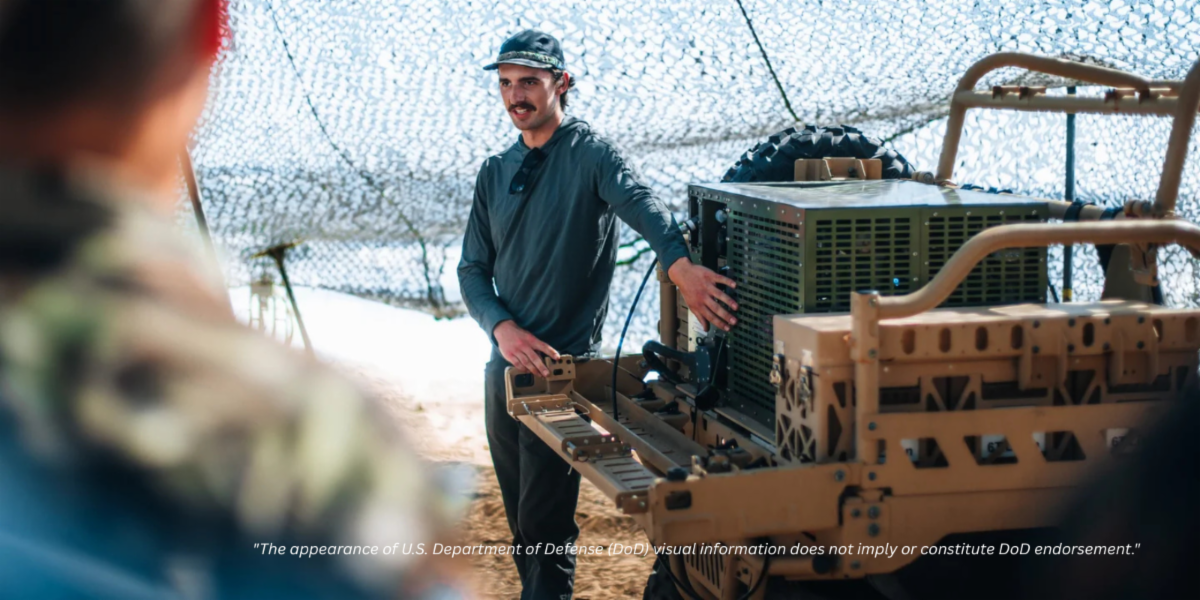
| IMAGE ABOVE: U.S. Marines in Hawaii demonstrate a SAWG-28 mounted on an MRZR for expeditionary operations. Read this article from Popular Science Magazine to learn more about this application: ARTICLE |
| Snowbird Atmospheric Water Generators (SAWGs) are designed to operate within defined environmental parameters to ensure optimal water production. The systems function most efficiently under the following ideal operating conditions:
- Ambient temperature range: 45°F to 125°F (7°C to 52°C)
- Relative humidity range: 30% to 99%
SAWGs are not designed for operation in subfreezing temperatures, and water generation becomes insufficient when relative humidity falls below 30%. The units are capable of operating in both indoor and outdoor environments, though outdoor deployment is preferred to maximize air intake volume and moisture content. For accurate performance evaluation and sustained output, the systems should be deployed in live operational environments and run continuously over a minimum duration of 24 hours. This ensures proper thermal cycling, humidity exchange, and stabilization of internal components for reliable atmospheric water extraction. |
Discover More About AWG Solutions |
| Visit our website for the latest information and photo gallery at www.snowbirdtech.com. Contact us to learn more or request a quote! |
|
|
| Terms and conditions • Privacy policy © 2025 Snowbird Technologies. All rights reserved. |
|
|
|
|