| Topics covered on this page:
- Proposals to raise the minimum age for social media use to 16
Proposals to raise the minimum age for social media use to 16 Last updated July 2026 Worries regarding the impact of social media on young people are well-founded and increasingly prevalent across the UK. Please be assured that there are concerns that I absolutely share, particularly when 90 per cent of girls and half of boys in the UK have been sent unsolicited explicit content on social media and messaging apps.
There is no option for inaction on this matter. The safety of our children must be a priority, to ensure this generation of children and those that follow are protected and not exposed to deeply inappropriate content for their age.
Earlier this year, I wrote to the Prime Minister to give my backing for such a campaign, and to offer my support as the local MP representing many concerned schools and parents. You can read my letter via this link.
Having watched and listened to work around this issue in recent months, I am particularly interested by the steps taken in Australia over social media for under 16s. Since December 2025, the Labour Government in Australia has enacted a world-first ban on social media for users under the age of 16, ultimately removing them from Facebook, Instagram, Threads, X, YouTube, Snapchat, Reddit, Kick, Twitch, and TikTok. For those platforms that do not comply, they are at risk of being fined up to $49.5 million. I will continue to monitor the progress of this ban and note any lessons from its implementation.
That said, I think it is important to note that this Labour Government has already taken significant action in protecting children online. That is why I was pleased to see the much-needed progression of the Online Safety Act, following substantial delays under previous Conservative Governments. This Labour Government is working hard alongside Ofcom to implement the Act’s various measures as soon as possible.
For example, since 25th July 2025, the Protection of Children codes have come into force. Since then, more than 6,000 sites have taken action to protect under-18s from harmful online content that they should never be seeing. This includes pornography, suicide, self-harm, violence and hate speech. Additionally, the codes demand that the most popular apps and sites protect children from seeing dangerous stunts or challenges, misogynistic, violent, hateful or abusive material, and online bullying.
It was also welcoming to see this Government introduce amendments to the Data (Use and Access) Bill that place requirements on services likely to be accessed by children, ensuring they are protected and supported when online. This legislation has now passed through both Houses and has received Royal Assent, becoming law.
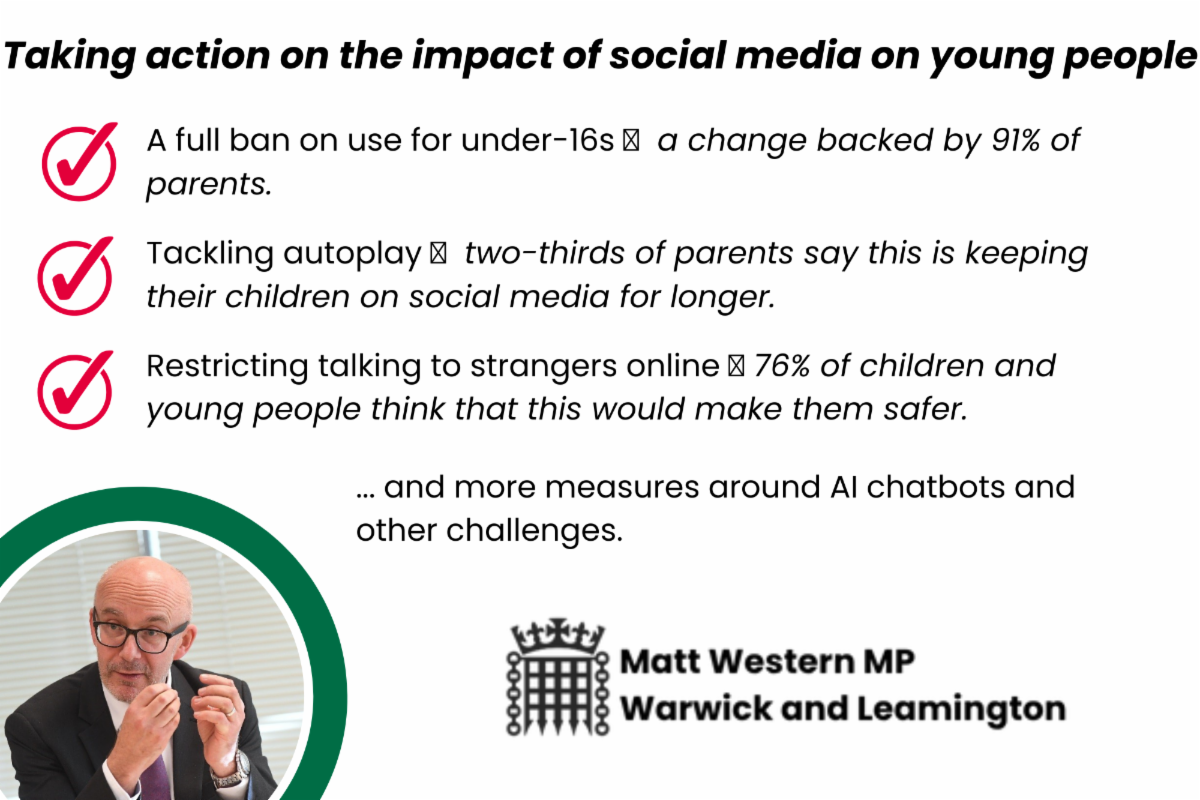
The Government has consulted on how best to address these risks, with the consultation receiving over 116,000 responses. I encouraged all readers of this newsletter to make their voice heard, and I am grateful to anyone who did so. Ministers then took these results away for analysis, and I am told that the results could hardly have been clearer, with nine out of ten parents who responded to the consultation saying they wanted an outright ban.
I have also stated previously that raising the minimum age for social media use to 16 should be just one of a holistic package of measures. On this too, I am pleased with the Government's response: Ministers also plan to restrict a wider range of features and functions that may pose risks to young people. They will ban livestreaming for under-16s, as well as communication with strangers. To avoid a cliff edge, these features will be switched off by default for those aged 16 and 17. Artificial intelligence chatbots were a key concern for parents, and the Government will act to ban those that offer sexualised content. I understand that further measures are also under consideration.
The Technology Secretary will present regulations before the Commons for a vote on a ban before the end of this year, with measures expected to take effect in early 2027. There is still more to do, but I believe this announcement represents landmark action that will help give children the freedom to be children again, so they can have the best possible start in life.
|