|
GROWIN’ UP
Ebling Road
DAVE: Where did you grow up, Carl?
CARL: I grew up in the Town of Tonawanda.
My family lived on Ebling Rd. - between Colvin and Eggert. Our neighborhood was across the street from Conway Field - now known as Kenney Field.
Conway was close enough that we could walk there to play. There were several baseball diamonds - so there'd often be a game going on. We’d also bring frisbees and footballs to toss around.
Conway had a large swing set and the Town of Tonawanda Recreation Department provided craft houses and day-camp activities in the summer as well. There was never a lack of things to do!
Some of your readers may recall that there was a military plane at Conway - near the corner of Colvin and Brighton. We'd climb on it and crawl around inside the cockpit. The plane is still there, but, access to the cockpit is now closed off.
It was a great place to hang out!
Kindergarten x 2
DAVE: Do you have a favorite memory of your childhood?
CARL: (Laughs) Yes.
I tell people that I failed kindergarten at St. Amelia’s. (Laughs) (Photo: St. Amelia School)
When I was four, St. Amelia’s needed a fourth-grade teacher for the upcoming school year. The pastor, Monsignor John McHugh, came to our house to convince my mother to take the job. She told him she would - but only if I could spend that year in the kindergarten class - not as a student – but to be babysat by the kindergarten teacher - Sister Angelica. (Laughs)
Eventually, Monsignor agreed to my mother’s “demands” (laughs). I spent the entire school year in kindergarten while my mom taught down the hall. The next school year, I returned to kindergarten – this time as a legitimate student! (Both laugh)
DAVE : Your mom was a tough negotiator! (Both laugh) THE TARANTINOS
DAVE: Tell us about your family, Carl.
CARL: There were five of us in our immediate family.
Along with my mom and dad, Amelia and Anthony Tarantino, there were three siblings: Ann Sharon, Charlotte and me.
Tarantino’s Market
My dad owned Tarantino’s Market, a produce store, located at 804 Niagara Falls Boulevard.
He took over the market in 1958 after co-managing it with his brother for a number of years. My grandfather, Angelo Tarantino, was the original owner.
Tarantino’s Market was a “mom and pop” operation and a family business. My dad ran a “tight ship.” All five of us; my parents, my sisters and I had responsibilities in the operation of the market. We were also assisted by my grandmother - “Gramma T” (Anna Bellanto Tarantino).
My father was very particular about what he would sell to his customers. He personally selected the produce from farmer’s markets and drove it back to sell at the store.
When I was in high school, on the weekends, I was expected to go with him to the farmer’s market on Clinton and Bailey and to the slaughterhouses on William Street to load up his open-cab Land Rover truck with everything and anything imaginable, from wooden crates of freshly slaughtered chickens, to baskets of fruits and vegetables, and various other commodities.
I enjoyed it when the Jeep was full because I got to ride in the back on the rear tailgate with my legs dangling. I clearly remember folks staring at me as I faced the cars behind us. (Both laugh)
While there were times that I wished I had less work responsibilities, I look back now and realize that I was learning life lessons and becoming more responsible. For example, I learned how to juggle what I needed to do with what I wanted to do. I made things work.
Off the Payroll
I can tell you that one thing I didn’t like was working for free. (Laughs)
Back then, according to New York State law, I couldn’t be on the payroll until I was 16. So, there were a few years when I worked for free while my sisters were on the payroll. I brought that up for discussion once in a while. (Laughs)
You may recall that back in the late 1960s, things were changing in the food market industry. That’s when “chain stores” like A&P and Super Duper were becoming more prevalent.
Seeing the "writing on the wall" my father and my uncle decided to close the market. They kept the property and rented out the store. My dad, my uncle, and my cousins joined forces to develop and replace A&P supermarkets with SuperDuper stores.
Later, dad worked at the Tarantino Wholesale Foods Warehouse that was once located on Clinton off of Bailey before they moved the warehouse around the corner to its present location near Clinton and Bailey. Today, you can see the warehouse from the I-190 when driving into Buffalo from the Southtowns.
CARDINAL O’HARA HIGH SCHOOL
Tight Schedule
DAVE: We've already talked a little about how working at Tarantino's Market in high school affected you…
CARL: My responsibilities at the store limited me somewhat when it came to participating in school activities. I had to be selective in the activities in which I chose t0 participate. Not only did I have to work a certain number of hours, but the time of day was sometimes unpredictable.
To make it work, I sought out school activities that I enjoyed but did not conflict with work. I couldn’t join everything I wanted - but I tried to check out as many things as I could. Musicals, Mixed Chorus and Clubs
DAVE: You liked to sing.
CARL: I enjoyed my four years in Mixed Chorus with Mr. Biscaro. He had a very strong personality! (Laughs)
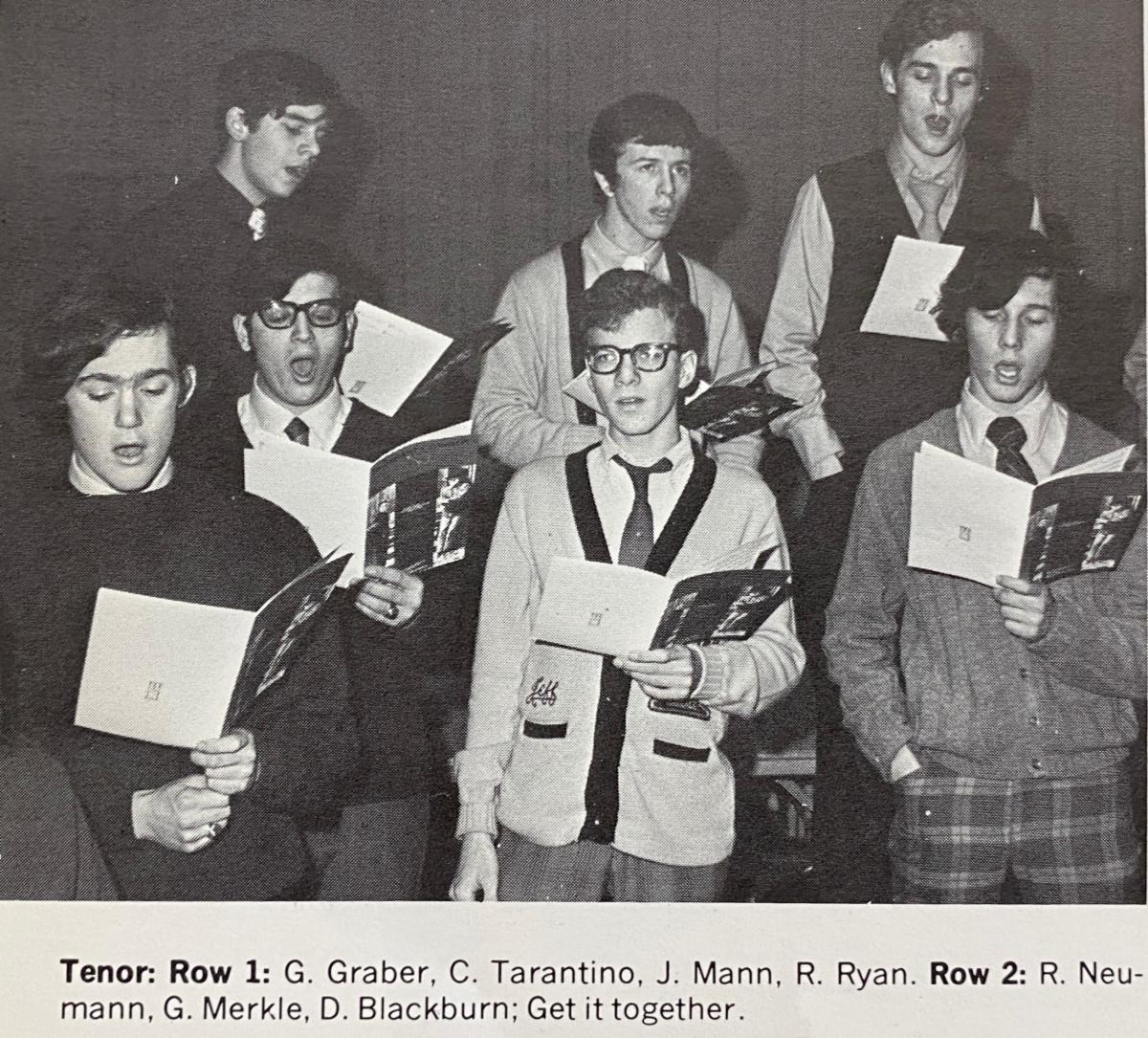
Some of my fondest and most memorable experiences at O'Hara were the ones in the school musicals. I remember that we perfomed Kiss Me Kate, On the Town and Oliver. I participated in the shows as a member of Mixed Chorus.(Photo: Carl, second from left)
I also helped out in the musicals in stage crew.
I belonged to a variety of clubs including the National Honor Society, Library Club, Math Club, Science Club and O’HaraScope – the school newspaper. I was often in one of those clubs for a year or two and then I'd try a different club the next year.
Third Order
I also joined The Third Order of St. Francis when I was a sophomore. I was a member for three years and President as a senior. Joining Third Order was one of the most impactful things I did at O’Hara.
Father Roman was the moderator for the three years I belonged. I got to know him well and we’d talk about all kinds of things.
The highlight of that experience was going to Santa Clara University, in California, with other members of Third Order for a week-long conference. It was an incredible experience - I really enjoyed it.
A Great Social Experience
Since I was in a variety of activities, I got to know a lot of people in my class. Meeting and getting to know my classmates was an important part of high school. I attended all the mixers - and all the proms, too. My experiences at O’Hara; academically, socially, and culturally were all very positive.
I count my experiences at O’Hara among my life's blessings.
FAVORITE TEACHERS
DAVE: Who were some of your favorite teachers?
CARL: I had some excellent teachers at O’Hara.
The ones that come to mind, and for different reasons, are: Father Charles, Father Placid and Father Roman.
Father Roman’s influence was more spiritual than academic. I learned a lot from him. At one point, I considered pursuing a vocation with the Franciscans. I even went to visit the Franciscan seminary at Granby, Massachusetts for discernment. And, as I mentioned earlier, it was Father Roman who took me and several other young men from COHS to Santa Clara University for a conference.
Although I never actually formally pursued the priesthood, I later became a lay person of the Third Order of St. Francis for several years. Father Roman influenced me to live the values of St. Francis. That is very special to me to this day.
Father Charles, who taught me Biology, was a down-to-earth person outside of the classroom. He, planted the seeds for me to eventually become a science major in college.
Father Placid also had a big influence. He was my Trigonometry teacher when I was a junior and I also had him for algebra. He worked very hard to help his students succeed, offering extra credit and spending extra time with you if you needed it.
As it turned out, in my future career as a Health Physicist, I relied heavily on my background in the disciplines of science and mathematics. I have Father Charles and Father Placid to thank for helping me become so well-prepared. O’HARA’S IMPACT
DAVE: How did O’Hara impact you?
CARL: O’Hara profoundly impacted me in several ways.
As I mentioned earlier, in high school, math and science were the academic courses that interested me. I was fortunate to have teachers like Father Charles and Father Placid who inspired me to follow my passions. Later, in my career as Health Physicist, the work I did centered on those two disciplines: science and math.
On the spiritual side, I have tried to live my life and value what is important by modeling St. Francis. Obviously, that was accentuated by my participation in Third Order. Third Order helped provide me with the clarity on how I look at life today.
ST. JOHN FISHER
DAVE: As you were contemplating your choice of college, did you have a particular career field in mind?
CARL: Not exactly - certainly not when I first started.
As a college freshman, I was a math major. I minored in science. The following year, I decided to pursue a Biology degree with Chemistry as a minor.
In college, I considered different career options. My mother and two sisters were teachers. I thought about becoming a science teacher but let that slide.
Later, I gave some thought to a job in pharmaceutical sales. I worked with the placement center at St. John Fisher to pursue that option. However, it was the mid-1970s when it was very difficult to find jobs.
In 1975, after getting my Biology degree, I worked in retail for two years, helping to manage a Super-Duper store and later, managing the shoe department at K-Mart. Essentially, I was biding my time, hoping to get a job in pharmaceuticals.
IN THE NAVY
DAVE: You’re in your 20s…
CARL: I was 24 with a college degree and had worked in retail for a couple of years after graduating, I was anxious to put my science degree to use.
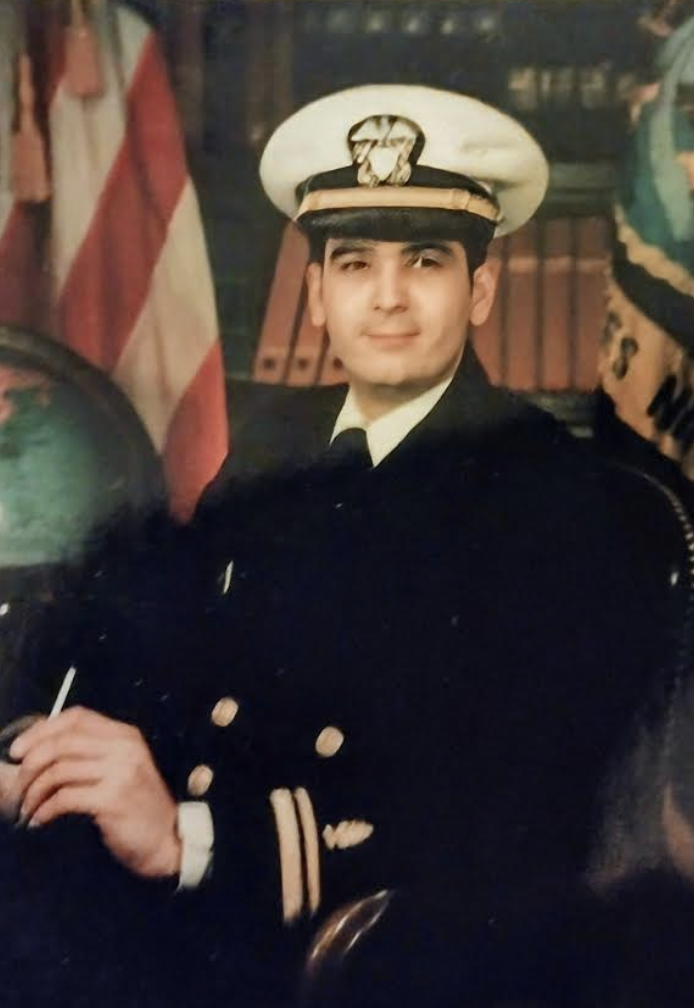
I began to consider a career in the military – specifically – the US Navy. My father served in the Navy – and so did my grandfather – although he was in the Italian Navy.
When I looked into it, I realized that I qualified for several positions in the Medical Service Corps where I could put my science degree to use in Aerospace Physiology, Industrial Hygiene or Radiation Heath.
Ultimately, I decided to apply to become a Radiation Health officer. However, it generally takes about ten months to get a commission and first the commission must be approved. So, while I waited to hear from the Navy, I continued to work in retail where I was becoming more and more disenchanted. In January 1977, I decided not to wait for the commission to come through and enlisted in the Navy. My first assignment was ten weeks of boot camp. After boot camp the Navy sent me to ten weeks of “A” School. In “A” school I was able to select my field and, because of my science background I chose Hospital Corpsman. In the meantime, my application for commission was working its way through the proper channels.
After eight weeks of “A” School, I was facing an assignment in Okinawa. Before that happened though, my Company Commander (CC) called me to his office. I figured I was in trouble! (Both laugh) As it turned out - I wasn’t in trouble at all! In fact, he told me I had received the commission for Medical Service Corps, and, that if I still wanted to, I could begin an assignment as a Radiation Health Officer, with the US Navy. He told me in front of my School “A” classmates. That was cool!
I had started in the Navy as an Ensign 3 then became Ensign O 1. I progressed to Lt. Junior Grade and then to Lt. Commander.
Radiation Health Officer
DAVE: What is the main job of a Radiation Health Officer?
CARL: In the field of radiation health there are different titles but the core work is very similar. Fore instance, in the Navy, my title was Radiation Health Officer. In the civilian world, my title was Health Physicist. There are some differences but the work I did in both was quite similar.
In a nutshell, a Radiation Health Officer, like a Health Physicist deals with the radiological protection of people and to manage the beneficial use of ionizing radiation while protecting workers in the public from potential hazards.
A Health Physicist is concerned with both the “health” and “physics” side of radiation. On the “health” side, you are looking at the health and safety of individuals and their exposure to radiation. How does it impact them - and how do you safeguard against exposure.
On the “physics” side, you monitor the nuclear reactor itself and how it is using the fission of uranium atoms and the physical reactions that occur with the uranium atoms to produce power in a reactor.
Health Physics is an overarching term that covers many different roles in nuclear science. The military is not the only place where you will find people who deal with radiation science. You’ll find people in nuclear power, government, and medical fields doing similar work.
DAVE: How many years did you “owe” the Navy?
CARL: It was a three-year active-duty commitment to Medical Service Corps.
Travelin’ Man
DAVE: Where was your home base?
My home base was in Norfolk, VA but I moved around from Bethesda, Maryland to Groton, Connecticut to Balston Spa, NY and Cincinnati, Ohio for training.
After training, I was assigned to a ship - the U.S.S Puget Sound. As a Radiation Health Officer, you are generally assigned to where there is a nuclear reactor on board. . After that assignment I was given a different one with the Navy Environmental Health Command in Norfolk. By that time, I was a Lt. Junior Grade working for a captain.
I was part of an Occupational Health Team that included an Occupational Health Nurse, an Industrial Hygienist, an Occupational Physician and myself – a Radiation Health Officer.
That team would go to the different preventative medicine units and Navy installations both land-based and ship-based to do inspections that were required by the Navy. We had to make sure that things were up to code and that all regulations were being followed. There were a multitude of procedures we had to check on.
It was up to us to find the things that needed to be rectified before the auditors came in. We’d go to sites such as naval hospitals and ships.
It was a high-intensity travel job. I was single at the time and traveled quite a bit throughout Europe. I was in Spain, Italy, Lisbon, Portugal, and South Wales doing inspections for pretty much the rest of my first tour of duty.
THE UNIVERSITY OF FLORIDA
DAVE: What was the next step?
CARL: I decided to continue my career in the Navy with an eye on furthering my knowledge of Radiation Health.
I put in for out-service training in Health Physics at the University of Florida (UF). Out-service training refers to professional development conducted outside the Navy’s own offerings.
I was accepted at the University in their program that led to a Master of Science Degree in Health Physics from the Department of Environmental Engineering at UF.
I had gotten the “green light” from the Navy that the next two years would be called out-service training and would constitute my next tour of duty. That was the plan.
At the 11th hour I was told by my detailer that they would not be able to send me to the University of Florida. I was told that it would be another three years before they would consider it.
It was disappointing because I was excited about getting back in an educational setting and pursuing my M.S. degree at the University of Florida. I explored my options.
In the end, I decided to come off active duty and become an active reservist and have that time still count for military time.
I graduated from the University of Florida in 1981 with an M.S. in Health Physics. SNAFU DAVE: Sounds like you are on your way!
CARL: Armed with my degree, I was anxious to pursue a full-time job as a Health Physicist somewhere where I could also continue in a Naval Reservist role.
I left Florida and headed back to Norfolk where I applied for a civilian position at Virginia Electric and Power Company (VEPCO). As I mentioned, my planned was to continue my naval career as a Reservist. To assure certain benefits, I sought a pay billet from the Navy.
A pay billet is a reservist assignment that guarantees military salary according to rank (for me Military Service Corp. (MSG) Lt. Junior Guard and Lt. Commander). With a pay billet, retirement credits are earned.
Unfortunately, after a year of trying, the pay billet never materialized. I ended up resigning my commission - effectively ending my career with the Navy.
I had intended to make the Navy my career so it was a disappointing outcome. I would have loved to have had a 20-year career in the military. However, I have never regretted leaving.
CIVILIAN CAREER
VIRGINIA ELECTRIC AND POWER COMPANY (VEPCO) 1982 – 1984 and 1985 – 2016
DAVE: You had a long career and held a variety of positions at VEPCO!
CARL: VEPCO, the Virginia Electric and Power Company, changed names over the years a few times. Today it is known as Dominion but I’m fine if we just refer to it as VEPCO. (Laughs)
It is a regulated public utility that generates and distributes electricity in Virginia and North Carolina to about 3 million people.
When I joined the company, my title was Health Physicist.
My focus a VEPCO was the same as my focus in the Navy - keep people as safe from radiation. That was my focus at every point in my career at VEPCO too.
Nuclear Plants
CARL: When I started, VEPCO had two nuclear power stations in the Virgina including the one at North Anna Power Station. I started my career there, at the facility in North Anna.
VEPCO supported a number of other nuclear power plants as well.
We were responsible for the radiological protection of the people that worked at all the nuclear plants they ran including two in Long Island and one in Green Bay. My job was to make sure all the nuclear regulations that were set up by the Nuclear Regulation Commission (NRC) were being followed. We made sure the workers were protected and monitored appropriately.
A big part of my job was to make sure that federal and state regulations were adhered to. Another of my major roles was to advise corporate executives on what we needed to do to maintain high standards of safety within our plants.
I never sought to become part of the corporate structure of the company. I stayed on the technical side of things. That was my own choosing. PROJECTS
DAVE: You oversaw many projects at VEPCO.
CARL: There were a number of projects that I led. Some were bigger than others.
DAVE: Please highlight a few.
CARL: Sure. I’ll try not to get too technical. Health Physicists are known for unnecessarily confusing people! (Both laugh)
Rule 10CFR20
CARL: Of all the projects I led, the biggest one sprung out of a change made by the Nuclear Regulatory Commission (NRC) having to do with Rule 10CFR20 - a piece of federal legislation. The 10CFR20 contained mandates from the Nuclear Regulatory Commission (NRC). They weren’t to be taken lightly.
The rule change contained a major revision. I was the one who implemented the new rule in all nuclear programs across our fleet. It was a five-year project and the biggest and most intense job I had in my career. It took five years, from the late 90s to the early 200os to implement the changes.
MSRB Management Safety Review Board
CARL: Another important role I had was serving on VEPCO’s Management Safety Review Board. The MSRB meetings involved the highest executive levels of the company. The meetings were quarterly and looked at all aspects of safety, from A to Z, at their nuclear plants. I played an integral role in pulling all the technical “stuff” together for the Board’s review.
Meetings With Other Utilities
CARL: Another of my big responsibilities was to represent VEPCO at regional meetings with other utilities where we’d “benchmark” to see how we stacked up against one another.
The goal was for the utilities to learn from one another and determine “best practice.” After those meetings, I reported back directly to the CEO.
PERSONAL ACHIEVEMENTS
DAVE: Sounds like you were a “big shot” there, Carl!
You also told me earlier that you had some personal achievements that were quite meaningful to you.
MBA
CARL: Well for one thing, in 2004, I got an MBA at Averett University in Danville, Virginia.
Black Belt Six Sigma Certification
CARL: I also completed a Black Belt Six Sigma certification program.
The Black Belt Six Sigma program has nothing to do with martial arts! Rather, it is a corporate award.
Becoming certified as a Black Belt Six Sigma is a rigorous professional certification process indicating advanced mastery of process improvement, statistics, and project management.
It validates one’s expertise in quality management and process improvement. It signifies that the recipient has expertise to lead high impact complex organizational projects, reduce deficits, eliminate waste and increase efficiency.
Certification in Health Physics
CARL: In 2000, I started working towards obtaining my Certification in Health Physics (CHP) from the American Board of Health Physics. This certification acknowledges the recipient as an expert in the field.
DAVE: Wait a minute, Carl! I thought you already were a Health Physicist? (Both laugh)
CARL: I was a Health Physicist by job title only - not certification.
Becoming a Certified Health Physicist takes it to another level.
In 2002, after a two-year process, I was awarded certification in Health Physics by the American Board of Health Physics. The certification has to be renewed every four years.
Becoming certified allowed me to practice anywhere - from nuclear power plants to hospitals, industrial settings, and academia.
DAVE: You retired from VEPCO in 2016.
CARL: They offered a retirement package and I accepted.
HEALTH PHYSICS CONSULTANT
DAVE: So, you’re now retired! Your time is yours to do what you want!
CARL: (Laughs) Not exactly!
After stepping away from VEPCO, I started my own Health Physics consultant business.
Along with consulting, I taught at Virginia Commonwealth University where I developed two full-credit, graduate level radiation health courses. I taught both courses for two years.
In 2019, a professional colleague asked if I’d be interested in working for him as a consultant doing inspections of medical and dental x-ray equipment in Virginia and North Carolina. That’s what I am currently doing. It’s worked out really well and it has made it easier for me to maintain my certification.
Soon, my current HP certification will expire. I’m not sure if I will seek to extend it. It may be time to end that chapter of my life. COHS CAREER DAY
DAVE: You’ve made several long trips back to Tonawanda from Virginia to speak at Cardinal O’Hara Career Day.
CARL: Yes. I’ve enjoyed coming back and talking to the students about a career in radiation health. I’ve also spoken at John Fisher on the same subject.
It’s my aim to plant a seed in the minds of students who are looking at careers in science or math, or both, to let them know that there are non-traditional fields in both disciplines that they may want to explore.
IT’S PERSONAL!
DAVE: Do you have any children?
CARL: I have three children; two sons and a daughter.
My oldest son, Brian, is 42. He and his wife had four children. Sadly, their first child, Nathan Scott, had an inoperable brain tumor and passed in 2021. Their son Owen, is now 15, another son, Christian is 8, and their daughter, Emerson Grace is 5.
My daughter, Catherine Amelia, and her partner have a daughter, Cecilia Rose who turned four in April.
My youngest, Peter, lives in Alabama and is looking to buy a house. He has a girlfriend from a wonderful family - so we’ll see what happens there. In meantime I’m helping Peter with this house hunting. (Laughs)
“Extended Family”
CARL: Even though I have no blood relatives nearby, I maintain that I have an extended family here in North Chesterfield, Virginia.
I used to belong to an adult chapter of the Third Order for a couple of years. Currently, I am in the Knights of Columbus.
Bells and Bows
CARL: I still love music!
I took piano lessons as a child and really enjoyed playing. There was a long stretch when I didn’t play,
Now, in my later years (laughs), I’ve gotten back to playing again - more as a hobby.
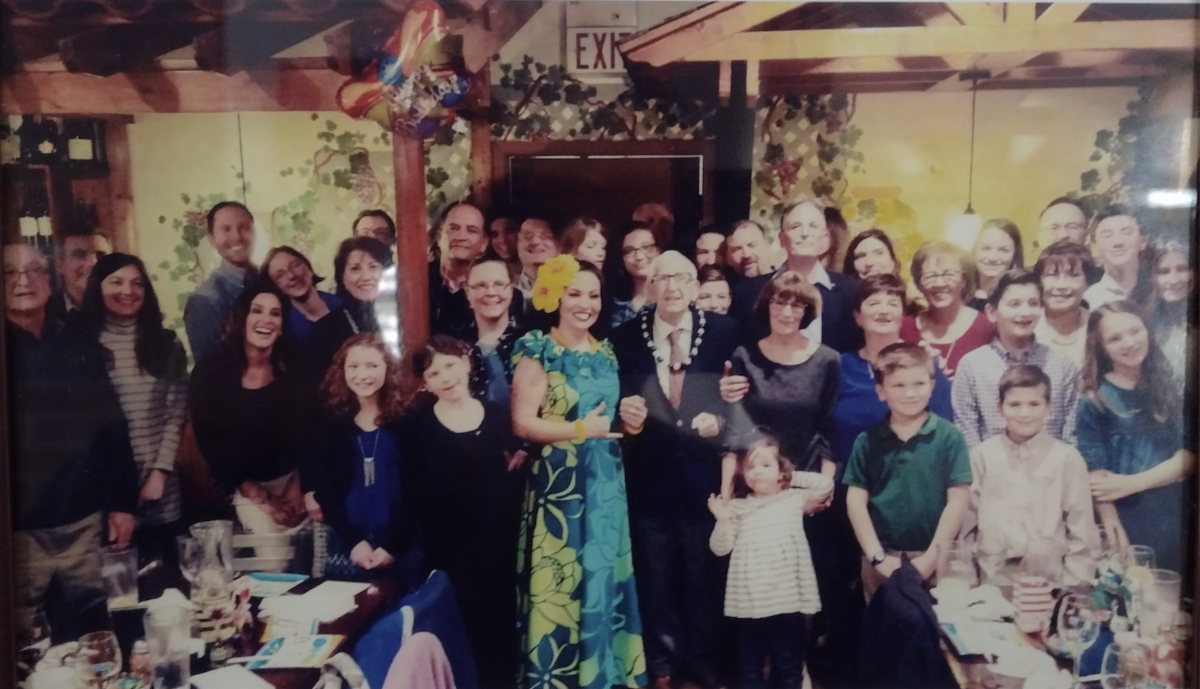
I belong to a small group of fellow musicians and we go out to assisted living residences once a month and play for the folks. Mostly we play secular music but there’s some spiritual music as well. A FAMILY TRIBUTE
CARL: One thing that I haven’t mentioned yet is that my dad moved down here at the age of 95 to live with me. Once a week we’d go out golfing together. He took up golf at the age of 73!
Dad passed at 98.
One of my goals is to write a book about my family. In my mind’s eye it would be a series of vignettes... and would serve as a kind of tribute to my father… but, really, more like a tribute to my entire family.
That’s one of those projects I can start when I fully retire and step down from consulting!
55 YEAR REUNION
CARL: I’m very excited about reconnecting with my ’71 classmates. It’s been fun working on the Reunion Committee. I know that everyone that attends our reunion weekend in July is going to have a great time together.
I don’t think of reunions as time when I merely re-live the past. I look at them as a way to give back for all the things O’Hara did for me.
In fact, I often think that if I were still living in Buffalo I’d be working at O’Hara.
DAVE: I have an idea! You can be the Alumni Relations Coordinator!
by Dave Lovering '74
|