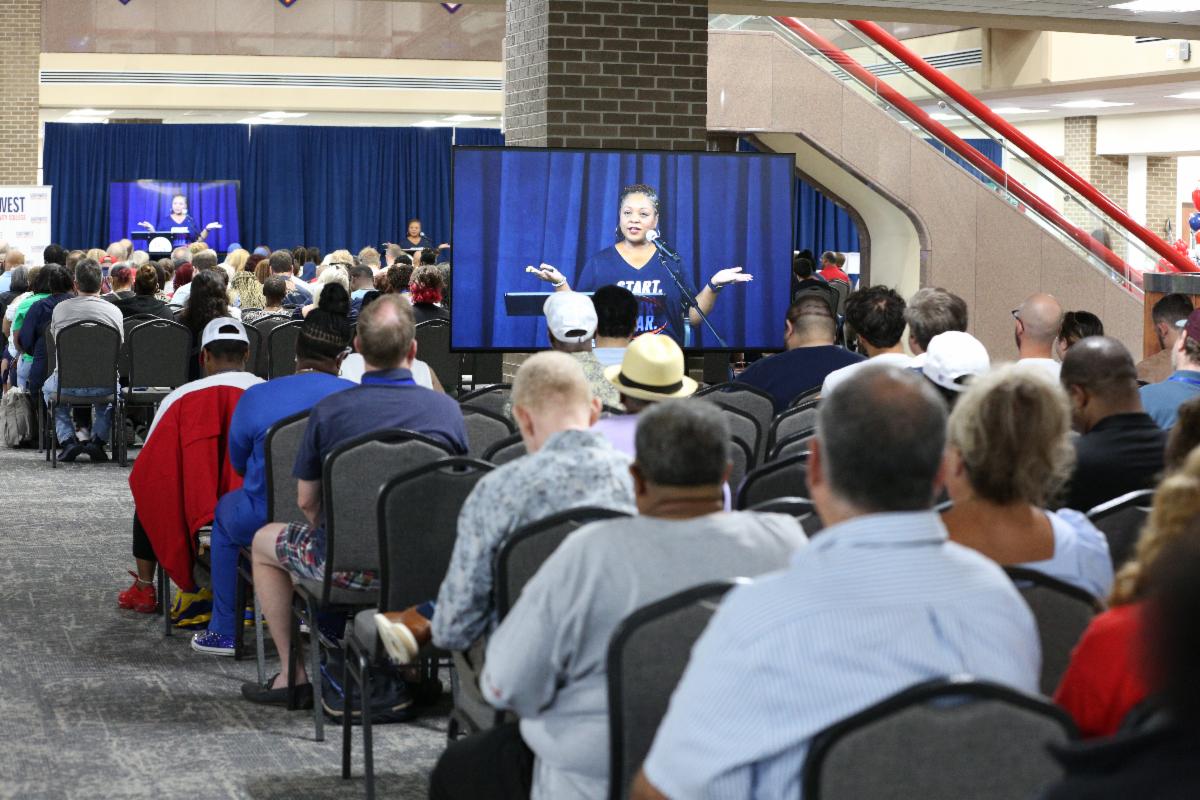
| Southwest began its 2026-27 academic year Aug. 17 with its Faculty and Staff Convocation at the Union Avenue Campus, placing the college’s Reform 3.0 initiative at the center of a call to rethink how Southwest serves students, uses its resources, and measures success. President Tracy Hall told faculty and staff that the initiative is about more than a new strategic plan. Reform 3.0 is intended to reshape the student experience around a broader definition of success — one that extends beyond enrollment, retention, and graduation to the trajectory of students’ lives after they leave the college.
“Today’s success is defined entirely by the trajectory of their lives,” Hall said.
That definition reflects a changing national conversation about the value of higher education. Hall said colleges are increasingly being asked to demonstrate their return on investment and to explain why students should attend college when some can move directly from high school into well-paying jobs.
For Southwest, answering that question means examining how the college uses the state-invested resources and whether its programs prepare students for the next stage of their lives. Reform 3.0 continues what Hall described as a “big audacious journey” to redesign, reinvent and reset the student experience.
At the heart of that effort is Pathways to Prosperity, Southwest’s strategic plan, which establishes two major pathways: strengthening workforce programs and increasing bachelor’s degree attainment.
The first pathway calls for the college to be more intentional about the programs it offers and their connection to workforce demand. Faculty and staff are being asked to consider difficult questions, such as: Are students graduating from a particular program? Is there still demand for its graduates? Is the program preparing students for existing jobs?
Hall emphasized that Southwest cannot prepare students for opportunities that have disappeared.
“If we are preparing them for jobs that no longer exist, then we are not doing the work that they are doing,” she said, referring to the college’s business and industry partners.
Reform 3.0 also calls for stronger relationships with employers and career advisory boards so those partners can help inform the college’s academic and workforce offerings.
The second pathway focuses on increasing bachelor’s degree attainment by improving the experience of students who transfer to four-year universities.
Hall said Southwest must make sure transfer students are prepared to begin university as juniors, rather than simply completing courses that satisfy transfer requirements. That means deeper engagement with university partners and a clearer understanding of the academic expectations students will encounter after leaving Southwest.
“We have to think differently about how we do our work,” Hall said.
That emphasis on preparation also extends to classroom expectations. Hall urged faculty to maintain high academic standards while recognizing the barriers students face.
She cautioned that a desire to help students can sometimes unintentionally prevent them from developing the skills they will need later. “Sometimes help is just that. Help sometimes is enabling,” Hall said.
Rather than lowering expectations, Reform 3.0 calls for high expectations paired with the supports students need to meet them. Hall said that a student who submits poorly written work, for example, needs feedback and an opportunity to improve, because the consequences of inadequate preparation will follow that student into university or the workplace.
The larger goal is economic mobility and prosperity.
“We’re talking about not just getting a degree,” Hall said. “We’re talking about how you contribute to this global economy. How do you contribute to being an educated citizen?”
That broader definition of education is reflected in Reform 3.0’s emphasis on helping students become successful workers, employers, and citizens. Hall said Southwest’s responsibility extends to preparing students to evaluate information, participate in civic life, and understand the world around them.
To turn those priorities into a daily operating model, Southwest is adopting “Start, Stride, Soar.”
The three-part model follows students across their journey at the college. “Start” focuses on helping students successfully connect with Southwest and ensuring a smooth entry into college. “Stride” represents progress and persistence, emphasizing keeping students engaged after they arrive. “Soar” represents completion and prosperity — what happens when students leave Southwest and move into the workforce or continue their education.
The model also incorporates wraparound support services, including academic support, coaching, financial aid, and health and wellness services. Those supports are intended to operate across all three stages rather than function as isolated services.
Reform 3.0 also seeks to change how employees work with one another.
Hall described student affairs, academic affairs, and workforce development as areas that historically have operated as separate pillars. The initiative calls for greater integration across areas, with employees developing stronger relationships across departments.
That cultural change, Hall said, is essential because the student does not experience Southwest as a collection of departments.
“When we think collectively, and we don’t think in terms of it’s my department. We think in terms of, we are all doing the same thing to help our students be successful,” Hall said. “It’s not about my territory. It’s not about my, my, my. It’s about us.”
That philosophy is at the center of Reform 3.0’s shared responsibility model. Hall challenged employees to stop passing students from one department to another and blaming other areas when problems arise.
“Students don’t experience organizational charts,” Hall said. “They don’t care about titles. … They want help when they need help. They want to graduate. They want to be successful.”
The change also means giving employees permission to question established practices and develop new approaches. Hall told faculty and staff that innovation is expected regardless of position or tenure at the college. Institutional knowledge matters, she said, but so do fresh perspectives.
“Everyone matters here,” Hall said.
The strategic plan, however, is only the beginning. Hall repeatedly emphasized that Reform 3.0 will succeed or fail through the daily actions of faculty and staff.
“The daily reality is the individual leadership that we will provide in executing on this plan,” she said. “We are the ones who will bring this plan to life.”
Hall asked employees to apply what she called a “daily impact study” to their interactions with students. Are they removing a systemic or financial barrier? Are they building collaboration across departments? Are they helping a student confidently start, persistently strive or successfully soar? Are their decisions contributing to a student’s long-term economic mobility?
She challenged employees to question assumptions, take calculated risks and engage in difficult conversations when necessary.
“Students may never read our strategic plan,” Hall said. “But every day they will experience it through our leadership, through our decisions, and through our actions.”
That, ultimately, is the measure Reform 3.0 places before Southwest as the new school year begins: not simply whether the college has a plan, but whether students experience its priorities in every interaction.
“Together we are writing Southwest’s next chapter,” Hall said, “one student, one opportunity, and one success story at a time.”
|