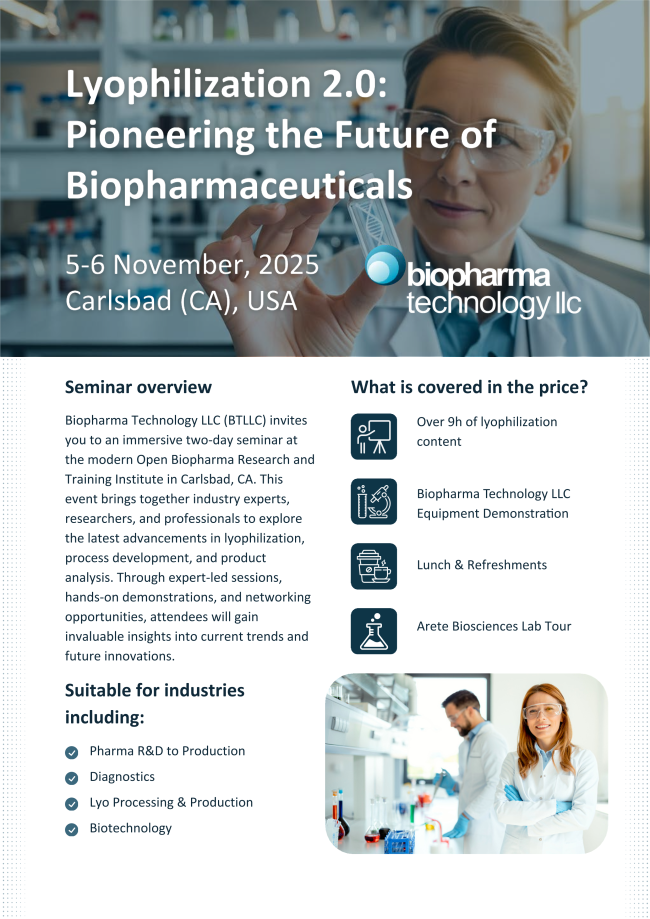
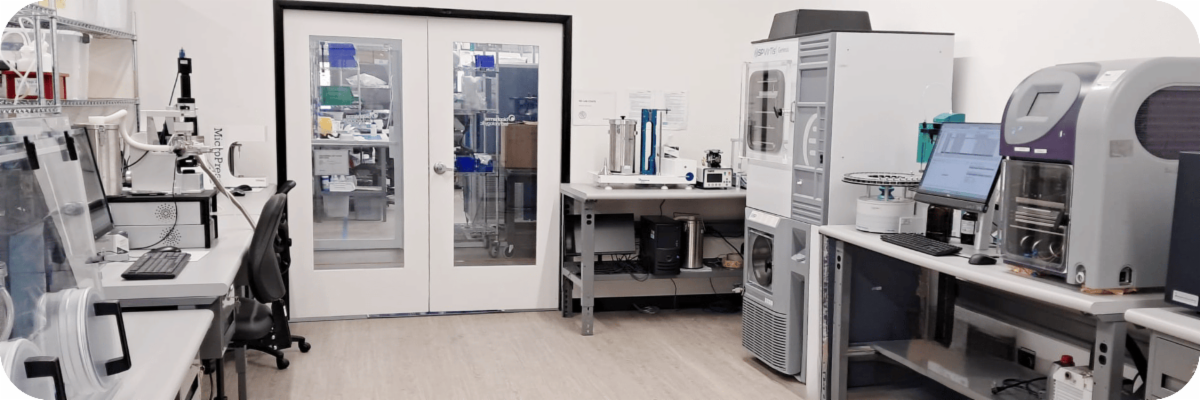
Biopharma Technology LLC (BTLLC) invites you to an immersive two-day seminar at the modern Open Biopharma Research and Training Institute in Carlsbad, CA. |
This event brings together industry experts, researchers, and professionals to explore the latest advancements in lyophilization, process development, and product analysis. |
Through expert-led sessions, hands-on demonstrations, and networking opportunities, attendees will gain invaluable insights into current trends and future innovations. |
|
|
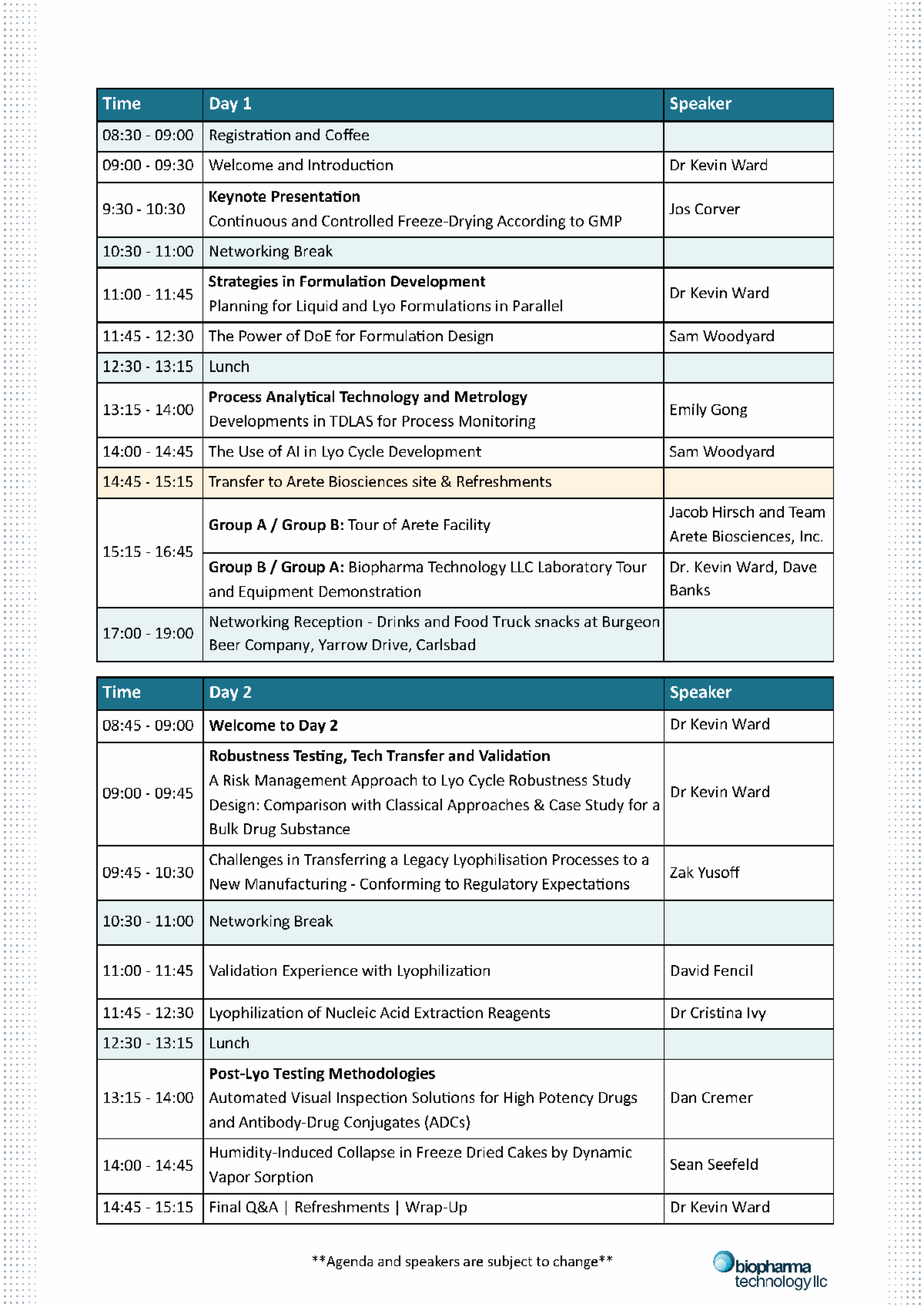
| Throughout the seminar you will have a chance to hear from 9 professionals in the lyophilisation industry covering the variety of current trends, a total of 11h freeze drying content, including Practical Demonstrations and Q&A sessions. You will also meet Biopharma Technology LLC representatives - Kari Roberts and Dave Banks, who will be hosting the event and can answer questions regarding our product and services.
Additionally, we provide: |
|
BTLLC Equipment Demonstration |
|
BTLLC and Arete Biosciences Lab Tours |
|
|
Get a $250 credit towards lab services |
Registrants for the Carlsbad seminar will receive a $250 credit toward any Biopharma Technology LLC lab service, valid for six months from the seminar start date of 5th November 2025. |
|
|
Topics Covered & Presentation's Abstracts |
|
1. Planning for Liquid and Lyo Formulations in Parallel & A Risk Management Approach to Lyo Cycle Robustness Study Design by Kevin Ward |
|
|
| Planning for Liquid and Lyo Formulations in Parallel: The primary use of lyophilization is to stabilize products that do not exhibit sufficient shelf stability in the liquid state. However, this is not always limited to the final product itself. For example, it may be employed strategically to provide material for pre-clinical and early clinical studies for an investigative medicinal product, while work continues in parallel on the longer term goal of developing a stable liquid formulation. This presentation will explore the reasons, concepts and practicalities of developing liquids and lyo formats in parallel. |
|
|
| A Risk Management Approach to Lyo Cycle Robustness Study Design: Historically, the demonstration of robustness for a lyo cycle was never demanded as part of the drug filing paperwork for a (bio)pharmaceutical product. However, it is now expected that some robustness of the process is evidenced as part of the supporting documentation, although there is no harmonized guidance on how this might be approached. This presentation will explore and contrast two classical approaches – the iterative approach and the ‘Quality by Design’ (QbD) approach – and will introduce a ‘hybrid’ approach that incorporates a formal risk management element into the iterative approach, which may represent a workable solution with enhanced data output. |
|
|
2. The use of AI and Machine Learning Algorithms in Lyophilisation & The Power of DoE for Formulation Design by Sam Woodyard |
|
|
| The use of AI and Machine Learning Algorithms in Lyophilisation: Current AI and Machine Learning models such as ChatGPT, Co-pilot and DeepSeek are revolutionising how we approach problem solving, not just in the pharmaceutical, biotech and diagnostic industries, but across every sector in the world. In lyophilization, there is a clear benefit to their use in formulation design and cycle development. However, as advantageous as these systems are, there are definitive shortcomings that can lead to inaccuracies in cycle design and even batch failure. In this presentation, we will explore the contrast between these off-the-shelf systems and how Biopharma Group is leveraging 25 years of expertise and real-life datasets to design a customized Machine Learning platform specifically targeted towards the development of lyophilized products. |
|
|
| The power of Design of Experiments for Formulation Design: Formulation design in lyophilization is a key factor in producing a stable product with a long shelf-life and good activity in the liquid state post-reconstitution. The traditional one-factor-at-a-time approach to formulation design can deliver a workable formulation, but may not yield the most optimum design. Design of Experiments (DoE) software applies statistical/factorial experimental methods to calculate the quickest and most effective route to identifying the optimum formulation for a lyophilized product by enabling the identification of critical factors, interactions, and optimal conditions that drive product stability and performance. This presentation will explore the benefits of the typical DoE approach and what is required to identify the ‘optimum freeze-drying formulation. |
|
|
3. Continuous and Controlled Freeze Drying According GMP by Jos Corver |
|
|
After showing the background of the RheaVita technology, we are going to present results from the GMP-ready prototype including process data. This will demonstrate the power of process control at the individual vial level. Next we will give an outlook towards the embedding of the technology into an industrial manufacturing environment, including the integration with grade A environment pre and post freeze drying. |
|
|
4. Process Analytical Technology and Metrology: Developments in TDLAS for Process Development and Control by Emily Gong |
|
|
This work presents the development of a Process Analytical Technology (PAT) enabled freeze-dryer that automatically designs and controls lyophilization cycles using real-time sensor data and predictive modeling. The system integrates tools such as Tunable Diode Laser Absorption Spectroscopy (TDLAS), manometric temperature measurement, thermocouples, and pressure gauges to continuously adjust drying conditions based on the warmest vial temperature, addressing both intra- and inter-batch variability. Tested with sucrose and proprietary drug formulations at both lab and pilot scale, the algorithm successfully maintained product temperatures below critical limits with minimal safety margins, adapted to anomalies like pressure loss and vial overfilling, and automatically determined drying endpoints. Scale-up was achieved by incorporating vial heat transfer data and resistance models, enabling accurate prediction and control of product temperature throughout the process. This approach supports rapid process development, robust control, and efficient scale-up in freeze-drying of biopharmaceuticals. |
|
|
5. Validation Experience with Lyophilization by David Fencil |
|
|
In developing a new product or a modified product, one must convince themselves and the regulatory bodies that the processes used to produce said product consistently and reproducibly yield product that conform to specifications. This session will discuss experience with validating mixing and freeze-drying of this product. This enzyme product is used as one step in disaggregating skin cells from a small skin sample for reapplication to a prepared burn wound, and must be reliable every time. To ensure this, the mixing, filling, and lyophilization processes were validated. We will briefly discuss the basics of validation (IQ, OQ, PQ) then take a deeper dive into how we approached this process. After this session the participants should know how to approach validation of lyophilization, how this was performed in one case, and begin thinking toward how they might do the same, as necessary. |
|
|
6. Automated Visual Inspection Solutions for High Potency Drugs and Antibody-Drug Conjugates (ADCs)
by Dan Cremer |
|
|
| The growing adoption of highly potent drugs and antibody-drug conjugates (ADCs) presents unique challenges for pharmaceutical manufacturing, particularly in inspection and quality assurance. ADCs are designed with powerful cytotoxic payloads, making operator safety and containment critical considerations. Traditional manual and semi-automated inspection methods expose staff to unnecessary risk, create ergonomic burdens, and struggle to maintain consistent quality at scale.
This presentation examines evolving industry trends in ADC production, including Occupational Exposure Limit (OEL) and Occupancy Exposure Band (OEB) requirements, batch size considerations, and the limitations of legacy inspection approaches. It then introduces the ATS PharmaScan HiPo automated visual inspection platform, developed to meet the stringent demands of high-potency drug handling. Key features include robotic vial singulation, non-glass-to-glass handling to minimize breakage, automated reject segregation, and ATS SmartVision technology for high-speed, single-pass defect detection. Integrated isolator containment further reduces operator exposure while maintaining throughput and regulatory compliance.
By combining advanced automation with validated high-potency handling, the PharmaScan HiPo enables manufacturers to improve safety, efficiency, and product quality. The session highlights how automation redefines inspection for ADCs—delivering a safer, more cost-effective, and future-ready solution for high-value biopharmaceuticals. |
|
|
7. Challenges in Transferring a Legacy Lyophilisation Processes to a New Manufacturing - Conforming to Regulatory Expectations by Zak Yusoff |
|
|
Transferring legacy products comes with its unique challenges. This presentation will explore some aspects of transfer that should be considered prior to, during and after the transfer process to ensure a successful and compliant transfer of your product to a new manufacturing line. Consideration to processes, equipment, facility, and capability which will have some impacts to the transfer will be explored. We will discuss a few transfer scenarios and case studies to demonstrate the regulatory expectations. |
|
|
8. Lyophilization of Nucleic Acid Extraction Reagents by Cristina Ivy |
|
|
Lyophilization plays a critical role in Grifols’ operational and product development strategies, offering multiple advantages that enhance efficiency and reliability across workflows. This freeze-drying technique ensures room temperature stability of nucleic acid extraction reagents which is important in significantly extending shelf life and simplifying storage requirements. By streamlining preparation steps, lyophilization also reduces time to result, accelerating diagnostic and analytical processes. Furthermore, it minimizes instrument consumable waste, contributing to more sustainable laboratory practices. The flexibility it introduces into nucleic acid extraction workflows allows for greater adaptability in diverse testing environments, reinforcing Grifols’ commitment to innovation and operational excellence. |
|
|
9. Humidity-Induced Collapse in Freeze Dried Cakes by Dynamic Vapor Sorption by Sean Seefeld |
|
|
As the number of freeze-dried therapeutics increase, the role of water on the long-term stability, activity, structure, and drug-carrier interactions becomes increasingly critical to the successful development of biopharmaceuticals. For instance, water may have a range of effects on proteins including: hydrolysis, oxidation, deamidation, and folding. Each of these interactions affect the bioactivity and stability of the formulation. In particular to freeze-dried formulations, changes in moisture content may cause a glass transition and/or crystallization event of the formulation resulting in a loss of stability. This presentation will overview Dynamic Vapor Sorption (DVS) as a technique to study moisture sorption behavior on freeze-dried materials and provide multiple case-studies. |
|
|
Biopharma Group Speakers: |
|
|
|
|
Dr Kevin Ward |Director of R&D |
Kevin Ward began his career in freeze-drying in 1993 with a PhD on protein and liposome stabilisation. After working in the pharmaceutical industry and in vaccine development, he joined Biopharma, where over the past 25 years, he has built up a team of dedicated lyophilisation scientists have worked on over 3000 projects for more than 600 client companies worldwide, developed 4 lyo-related instruments, run more than 200 training courses and been part of 18 national and international research projects. Dr Ward has appeared on BBC television for his team’s work on red blood cell preservation, was industrial supervisor to two doctoral students, and has authored numerous papers, book chapters and patents in the field of freeze-drying. In 2019, he co-edited a text book on lyophilization technology and approaches with Dr Paul Matejtschuk of the MHRA. |
|
|
|
Sam Woodyard | Research Scientist |
Sam Woodyard joined Biopharma Group in 2020 as a Research Assistant after earning a degree in Biological Sciences from Reading University, where he specialised in molecular biology and biochemistry. He further honed his skills with a research project in the cardiovascular lab, focusing on protein expression in murine red blood cells. Since progressing to Research Scientist in 2022, Sam has been instrumental in managing projects, cycle recipe development, developing freeze-drying formulations, and performing pre- and post-lyophilization analyses. |
|
|
|
Emily Gong | Principal Scientist at Physical Sciences |
Emily Gong received a B.S. in Chemical and Biomolecular Engineering from the Georgia Institute of Technology and an M.S. in Chemical Engineering from Northeastern University. She joined Physical Sciences, Inc. (PSI) in 2017 and is currently a Principal Scientist in the Applied Optics group. At PSI, she is the lead engineer performing installations of the LyoFlux™ Tunable Diode Laser Absorption Spectroscopy (TDLAS) based water vapor mass flow rate sensor and providing training to industry end users. She has worked on multiple freeze-drying related research programs including developing software-based application tools utilizing LyoFlux sensor data for lyophilization process development and control as well as developing novel TDLAS-based sensors for freeze drying process monitoring. She has also lead programs to develop freeze-drying formulations and processes for drug products including proteins, lipid nanoparticles (LNPs) and bacteriophages. |
|
|
|
Jos Corver | Co-funder & CTO at RheaVita |
Jos Corver's technical background started in Aero- and Hydrodynamics with a special emphasis on rheology. During his 45-years of R&D activities he developed technological solution in various business environments such as printing & copying, semiconductor industry, automotive industry, food processing. The recent 25 years have been devoted to primary packaging in pharmaceutical industry and more specifically to freeze drying. His list of patents and publications range from printing technology, optics, NMR, plasma-physics and freeze-drying. Bridging and merging technology fields is the key source of his innovative accomplishment. Since 2011 he started developing the continuous freeze drying process. In 2018 he co-founded RheaVita to further develop and market this technology. Together with Prof. Dr. Thomas De Beer he leads RheaVita as CTO. |
|
|
|
David Fencil | Fencil Consulting |
Dave recently retired after a 40 year career in medical device development and operations, working with devices as diverse as blood oxygenators to active implantable devices. His most recent and longest tenured company was Avita Medical who develops and builds products for wound management, primarily for burns. One component of the principal device at Avita Medical is a lyophilized enzyme product used to process skin samples. Dave holds a BS from Penn State and an MBA from CSUN. |
|
|
|
Dan Cremer | Global Key Account & Sales Manager at ATS Corporation |
Dan Cremer has been a valued member of the ATS Automation team for over 20 years, contributing his expertise across both the North American and European Markets. Throughout his tenure, he has held key roles in Project Management, Operations, and Sales Leadership, bringing a wealth of experience and a deep understanding of automation technologies to every facet of the business. |
|
|
|
Zak Yusoff | Founder at Pharma Process Management |
Zak Yusoff is a chemical engineer and has been in the pharmaceutical industry for over 25 years. He is also a certified project management professional, PMP, and a member of the Project Management Institute. Currently, he is consulting on aseptic processing, lyophilization and technical transfer, commissioning, qualification and validation (CQV), and project management. Zak’s prior experience includes over 16.5 years in the manufacturing pharmaceutical injectable, manufacturing process validation, CQV, facility and utilities validation, and managed the aseptic process simulation (media fill) program. Zak spent over 5 years managing pilot plant activities and participated in the technical transfer of commercial products. Zak participated in routine GMP inspection by regulatory agencies such the FDA, EMEA, Envisa, TGA, KFDA and a few others. Other related experience includes managing product development and portfolio management for a global lyophilizer OEM |
|
|
|
Cristina Ivy | Director at Grifols |
Cristina is a product development leader with over 20 years of expertise in molecular biology and microbiology. Experienced in guiding projects from early research through commercialization, with a strong background in developing diagnostic assays and biopharmaceutical tools. Skilled at bridging marketing and R&D, facilitating cross-functional collaboration, and ensuring delivery of CE- and FDA-cleared products. Proven ability to translate scientific innovation into practical solutions for clinical laboratories and industry partners. |
|
|
|
Sean Seefeld | Territory Manager at Surface Measurement Systems |
With over 10 years of expertise in materials science, biotechnology, thin films, and project management, Sean ensures that organizations ranging from Fortune 500 companies to Silicon Valley start-ups achieve their strategic goals. |
|
Biopharma Technology LLC’s Carlsbad, CA facility provides end-to-end CDMO services in lyophilization. We offer a wide selection of lab analysis, lyo training courses and small-batch production solutions that raise the bar for product quality and stability. |
Our team of experts, with decades of experience, supports partners in R&D, analytical testing and manufacturing. ISO 9001 and 13485 certified, we deliver practical solutions that improve product quality, efficiency and scalability. |
|
|
|
|