Hello, and welcome to our second NHS Wales Executive stakeholder update |
|
| There are additional functions joining the NHS Wales Executive on 1 April 2024
Improvement Cymru will become fully integrated into the NHS Wales Executive structure as part of a new Quality, Safety, and Improvement Directorate and incorporated within the formal Hosting Agreement with PHW. The Quality, Safety and Improvement Directorate will continue to drive work with NHS Wales on the design, development, and delivery of system-level improvements to quality and safety as set out in national policies and standards to meet the needs of the service.
Contact Dominique.Bird2@wales.nhs.uk for further information. |
|
|
| Digital, Technology, Innovation and Value will be a new directorate within the NHS Wales Executive structure. The directorate comprises a new team, bringing together staff from the Welsh Value in Health Centre as well as staff from Technology Enabled Care (TEC) Cymru (with the latter joining the NHS Wales Executive in September 2024).
Contact Sally.Lewis2@wales.nhs.uk for further information. |
|
| The Strategic Programme for Primary Care (SPPC) is the all-Wales primary care response to A Healthier Wales and will be a new directorate within the current NHS Wales Executive structure. This national strategic programme focuses on the actions required to implement the Primary Care Model for Wales with a focus on providing care closer to home via sustainable primary and community care services. The Strategic Programme for Primary Care team is comprised of national lead roles and a Programme Management Office, which collectively support its portfolio of national work.
Contact SPPC@wales.nhs.uk for more information. |
|
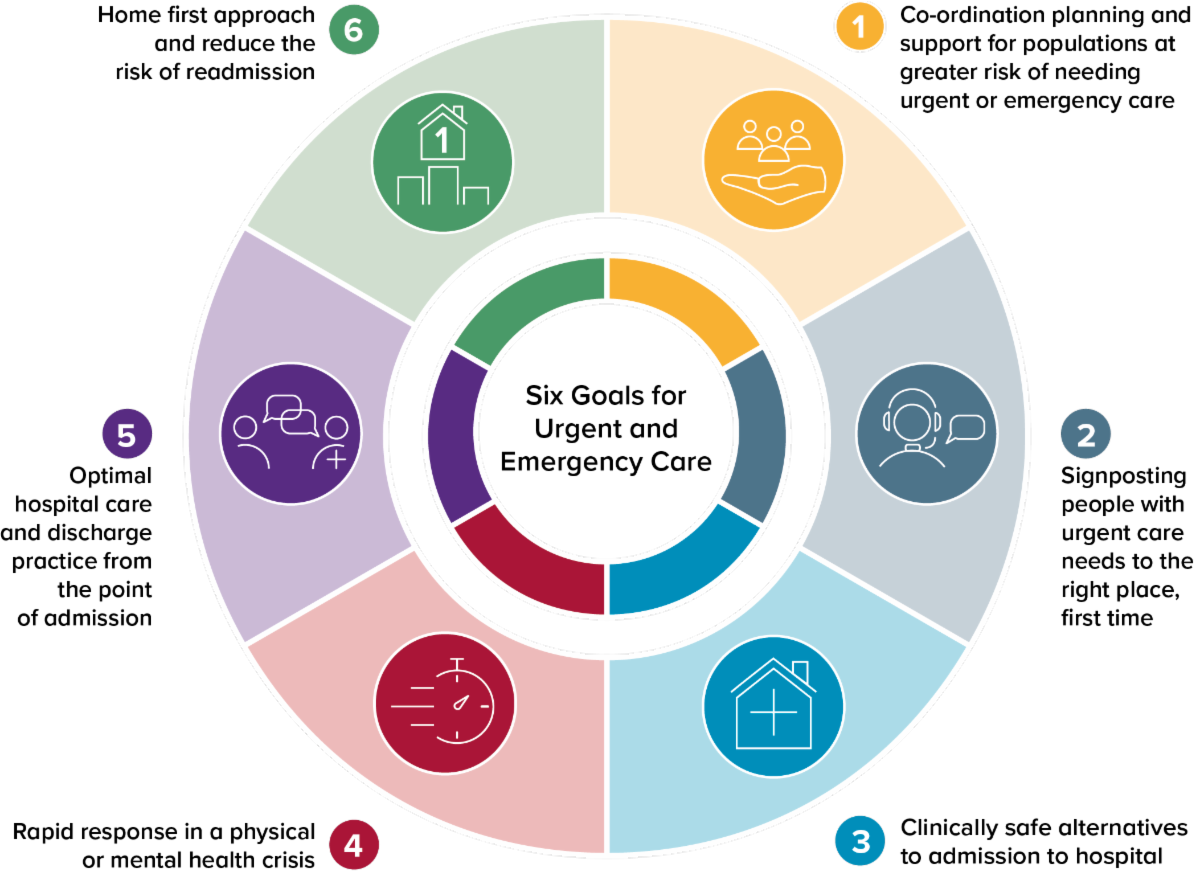
| The National Programme for Urgent and Emergency Care (UEC) oversees delivery of the six policy goals that span the urgent and emergency care pathway. These six goals reflect 11 the priorities in the Programme for Government 2021-2026 to provide effective, high quality and sustainable healthcare as close to home as possible, and to improve service access and integration. The UEC (Six Goals) team comprises national clinical and professional leads and a Programme Management Office, which collectively supports its portfolio of national work. The team will be a new directorate within the current NHS Wales Executive structure.
Contact Richard.Bowen@wales.nhs.uk for more information. |
|
| Emergency Planning and Response During the Covid-19 pandemic, a HSSG Covid-19 Planning and Response Group was established to provide a national, strategic co-ordinating function across health and social care. A key recommendation from HSSG’s review of its response was that planning and response arrangements should be formalised within an emergency planning function of the NHS Wales Executive.
The Executive Emergency Planning and Response function will provide a national focus for co-ordination in NHS Wales contingency arrangements, monitoring and assurance of emergency preparedness activities, as well as providing a mechanism for briefing and information flow across NHS Wales on behalf of Welsh Government (in accordance with the mandate and remit letter).
This new, new coordinating function for Emergency Planning and Response will be based within the Networks and Planning Directorate, with accountability for this coordinating function transferring to the National Director of Networks and Planning through to the relevant EDT Policy Director.
Contact nhswhc.commsteam@wales.nhs.uk for more information. |
Following the integration of these new functions under the formal hosting arrangements of PHW on 1 April 2024, the NHS Wales Executive will include the following services |
|
|
|
'Better Together' - Our new ways of working
The Executive provides a central guiding hand, working in partnership for and on behalf of Welsh Government, in and with the NHS in Wales.
Recognising the benefit of bringing our services together to plan and support improved outcomes and strengthen the quality of services across NHS Wales, the Executive has been focusing staff engagement on promoting opportunities to collaborate by showcasing examples of early progress.
The following outlines two of these areas - Mental Health and Diabetes - that we continue to build on. |
|
|
|
Mental Health On 1 April 2023, the Strategic Programme for Mental Health (SPMH) was formed as part of the newly established NHS Wales Executive, taking leadership and oversight of the work of the Mental Health Network and its subgroups that had been in place in the NHS Wales Collaborative. The mandate from Welsh Government to the SPMH is to:
- Drive improvements in quality and safety. Deliver better and more equitable outcomes, access, and experience
- Reduce variation and improve population mental health outcomes
- Be the interface between Welsh Government policy and service delivery
- Provide direction and support to NHS Wales organisations, public sector and third sector organisations.
|
|
|
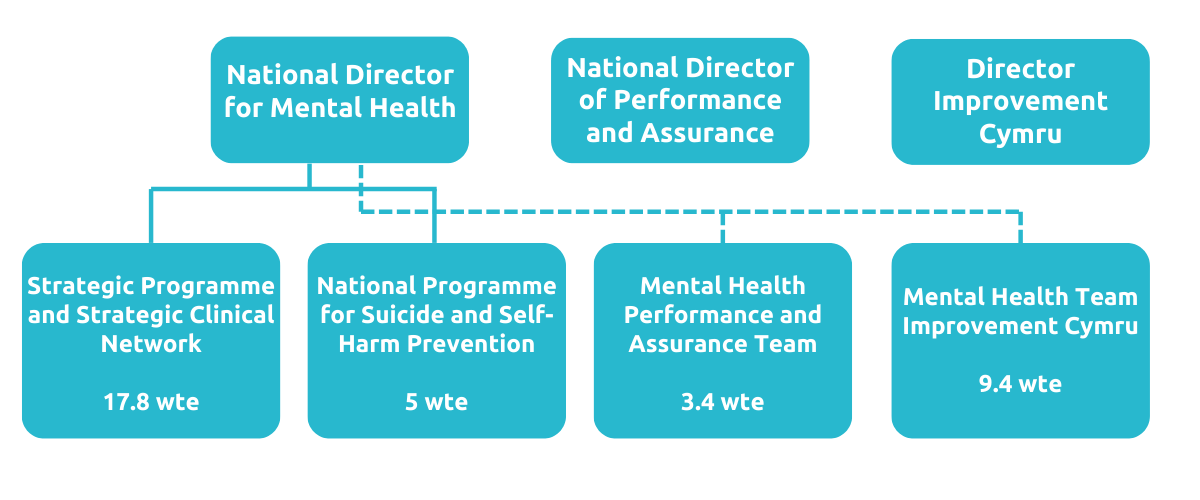
| Year One has focused on completing the legacy work of the Networks under the Together for Mental Health Strategy, completing the delivery of the agreed plans for the Suicide and Self-Harm Prevention National Programme as part of the Talk to Me 2 strategy, establishing and recruiting the Programme and Networks Teams, developing our ways of working within the NHS Wales Executive, with Welsh Government and the wider system and contributing to the drafting of the new Mental Health and Suicide and Self Harm Strategies. We have dedicated mental health teams within the NHS Wales Executive: |
|
| Each team has distinctly different roles and functions and so do not duplicate effort or resource and further, every team in the NHS Wales Executive has a role to play in our mental health system.
By using the quality management system as our framework, our aim is to drive improvement in quality and safety, to reduce variation in access, experience, and outcome. We looked to the Duty of Quality, to the health and care quality standards to drive improvement and this has given us an opportunity to mirror work going on in the wider system in Wales.
This framework has enabled us to start looking holistically at all our work and to bring it all together. |
|
|
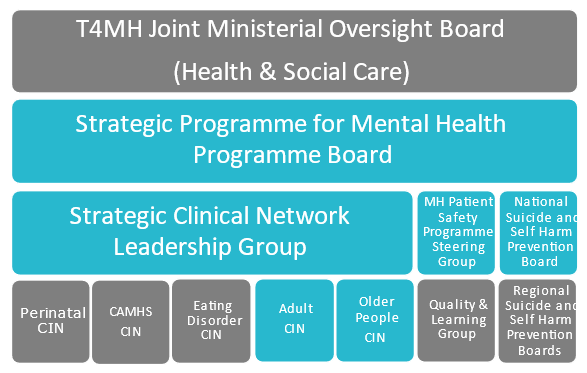
Using the quality management system, we started to plan our work and use of resources. We reviewed our people and processes, we held a series of full team face to face workshops, reviewed our purpose and designed activities to build trust and enable everyone to build relationships. We collectively reviewed progress and challenges against the deliverables of the remit letter. Developing this collective voice will enable greater influence. Emerging Programme and Network Governance for Mental Health We report to the ministerial board and the grey areas in the diagram (left) depict existing arrangements with the blue highlighting what’s to follow as we take legacy arrangements and shape them for the future. |
|
A live example of our guiding hand |
|
| This model illustrates how the NHS Wales Executive can now provide a national, guiding hand. Prior to our formation, there was no space to provide that consistent, clear guidance and support across Wales.
Right Care Right Person (RCRP) is a new framework for police decision making on their response to reported incidents involving people with mental health needs. All four Welsh police forces are implementing RCRP.
|
|
 |
| The NHS Wales Executive is co ordinating the National Partnership Group across Health and Social Care, bringing all partners together and agreeing the principles of partnership working with the four police forces in Wales. We are setting the process for agreeing roles and responsibilities and quality impact assessment.
Finally, we are providing a central point of contact for escalation of risks from health boards. |
|
At a glance The early benefits of our ‘Better Together’ approach in mental health:
- Consolidated national support around a smaller number of priorities.
- Starting to apply the national clinical framework,
- Freeing up time for policy team to focus on legislative and policy functions,
- Providing better system intelligence to inform policy development,
- Increased capacity at a national level to drive transformation,
- Better alignment of workforce plan and data and digital plan with strategic programme and clinical networks plans,
- Increased focus on quality and safety,
- Starting to streamline the governance landscape.
|
|
|
Our next steps
- Establish Strategic Programme and Strategic Clinical Network Governance
- Further engage with the wider teams in the NHS Wales Executive
- Further develop how we work with health boards and how we better feed into IQPD and IMTP structures
- Integrated planning for measurable impact on key priorities for 2024/25 in the following areas:
- Perinatal Mental Health
- Children and Young People’s Mental Health
- Eating Disorders
- Community Mental Health Services for Adults & Older People
- Mental Health In-Patient Safety
- Access to Psychological Therapies and Interventions
- Mental Health Crisis Care Pathway.
Want to know more? Contact Ciara Rogers, National Director, Strategic Programme for Mental Health ciara.rogers@wales.nhs.uk |
|
|
|
Tackling Diabetes Together The Welsh Value in Health Team (WVIHC) is working closely with the Tackling Diabetes Together Programme (TDTP). Diabetes affects around 7% of people in Wales and, whilst Type 1 diabetes affects around 16,000 people in Wales and cannot be prevented, more than 190,000 people have Type 2 diabetes, which can be prevented or delayed.
Estimates suggest the prevalence of diabetes may rise to 10% of the population by 2035. When diabetes is not managed well, it can result in serious damage to the heart, eyes, kidneys, and feet as well as cause diabetic emergencies for some people. |
|
|
|
| There is a shared recognition that we need to stop the rise in diabetes prevalence (T2DM) and ensure that people who are living with the condition are in the best health possible, thus minimising the impact of the condition and its complications. A step change in diabetes management and prevention is needed to achieve two strategic outcomes.
This ambition has already been socialised with Welsh Government, the NHS Wales Executive and Chief Executives, in that, five years from now Wales will:
- Have more people living well with diabetes (Type 1 and 2) as measured through a reduction in amputations and other diabetes pathways
- Have stopped the prevalence of diabetes increasing, focusing principally on T2DM
|
|
|
| The work that the WVIHC is supporting is specifically around Workstream 1 Preventing poor outcomes: Effective diabetes care, led by Julia Platts and Sally Lewis. The overall objective of Workstream 1 is to deliver improved outcomes for all diabetes patients across the NHS Wales system through the design and reporting of a small number of value metrics.
This will ultimately reduce unwarranted variation, avoiding amputations and complications from the 2023 baseline.
In doing so we have met through the clinical leadership and designed an initial draft optimum pathway with a range of supporting value metrics. |
|
Six Goals for Urgent and Emergency Care |
|
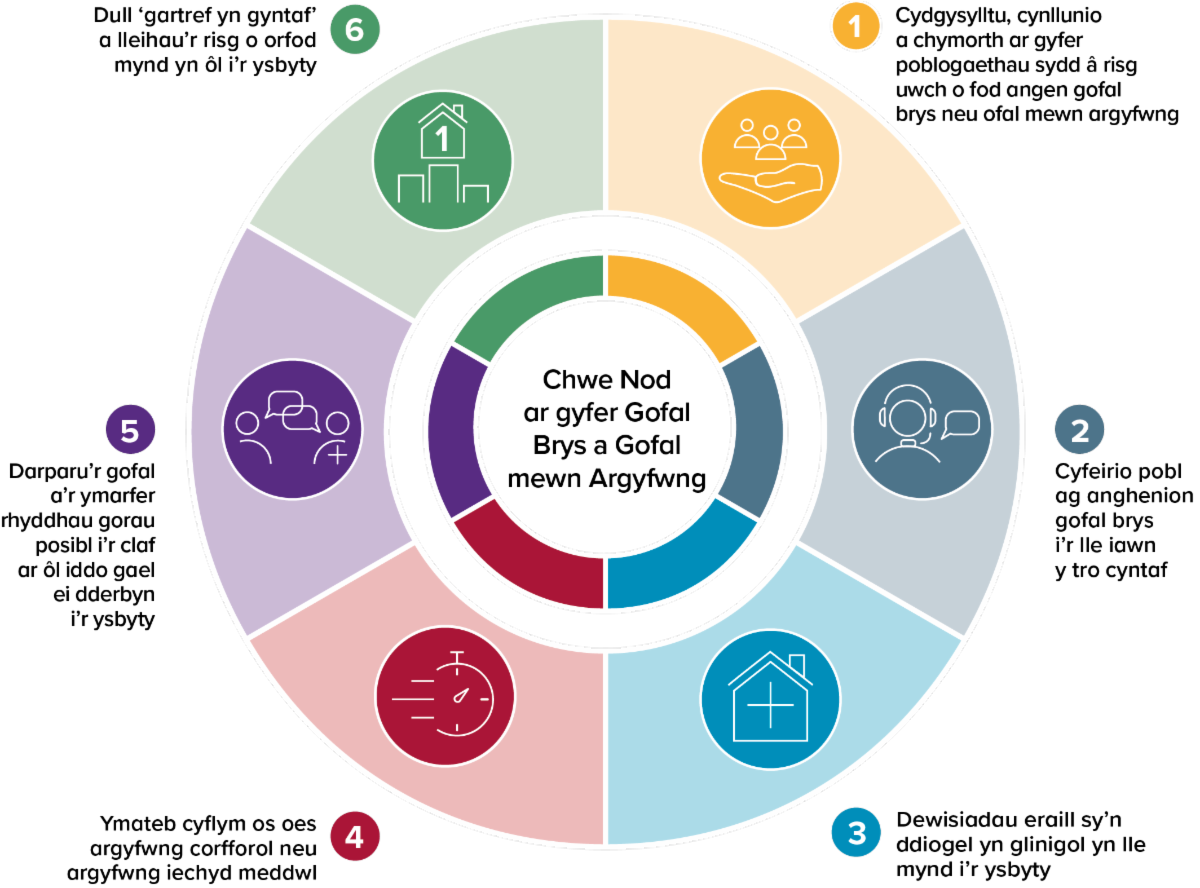
| The national Six Goals for Urgent and Emergency Care Programme has been established to support Health Boards and their partners to transform and improve delivery of Urgent and Emergency Care services to the people in Wales.
The Six Goals, co-designed by clinical and professional leads, span the Urgent and Emergency Care pathway and reflect the priorities in the Programme for Government 2021–2026 to provide effective, high quality and sustainable healthcare as close to home as possible, and to improve service access and integration.
The Six Goals for Urgent and Emergency Care Policy Handbook sets out the priorities for Urgent and Emergency Care to ensure that patients get the right care, in the right place, first time. The handbook contains a series of quality statements for each of the Six Goals, to describe the outcomes and standards individuals can expect when they may need Urgent or Emergency Care.
The Six Goals for Urgent and Emergency Care Portfolio Management Office (PMO) supports delivery of the Programme, working closely with local Health Board leads, Welsh Government, the Welsh Ambulance Service, NHS Trusts and partner organisations. The PMO ensures the connectivity and flow of information between national initiatives, local delivery and aligns with the governance and accountability arrangements within the National Six Goals Programme Board. |
|
|
|
|
|
| Overarching principles of the Six Goals Programme
1. Improved access and consistency of delivery 24/7 regardless of organisational boundaries. Weekend service delivery should match those delivered during the working week.
2. Increased focus on critical clinical pathways, with priority being given to frailty, palliative care, falls, stroke, crisis mental health and urgent dental.
3. Continued drive on pre-hospital and community alternatives for patients, with a continued focus on 111 and Urgent Primary Care Centres (UPCC), and Anticipatory Care Planning for patients in care homes.
4. Where patients are likely to require some form of hospital intervention, short-term attendances via Same Day Emergency Care (SDEC) will remain critical, allowing direct access for paramedics and other health care professionals.
5. Improved patient flow and timely access to diagnostics to support admission avoidance and/or reduced length of stay (LOS) particularly for those over the age of 65 during the first 48hrs, 0-7 days and 0-21 days. A focus on improved patient flow will directly impact on ambulance handovers and pressure in Emergency Departments.
6. Digital and workforce planning will underpin all the above.
7. Strong partnership working aligned to links with Regional Partnership Boards to ensure there is wider consolidation on priorities across Health and Social Care. Moving into the NHS Executive will allow the Six Goals Programme to align priorities with the National Networks, Value in Healthcare and other National Programmes. |
|
Examples of progress to date |
| NHS 111 Wales and Urgent Primary Care
- 111 and out-of-hours service resilience continues to go from strength to strength with marked improvements in abandonment rates and in clinical response times since April 2023 to date – linked to better workforce, internal efficiencies, demand and capacity alignment and continued focus on clinical outcomes/disposition to other services. The latest data is now available and published on the Stats Wales website.
- 111 Press 2 for urgent mental health support available pan-Wales. The 24/7 service, available for all ages, can be accessed by calling 111 and selecting ‘option 2’, and callers will be transferred to a dedicated member of a mental health team in their Local Health Board area. The service is being kept under close review but to date, has received positive feedback from clinicians operating within the service and local GPs.
- 111 pathway redesign: palliative care, repeat medicines and urgent dental care review underway (supported by Chief Dental Officer).
- The NHS 111 Wales website continues to be refined and updated with the latest January figures showing approx. 500,000 hits.
- Phase 1 of updating the Directory of Services is complete by WAST and local health boards.
|
| Urgent Primary Care Centres (UPCC)
- UPCC are now in year 3 and are broadly stabilised and integrated with wider urgent care services. The combined service provides approx. 9,000 contacts per month across Wales.
- 80% of these contacts are resulting in the management of the condition either through self-care or medication.
- Whereas previously most referrals came directly from GMS, we are now seeing an increase in activity from Emergency Department referral, but importantly a 7% increase in 111/out-of-hours referrals. We are currently exploring direct booking arrangements with a pilot site in Betsi Cadwaladr University Health Board.
|
| Same Day Emergency Care (SDEC)
- There are now 24 SDEC units in operation across Wales and offerings to support both medical and surgical patients are increasing.
- Data capture has been a challenge, however January saw an agreed approach to consistently obtain this information.
- Regardless of data source, we have seen a step increase in activity levels through several SDEC units.
- A WAST Referral to SDEC Policy has been launched and we are working hard to improve the number of patients who can be directly admitted via a paramedic.
- Our expectation will be for greater consistency of approaches both within and across Local Health Boards. Primacy has been given to surgical patients, however this has now shifted to medical patients as an alternative to Emergency Department or hospital admission, and removing delays for patients requiring further investigation or treatment.
|
| Rapid Response in a Crisis
- Joint WAST and Local Health Board improvement plans to free up capacity and improve responsiveness.
- Targeted support to St John’s Ambulance and each Emergency Department this winter to improve the transfer and immediate repatriation of patients (particularly frail patients back to care homes).
- Targeted investment in the 999 clinical software and recruitment of 999 staff in call centres which has led to a 5% increase in hear and treat rates.
- Development of a system escalation tool which now covers primary, community and secondary care.
- System dashboards developed with DHCW to support daily escalation decision making.
|
| Care Homes Support
- Steps taken to minimise demand on the Urgent and Emergency Care system from care homes including:
- Senior clinical assessment of any care home resident before conveyance into hospital
- Where conveyance is still contemplated after senior clinical assessment, contemporaneous communication between secondary care and primary care clinicians occurs which include the active exploration and recording of evaluation of community alternatives to deliver safe urgent care for this resident at this time.
- Active engaging with local authorities to ensure system wide approach to maintaining care home residents on-site.
- In collaboration with Airedale NHS Trust (Immedicare), a service improvement project is ongoing to support care home patients with a 24/7 NHS telemedicine service for 15 care homes located in the Betsi Cadwaladr University Health Board area. This clinical service offers care homes immediate access to a multi-disciplinary NHS clinical team of healthcare professionals with a broad range of specialities, to help reduce hospital conveyances, and ensure patients receive the right care, at the right time, closer to home. Positive results show an 88% reduction in conveyance to hospital (25 patients
- We are also supporting similar initiatives in Swansea Bay and Cwm Taf Morgannwg University Health Boards who are equally seeing similarly impressive non-conveyance rates.
|
|
| Data and Digital Numerous initiatives in this Enabling Workstream including:
- The introduction of e-triage ‘booths’ in Aneurin Bevan and Cardiff and Vale.
- Supporting Enhanced Community Provision (Virtual Wards) in Swansea Bay, Aneurin Bevan and Cardiff and Vale in the coming months.
- Getting It Right First Time (GIRFT) benchmarking for our Emergency Departments across Wales.
- Web-enabled decision-making tools linked to 111/WAST and financial support to the NHS 111 Wales website to support patients to make informed choices.
|
|
| Linking with Networks We have a long-standing link with the End-of-Life Network, however more recently we have been linking with the Critical Care Network, Stroke Network and are actively supporting the Falls Liaison and Fracture Prevention Service which is currently being rolled out across Wales. |
|
For further information please contact Richard Bowen, National Programme Director, in the first instance. |
|
Establishing the new National Clinical Networks |
|
Located within the NHS Wales Executive Networks and Planning Directorate, the National Strategic Clinical Networks work to improve the quality, sustainability and outcomes of NHS Wales services within their relevant area (except for the National Strategic Clinical Network for Mental Health, which sits under the responsibility of the National Programme Director for Mental Health). |
|
|
|
| The networks are a core component of the learning health and care system described in the National Clinical Framework and work between operational service delivery in health boards and trusts and the formulation of policy and strategy in Welsh Government.
Clinically led, the networks seek to draw their expertise directly from clinicians working in front line service delivery in primary, community, secondary and tertiary care across NHS Wales, including through clinical reference groups. They are informed by available data and evidence (which they also contribute to improving and refining) and by widespread engagement including with the third sector, patient representatives, and industry.
Each network works to support the improvement of the quality and sustainability of NHS Wales services within its area of scope, guided by a relevant quality statement published by Welsh Government (with networks supporting the future development of these). Each network is also guided by and helps to inform relevant Welsh Government policy.
Taking as ‘top down’ starting points, the quality statement, policy imperatives and relevant priorities in the NHS Wales Executive’s remit letter, each network deploys ‘bottom up’ knowledge and intelligence on current service delivery issues and challenge, to develop a clear, prioritised work plan for subsequent approval by the National Clinical Framework Board. The network leadership team then manages the delivery of the agreed work plan, within allocated resources.
Outputs from network work plans include:
- Standardised and evidence-based care models and pathways aimed at reducing variation and improving outcomes
- Clear and evidence-based service standards and specifications
- Dashboards and other tools enabling clinical services to assess and improve the quality of their services.
Many of the above products are explored within the system by the networks and can be introduced to front line services without significant planning or investment. However, some require more significant change and are escalated via the National Clinical Framework Board for consideration by the NHS Wales Leadership Board and/or for inclusion in NHS Wales planning guidance and national plans issued by Welsh Government.
Networks will also support the wider planning and performance management functions of the NHS Wales Executive and Welsh Government, including through:
- Undertaking targeted work in response to identified service deficiencies
- Providing data, information and informed opinion to support performance management
- Supporting the review of IMTPs and other plans.
Networks will work in close liaison with each of the National Strategic Programmes and other programmes within the NHS Wales Executive on a range of issues where the scopes of networks and programmes meet. Their position within the NHS Wales Executive will enable them to play a role in fulfilling the expectations set out in the NHS Wales Executive’s Mandate and Remit Letter.
A core, agreed recommendation of the National Clinical Framework Clinical Networks Workstream was the establishment of a specified suite of new National Strategic Clinical Networks. The National Strategic Clinical Networks that will be in place by the end of 2023/24 are:
- Cancer
- Cardiovascular Conditions
- Child Health
- Critical Care, Trauma and Emergency Medicine
- Diabetes
- Gastrointestinal Conditions
- Maternity and Neonatal Services
- Mental Health (sits under the responsibility of the National Programme Director for Mental Health, not within NHS Wales Networks and Planning)
- Musculoskeletal Conditions and Orthopaedics
- Neurological Conditions
- Respiratory Conditions
- Women’s Health
Within the NHS Wales Executive, the National Strategic Clinical Networks will be a key component of the National Clinical Framework model. National Strategic Clinical Networks will perform the central role of the ‘knowledge-to-practice’ element in the Learning Health and Care System laid out in the National Clinical Framework.
Want to find out more? Contact nhswhc.commsteam@wales.nhs.uk |
|
|
|
Focus and priorities Our first year has been one of transition. During the past 11 months, we have worked to further strengthen the governance, engagement and ways of working across the functions and programmes we deliver.
Staff and stakeholder engagement is an ongoing priority for us, together with the wider Organisational Development for the Executive, working alongside the Executive Director Team in the Health and Social Services Group of Welsh Government.
Establishing new ways of working within the NHS Wales Executive, across the hybrid model into Welsh Government, and with NHS Wales organisations continues to be a significant focus for us as we mature. |
|
|
We do hope this update has provided you with a helpful insight to who we are, why we are here and how we are developing the building blocks to support Welsh Government and the wider NHS in improving the quality of care and outcomes for the people of Wales. If you’d like a conversation, to find out more, or to give feedback, please get in touch. |
|
|
|
|
|