Written by Phil Garn
The Second World War saw the Italian Port of Naples become a crucial point for Axis powers, serving as a hub for the movement of troops, equipment, and supplies destined for their campaigns in North Africa and the Aegean. In response, the Italians and Germans fortified the surrounding islands, including those in the Campanian Archipelago and the Pontine Islands, with Ventotene being one of them. Ventotene's strategic importance was underscored by its coastal gun batteries, a German radio communication center, and a radar station.
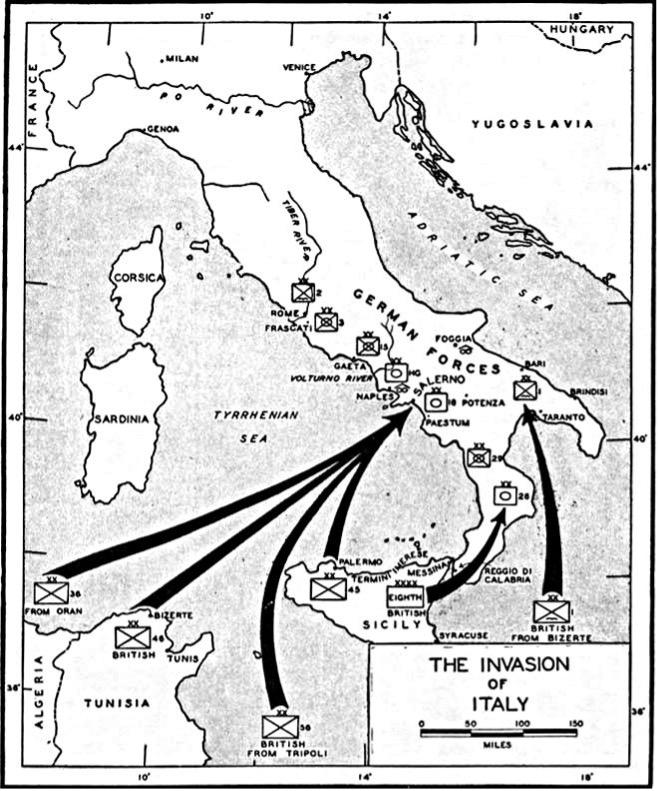
The Allied forces recognized the necessity of neutralizing these Axis outposts as a prerequisite to the occupation of Naples. Furthermore, they aimed to strategically divert Axis troops away from the primary Allied assaults planned on the Italian mainland at Salerno and Taranto. The execution of this strategy fell to Task Group 80.4, a unit notable for its assortment of unconventional personnel and the innovative tactics they employed.
Task Group 80.4 and the Diversionary Objective Task Group 80.4 (TG 80.4), under the command of Captain Charles Andrews USN, was instrumental in supporting Operation Avalanche. The task force was a diverse assembly of naval power and personnel. The flagship USS Knight (DD-633) led the group, accompanied by Dutch gunboats Soemba and Floreas, ten Air-sea Rescue Boats (ARBs) from Pappy Osbourn’s Beach Jumper Unit 1 (ARB Ron 1), and six Motor Launches (MLs) of the British 31st Flotilla, carrying fifty seasoned paratroopers from the 82nd Airborne. The flotilla also included four British Motor Torpedo Boats (MTBs) from the 32nd Flotilla and several US PT Boats from Motor Torpedo Boat Squadron 15 (RON 15), notably PT 202, which carried the esteemed author John Steinbeck.
The composition of Task Group 80.4 was particularly noteworthy for the inclusion of individuals with unique backgrounds and skills. Among them was LCDR Douglas Fairbanks Jr., the renowned Hollywood actor who also served as Tactical Commander and the founder of the Beach Jumpers, an amphibious deception group. Adding to the group's distinctiveness was Lieutenant (junior grade) Henry Ringling North, the Vice President of Ringling Brothers and Barnum & Bailey Circus, who also operated as an OSS operative known by the aliases "Bud" or "Buddy." Captain Frank Tarallo of the OSS, accompanied by 11 OSS operatives, and the Pulitzer Prize-winning author John Steinbeck further contributed to the task group's diverse expertise. At the eleventh hour, Captain Howland augmented the group with fifty 509th Parachute Infantry troops and British "Moonshine" deception equipment. A British amphibious group under Captain Derek Wyburd RN on board HMS Tormentor, along with Lieutenant Robert Laycock’s British commandos, was also assigned to the area for other operations.
The primary mission of these combined forces was to create the illusion of a more substantial landing operation near Naples. This strategic deception aimed to divert Axis forces from the main Allied landings at Salerno and Taranto.
The Approach to Ventotene and the Italian Armistice The approach to Ventotene was carefully orchestrated. RON 15 PT-214 led the Beach Jumper ARBs, equipped with loudspeakers known as "heaters," electronic countermeasure jammers, and RCM balloons. These units were joined by five MLs from Bizerte en route to Palermo to rendezvous with the USS Knight, the gunboats, and the rest of TF 80.4 on September 5th. The OSS personnel, including North, joined here, and the final planning conference took place on September 7th at the Palermo PT Base, where LCDR Barnes offered additional PT boats for use as a screening force.
During the briefing, Fairbanks, in his non-regulation uniform, characterized their mission as "an amusing job...a real game of pirates for we are to go round capturing islands starting with Ventotene," highlighting the unconventional nature of their operation. TF 80.4 then proceeded in two sections. The "slow section," comprising the USS Knight, the MLs, and the gunboat Flores (another gunboat having dropped out due to mechanical issues), departed at 0530 on September 8th, advancing at 10 knots. The "fast section," consisting of PTs, MTBs, and ARBs, left at 1100, overtaking the "slow section" before nightfall. The USS Knight led the formation for the final approach to Ventotene.
On September 8, 1943, the announcement of the Italian Armistice, secretly negotiated between Field Marshal Pietro Badoglio’s government and the Allies, was broadcast. The Allies hoped this announcement would facilitate their invasions of the Italian mainland. However, German Field Marshal Kesselring's forces, along with loyal Fascist RSI troops, swiftly reinforced Italy, disarming numerous loyalist garrisons throughout the country and the remaining Italian empire.
Deception and the Surrender of Ventotene The situation off Ventotene was marked by confusion and deception. Shortly after the Armistice announcement, gunfire and flares were observed off the USS Knight’s starboard bow, accompanied by sonar contacts. Depth charges were deployed, and PT boats engaged three unidentified aircraft, successfully shooting down one. The Knight's crew detected German radar signals, confirming the effectiveness of the reflector-equipped balloons attached to the small craft. German shore batteries contributed to the deception by firing flares and shells.
By 2300, TF 80.4 had approached to within two and a quarter nautical miles of Ventotene’s southeast tip. Captain Andrews then divided his force, with the MTBs and subchasers screening to the right and the ARBs to the south. This maneuver created the illusion of two large groups encircling the island, misleading the Luftwaffe radar operators stationed there.
PT-214 led ARB 48 to within 800 yards of the coast (Steinbeck's account states 500 yards), where a surrender speech, penned by Steinbeck and delivered by a sailor in fluent Italian, was broadcast, demanding immediate capitulation within 15 minutes. As the USS Knight and the Dutch gunboat prepared to shell the island, the Beach Jumpers executed another deceptive tactic. They reiterated the surrender demand, accompanied by background sounds of men shouting, anchor chains rattling, and other invasion noises, including aircraft sounds, for five minutes over their loudspeaker "heaters," before firing several salvos of five and six-inch shells intentionally short of the island. In response, the Italians promptly launched the surrender signal of three white rockets. This culminated in cheers from TF 80.4.
The Advance Party and the Capture of Ventotene Captain Andrews, cautious of a potential ruse, decided to verify the island's surrender. While Fairbanks began outlining landing procedures, Andrews, interpreting Fairbanks's enthusiasm as a volunteer, directed him to proceed. Steinbeck, embedded as a war correspondent, also volunteered, along with LT(jg) “Buddy” Ringling North and Captain Frank Tarallo of the OSS.
Fairbanks, accompanied by Beach Jumpers and OSS personnel, headed towards the island in the USS Knight’s whaleboats. Navigating with a sailor using a lead line to gauge depths, the boats initially approached what appeared to be the small harbor, only to discover it was a false cove, necessitating a backtrack to the correct harbor. However, local historians in 2024 told Dennis Cummings that the whale boat landed in two false coves, further confusing the German garrison, who believed there were three separate landings. As the whale boats entered the correct harbor, the Italian garrison fired three more white flares, reaffirming their surrender to the approaching Americans.
Just as the boats were docking, a scuttling charge detonated in an enemy gunboat, surprising the small American landing party. The German garrison, misinterpreting the earlier incident at the false coves as successful landings and witnessing the actual landing at the quay, concluded that the island was surrounded. Consequently, they initiated a fighting retreat westward, setting fire to buildings and destroying equipment as they moved towards their pre-established defensive positions.
The surrendering Italians and a German warrant officer greeted the Americans, informing them that the German garrison was in the process of destroying their equipment and retreating to prepared positions inland, fortified with machine guns and mortars. They were also met by a recently freed political prisoner, still in pink pajamas, who served as a translator.
Andrews ordered approximately 40 paratroopers to land, and LCDR J. I. Lloyd RN on ML 555 brought in the first contingent. However, the dock's limited size, capable of accommodating only one PT boat at a time, necessitated ferrying the paratroopers ashore in rubber boats, where they established a harbor guard. Meanwhile, sporadic explosions echoed as the retreating Germans continued to set fires and demolish both their own and Italian facilities.
Fairbanks led a group of paratroopers through the main village, while LTjg North directed the OSS men and the remaining paratroopers to the Italian barracks. Years later, Fairbanks recounted to historian Erick Simmel the surreal experience of navigating through the town from doorway to doorway with the paratroopers, a stark reminder that this was a real war, not a Hollywood set. North's group found thirty-three militiamen, who readily surrendered, and subsequently rounded up 50 more prisoners, confining them in the barracks’ basement.
Fairbanks, Tarallo, Howland, and North convened in the town to strategize their next move. Unbeknownst to the 90 Germans (Steinbeck reported 87), they still held a two-to-one numerical advantage over the small American contingent. North volunteered to deliver the demand for surrender to the Germans, accompanied by his OSS interpreter and a freed political prisoner, Signore Bracco, threatening a major bombardment and an overwhelming attack if they refused. Meanwhile, Fairbanks returned to the USS Knight and requested 5-inch rounds to be fired in the general direction of the German positions.
The German Surrender At dawn, the USS Knight fired a few convincing salvos while North and his party of three ascended the hill towards the German positions, waving a white bath towel as a flag of truce. North was escorted into the German positions, still holding the towel, and addressed the German Oberleutnant in charge:
“What’s the good? We’ve got six hundred men ashore and the cruisers are aching to take a shot at you. What’s the good of it? You’d kill some of us and we’d kill all of you. Why don’t you stack your arms and come in?”
After a tense pause, the German officer inquired about the treatment they would receive. North assured him of prisoner of war status under the Convention of the Hague. The Oberleutnant conceded,
"It is no dishonor to surrender to superior forces.”
Subsequently, the 90-strong German contingent surrendered to North, the OSS men, and the interpreter without firing a single shot. They stacked their arms and were escorted by approximately 30 of the paratroopers down to the town, where they were incarcerated.
The German officer in charge formally surrendered in writing:
I, the undersigned Commanding Officer of the Axis Armed Forces on the Islands of Ventotene and San Stefano, do hereby surrender unconditionally all men, arms, equipment and possession of said Island of Ventotene and San Stefano to the Allied Forces acting herein by and through Frank J. Tarallo Captain AUS and Henry R. North, LT (jg) USNR, under direction of Commander Task Group 80.4, Captain C. L. Andrews Jr., USN on order of Commander Western Naval Task Force and of General D. D. Eisenhower, Commander in Chief Allied Forces, North African Theater of Operations.
The USS Knight rendezvoused with Admiral Kent Hewitt’s flagship, the USS Ancon (AGC-4), off the Salerno beachhead to provide an update before returning to Ventotene on the afternoon of September 9th. Captain Andrews organized a guard detail and oversaw the evacuation of the 90 German POWs to the USS Ancon. The Germans, now confined, realized the deception they had fallen victim to. The ARBs then evacuated political prisoners who had been held in exile at Ventotene’s prison by Mussolini’s Fascist regime. The Americans also recovered a significant portion of the German radar equipment for analysis.
Meanwhile, other ARBs of BJ RON1 and RON 15 PTs carried out additional deception and intelligence missions, contributing to the confusion in support of Operation Avalanche and the Italian campaign, but that’s a story for another time. |