ICMS Outreach & Engagement Tip Sheet |
| Supporting Case Managers in Complex Field Work
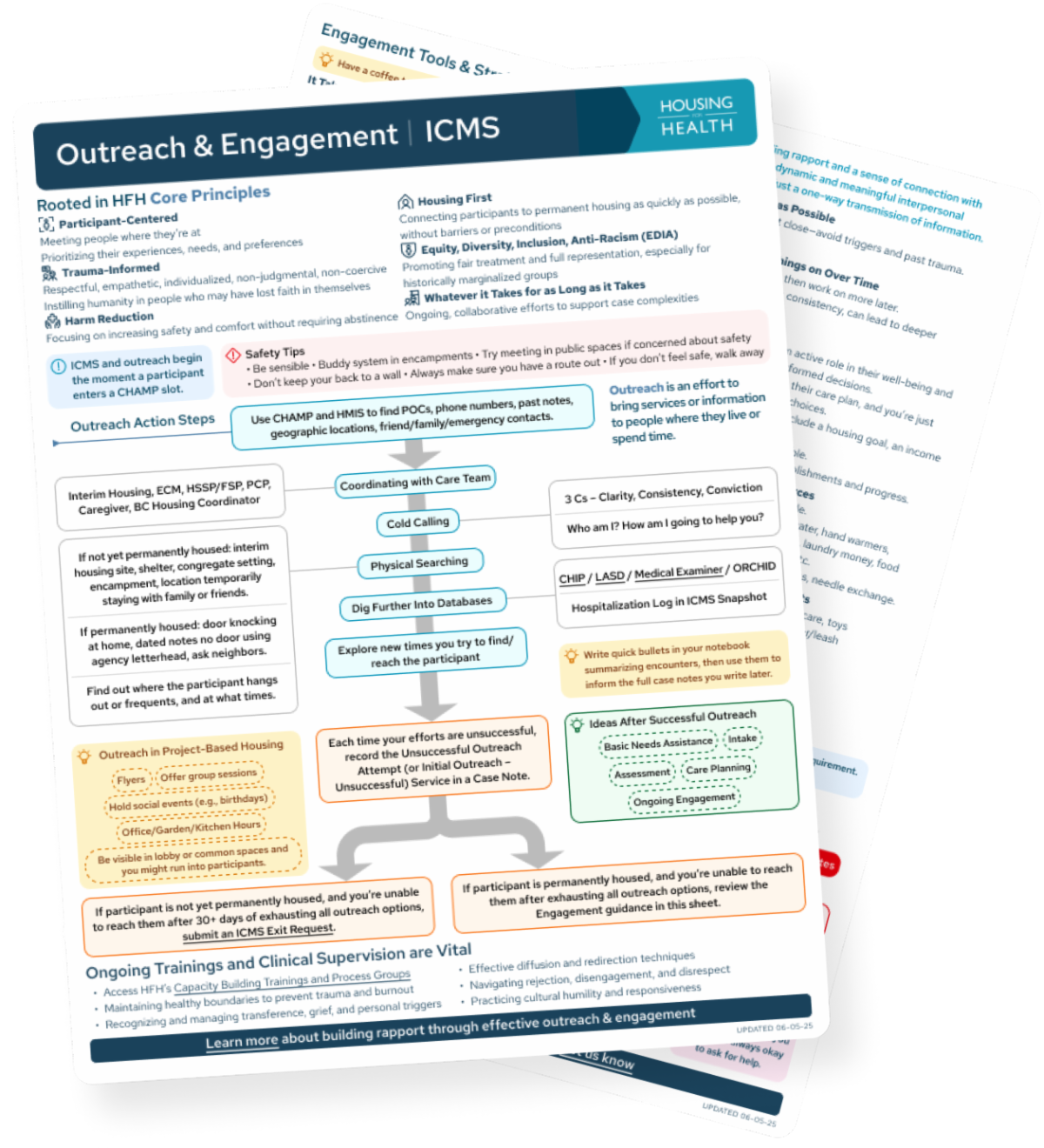
This downloadable tip sheet offers trauma-informed, participant-centered strategies for building trust, conducting outreach, and navigating engagement challenges in ICMS. Designed for real-world use, it brings together HFH’s core principles, best practices, and actionable tools—all in one place. |
|
|
Rooted in HFH Core Principles |
|
|
Participant-Centered Meet people where they’re at. Prioritize their experiences, needs, and preferences |
|
Trauma-Informed Respect, empathy, individualized, non-judgmental, non-coercive. Instill humanity in people who may have lost faith in themselves. |
|
Harm Reduction Focus on increasing safety and comfort without requiring abstinence. |
|
Housing First Connecting participants to permanent housing as quickly as possible without barriers or preconditions. |
|
Equity, Diversity, Inclusion, Anti-Racism (EDIA) Promote fair treatment and full representation, especially for historically marginalized groups. |
|
Whatever it Takes for as Long as it Takes Ongoing, collaborative efforts to support case complexities. |
|
|
Tip: ICMS and outreach begin the moment a participant enters a CHAMP slot. |
|
|
Tip: Write quick bullets in notebook summarizing encounters, then use to write full case notes later. |
|
|
|
| Safety Tips:
- Be sensible
- Buddy system in encampments
- Try meeting in public spaces if concerned about safety
- Don’t keep your back to a wall
- Always make sure you have a route out
- If you don’t feel safe, walk away
|
|
|
|
Ongoing Trainings and Clinical Supervision are Vital |
|
Access HFH’s Process Groups & Crisis Intervention Training |
|
 |
Maintaining healthy boundaries to prevent trauma and burnout |
|
|
Recognizing and managing transference, grief, and personal triggers |
|
|
Effective diffusion and redirection techniques |
|
|
Navigating rejection, disengagement, and disrespect |
|
|
Practicing cultural humility and responsiveness |
|
|
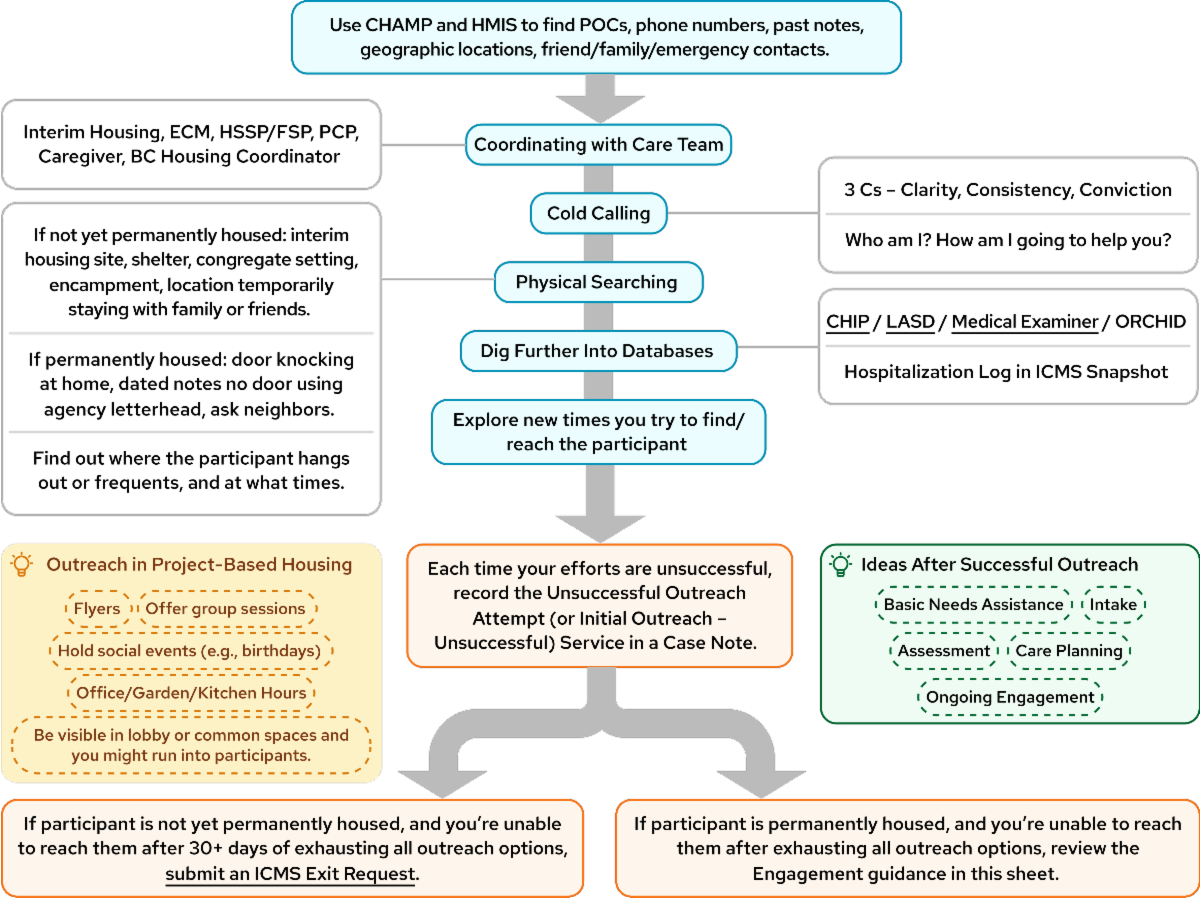
Follow-Up & Re-Engagement Flow |
|
|
Tip: Have a coffee together or meet at a fast food spot. |
|
| It Takes a Village
- Collaborate w/ Care Team: HSSP/FSP, ECM, Caregiver, BC, PCP, IH
- Involve friends and family wherever possible to build community
- By engaging more in their community, others engage more with you
All Action Steps Should be Participant-Centered
- You don’t know where someone’s at until you actively listen to them
- Speak to someone eye-level; don’t stand over them
- Believe participants and try to validate what they are saying
- No shame and no blame
- Focus on participant self-care
- Ask how you can help rather than assuming what the participant needs
- Put yourself in their shoes—What would I need in this situation?
- Regularly check your own motives
Be Transparent, Genuine, and Clear
- Make it clear what you can and can’t do in your role
- Operate with emotional intelligence and care
- Be concise and avoid using words people may not understand
- Emphasize importance of mutual respect and set boundaries
- Create an agreement each of you sign and can refer back to
- Post agency mission and code of conduct in common spaces
Don’t Overpromise and be Consistent with Meetup Schedule
- Establish a meeting schedule early in the relationship that works for the participant and then stick to it
- Always follow through—Consistency builds trust over time
- We’re tasked with making up for broken promises from the past—Keep asks and offers limited
- Always confirm the date and time of the next scheduled meetup
- Important to date notes and to monitor if they are piling up on the door
- I can’t guarantee the future, but I’m here for you today
- If you’re planning to be out from work, try to let participants know
- Participant circumstances can change quickly, keep regular contact
|
|
| Stay Present as Much as Possible
- Don’t open what you can’t close—avoid triggers and past trauma
- Try not to trauma-bond
Start Simple and Layer Things on Over Time
- Surface level interactions, with consistency, can lead to deeper conversations
- Prioritize safety and comfort, then work on more later
Collaborative Care Planning
- Support participants with taking an active role in their well-being and empowering themselves to make informed decisions
- The participant is the best at driving their care plan, and you’re just along for the ride—respect individual choices.
- A good mix of care plan goals might include a housing goal, an income goal, a health care goal, and a fun goal
- Offer a range of options whenever possible
- Foster a sense of hope—celebrate accomplishments and progress
Offering Items and Basic Needs Resources
- Use Participant Support Funds when available
- Hygiene kit, bottle of water, hand warmers, blanket, bag of chips, socks, goody bag, clothes, laundry money, food from food bank
- Notebook, clock/watch, pens
- Harm reduction: naloxone, pipe tips, needle exchange
Offer to Gather Resources for Children or Pets
- School, supportive services, clothes, supplies, toys for children
- Pet food, vaccinations, spay/neuter, grooming, adoption, collar/leash
Problem Solving
- Many cases are complex and no one approach fits all
Be Open to Learning from Participants
- Participants have lived expertise
- Ask participants for feedback about your service
|
|
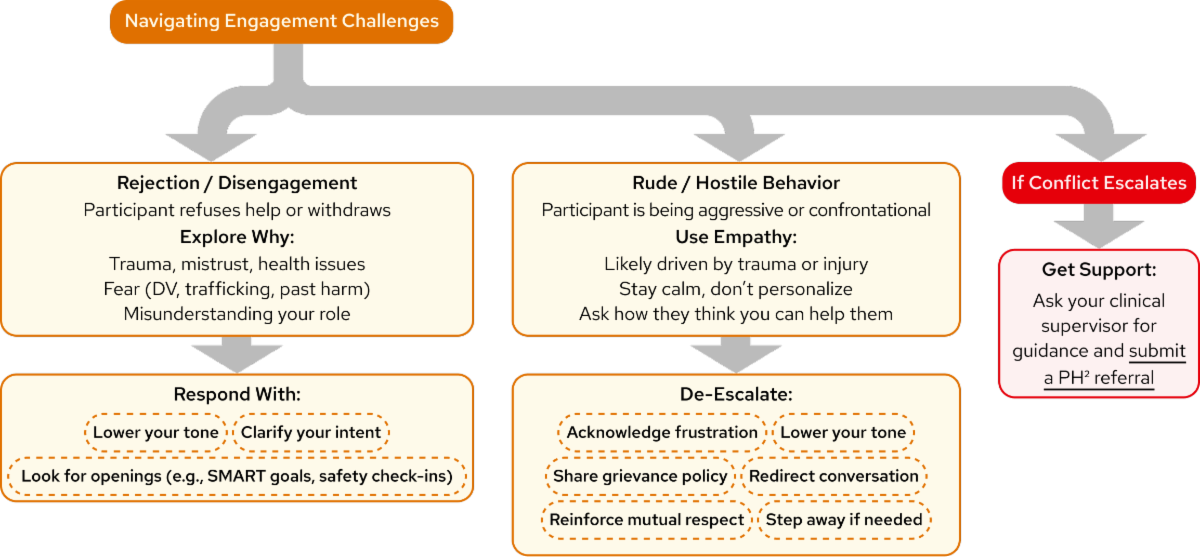
Navigating Engagement Challenges |
|
|
Tip: For many housing vouchers in our program, participating in ICMS is a requirement. Exit may not be an option when challenges arise. |
|
|
Tip: Sometimes a cigarette is a great conversation starter. |
|
|
Tip: It is always okay to ask for help. |
|
|
We value the incredible work you do. It’s always okay to ask for help. |
|
Comments, Questions, or Feedback about this guide? Let us know |
|
|
Explore More Resources for ICMS |
Find everything you need to support your outreach, housing navigation, and client engagement at the PSH ICMS Program Information Center — including guides, workflows, trainings, and system access tools. |
|
|
|
|