[[trackingImage]]

Is This Number Safe

 
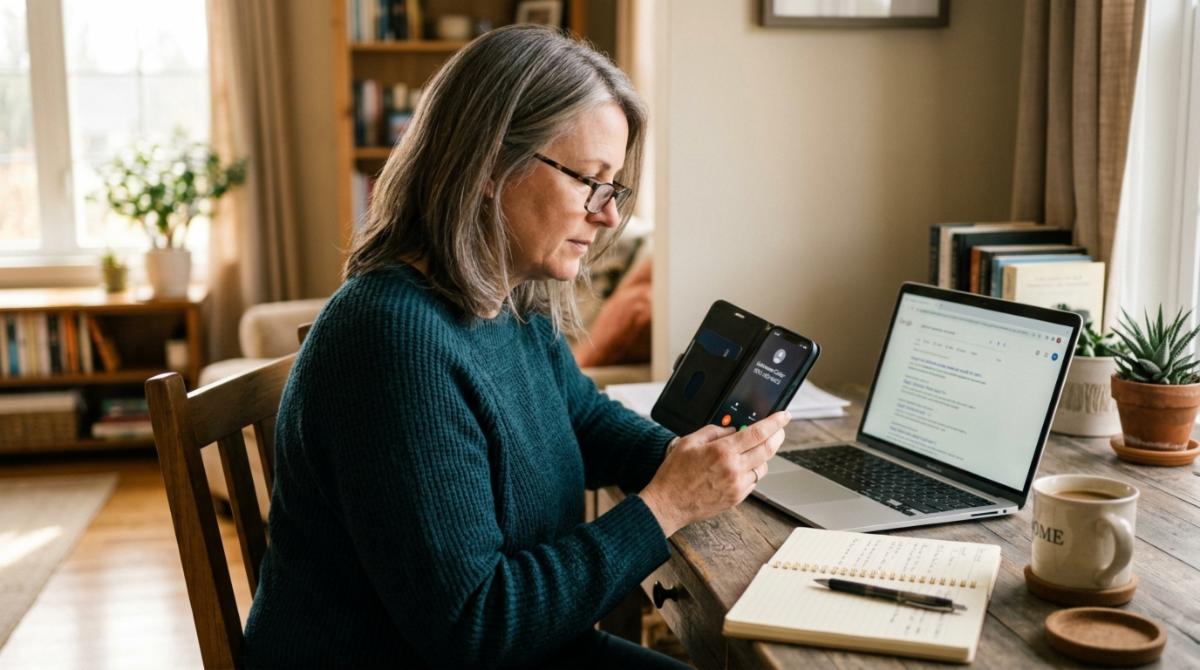
A middle-aged woman with glasses and grey-highlighted hair sits at a wooden desk in a bright, cozy home office, looking thoughtfully at an incoming call on her smartphone. In front of her on the desk are a laptop displaying a light webpage, an open spiral notebook with a pen, a potted succulent, and a coffee mug.

Getting a call from an unknown number can make you wonder, “Should I answer this?” With spam calls, fake businesses, and phone scams becoming more common, I’ve learned not to trust a number just because it looks familiar. In this guide, I’ll show you a few simple ways to check an unknown phone number, spot warning signs, and decide whether it’s safe to call back.


Introduction

Have you ever looked at your phone and thought, “Who in the world is calling me?”

I have.

Sometimes the number looks familiar. Other times, it is completely unknown. Maybe it has the same area code as mine, so I wonder if it could be someone nearby. Maybe the caller says they are from my bank, a delivery company, a government office, or even a doctors office.

And that's where things can get tricky.

These days, getting a call from an unknown phone number is pretty normal. The problem is that scammers can make their calls look very real. They may even use a local number to make you more likely to answer.

So, how do you verify if a number is safe?

The good news is that you don't need to be a technology expert.

I use a simple process whenever I get a suspicious call or text. I don't call the number back right away. Instead, I stop, check a few things, and look for signs that the number may be connected to a scam, spam, or a legitimate person or business.

In this guide, I'll show you exactly how I do it.


Key Takeaways

Before we get into the details, here are the main things I want you to remember:

  • Don't assume a familiar area code means the number is safe.
  • Search the complete phone number online and look for reports from other people.
  • Check whether the number belongs to a real business or organization.
  • Be careful with calls asking for money, passwords, Social Security numbers, or verification codes.
  • Caller ID can be faked. What appears on your screen isn't always the real caller.
  • Don't click links in suspicious text messages.
  • If someone pressures you to act immediately, that's a major warning sign.
  • When in doubt, contact the company using a phone number from its official website, statement, card, or app.
  • A phone number lookup can provide useful clues, but no lookup tool can guarantee that a number is 100% safe.
  • Your best defense is slowing down before you respond.

That last one is important.

Scammers want you to rush. I don't.


Why You Should Verify an Unknown Phone Number

Most of us get plenty of calls that we don't recognize.

Some are harmless. It could be a doctors office calling from a different line. A local business may be using a new number. A friend could even be calling from a temporary phone.

But other calls can be more serious.

Scammers use phone calls and text messages to trick people into giving away money or personal information. They may pretend to be someone you trust.

I've seen this happen in surprisingly convincing ways.

For example, imagine getting a call that says your bank detected suspicious activity on your account.

The caller sounds professional.

They know your name.

They even know the name of your bank.

Then they ask you to "verify" your account by providing a code that was just sent to your phone.

That can feel legitimate.

But it isn't.

The caller may be trying to get the security code needed to access your account.

That's why I don't judge a phone number only by how professional the caller sounds.

I verify the number first.


Step 1: Look at the Number Carefully

The first thing I do is simply look at the number.

This sounds obvious, but I pay attention to the details.

Does it have a familiar area code?

Does it look like a normal U.S. phone number?

Is there something unusual about the number?

For example, I might receive a call from a number with the same area code as mine.

My first thought could be, "Maybe it's someone local."

Not necessarily.

Scammers sometimes use a technique called neighbor spoofing. The number is made to look like it comes from your local area.

Why?

Because you're more likely to answer a local call.

So, a local area code is a clue. It's not proof that the number is legitimate.

That's a big difference.


Step 2: Search the Complete Phone Number Online

This is one of the easiest things I recommend.

Take the full phone number and search for it online.

I usually put the number inside quotation marks.

For example:

"555-123-4567"

Then I look through the results.

What am I looking for?

Reports from other people.

Someone may have posted that the number belongs to a telemarketer. Another person might report that it was connected to a fake delivery scam.

You may also find that the number belongs to a real company.

Sometimes you'll find nothing.

That's okay.

No search results don't automatically mean the number is safe.

It simply means I don't have enough information yet.

Think of an online search like looking through a neighborhood bulletin board. If someone's name is there, you may learn something useful. If it isn't there, you still can't assume the person is trustworthy.


Step 3: Look for Spam and Scam Reports

When I search a phone number, I pay close attention to reports containing words such as:

  • Scam
  • Spam
  • Robocall
  • Fraud
  • Telemarketing
  • Phishing
  • Fake caller
  • Debt collection
  • Impersonation
  • Suspicious text
  • Automated call

If several unrelated people report the same behavior, I take that seriously.

For example, suppose I search a number and find 20 people saying:

"This number called pretending to be my bank."

That's a pretty strong warning.

On the other hand, suppose I find several people saying the number belongs to a local plumbing company.

That's different.

Still, I don't stop there.

Online reports can sometimes be wrong. Numbers can also change owners.

So I treat these reports as clues, not absolute proof.


Step 4: Check Whether the Number Belongs to a Real Business

This is especially important when the caller claims to represent a company.

Let's say someone calls me and says they're from my credit card company.

I'm not going to trust the caller simply because they know my name.

Instead, I find the company's official website myself.

Then I look for its customer service number.

If the numbers don't match, I don't automatically assume it's a scam. Large companies sometimes use different numbers for different departments.

But I won't give the caller sensitive information until I verify who I'm dealing with.

I may hang up and call the company directly.

That's a much safer approach.

And it only takes a few extra minutes.


Step 5: Don't Trust Caller ID Alone

Here's something I wish more people knew.

Caller ID isn't a guarantee of identity.

A caller can sometimes manipulate the number that appears on your screen. This is known as caller ID spoofing.

That's why a call can appear to come from:

  • Your local area
  • A familiar company
  • A government agency
  • Your bank
  • A number you recognize

…and still be fraudulent.

This is one reason I don't say, "The number looks real, so it must be real."

Instead, I ask:

Does the caller's story make sense?

And more importantly:

Can I independently verify it?

If I can't, I don't provide personal information.


Step 6: Pay Attention to What the Caller Wants

The number itself isn't the only thing I check.

I also listen carefully to what the person is asking me to do.

A legitimate company may need to verify certain information. But there are things that should make you stop immediately.

Be very careful if a caller asks for:

  • Your password
  • A banking PIN
  • Your Social Security number
  • Credit card information
  • Online banking login details
  • A one-time verification code
  • Cryptocurrency payments
  • Gift cards
  • Money transfers
  • Remote access to your computer

The request might come with a scary story.

"Your account will be closed today."

"There's a warrant for your arrest."

"Your computer has been infected."

"Your payment failed."

"You need to act now."

That sense of urgency is often intentional.


Step 7: Watch for Pressure

This is probably one of my favorite scam-detection tricks.

I listen for pressure.

If someone wants me to make a major decision immediately, I slow things down.

Real businesses usually give customers ways to verify information.

Scammers don't want you to think.

They want you emotional.

Fear works.

So does excitement.

A caller might tell you that you've won something. Or that your account is in danger. Or that a family member needs emergency help.

Then comes the request.

"Send the money now."

"Give me the code now."

"Don't hang up."

That's when I stop.

If someone tells me I cannot hang up and call the company back myself, that's a huge red flag.


Step 8: Verify the Caller Through Another Channel

This is one of the safest habits you can develop.

Let's say someone calls claiming to be from your bank.

Instead of continuing the conversation, I hang up.

Then I open the bank's official app or website.

I find the customer service number.

Then I call that number myself.

This is called independent verification.

And it is very useful.

I don't use the number the caller gives me.

I don't click a link they text me.

I don't search for a random customer service number from a suspicious message.

I go directly to a source I already trust.

It's kind of like checking a person's story with someone else instead of taking their word for it.


Step 9: Be Careful With Text Messages

Phone scams aren't limited to calls.

Text messages can be just as sneaky.

Maybe you receive:

"Your package could not be delivered. Confirm your address here."

Or:

"Your payment was declined. Click here to update your information."

Or:

"We noticed unusual activity on your account."

The message may look completely normal.

But clicking the link could take you to a fake website designed to steal your information.

My rule is simple:

I don't click suspicious links in unexpected texts.

If I really am expecting a package, I'll open the delivery company's official app or website myself.

If I think there may be a problem with my bank account, I'll check my banking app.

I don't let the text message decide where I go.


Step 10: Use a Phone Number Lookup Carefully

A reverse phone lookup can be useful when you're trying to identify an unknown number.

Depending on the service, you may find information such as:

  • Possible owner
  • General location
  • Phone carrier
  • Business name
  • Number type
  • Spam reports
  • User complaints

This can help you understand what you're dealing with.

But there's an important catch.

Not every phone number lookup is accurate.

Mobile numbers can change owners. Businesses can change numbers. Some information may be outdated.

And some services may have limited information unless you pay.

So I use a phone lookup as one piece of the puzzle.

Not the entire puzzle.

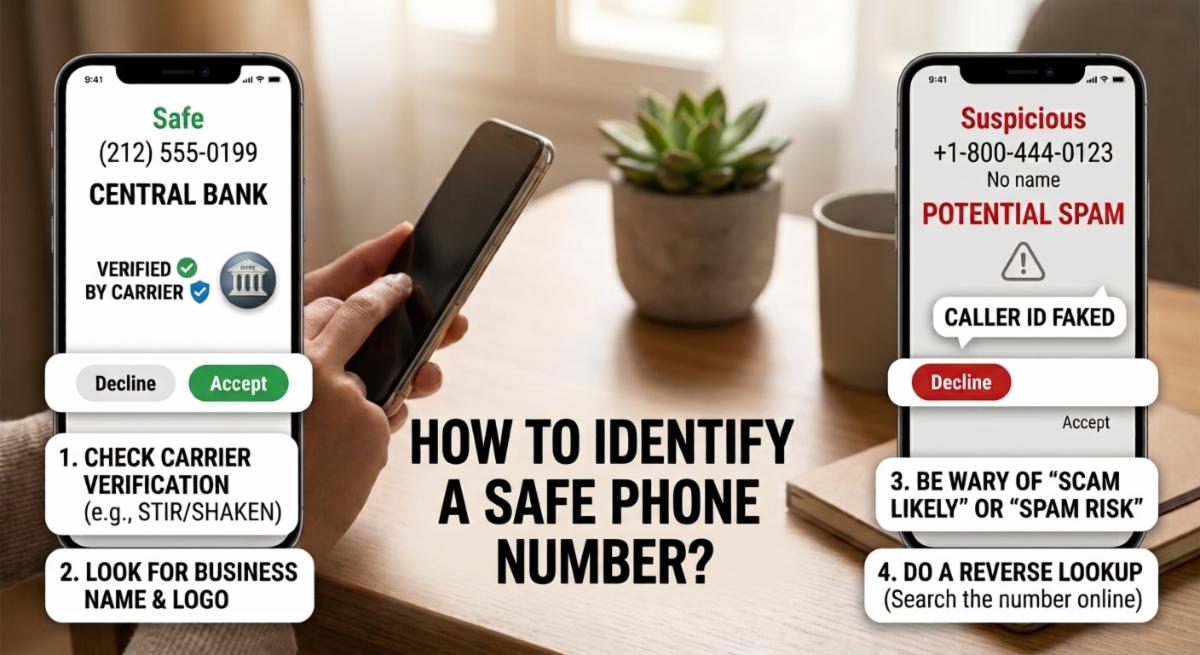
An educational graphic titled "HOW TO IDENTIFY A SAFE PHONE NUMBER?" placed on a wooden desk alongside two smartphone mockups illustrating safe versus suspicious calls.  Left Screen (Safe Call): Displays a green "Safe" label for "Central Bank" with carrier verification badges and options to decline or accept.  Right Screen (Suspicious Call): Displays a red "Suspicious" label for an unknown 1-800 number tagged as "POTENTIAL SPAM" and "CALLER ID FAKED."  Tips 1 & 2 (Left): "Check carrier verification (e.g., STIR/SHAKEN)" and "Look for business name & logo."  Tips 3 & 4 (Right): "Be wary of 'Scam Likely' or 'Spam Risk'" and "Do a reverse lookup (Search the number online)."

What About Free Phone Number Searches?

You can find free phone number search tools online.

Some are useful.

Some are not.

I don't automatically trust a website just because it says it can identify a caller.

Before using a service, I look at:

  • Who operates the website
  • Whether it clearly explains its service
  • Whether it has reasonable privacy information
  • Whether the results seem believable
  • Whether it asks for unnecessary personal information

Be especially careful with websites promising that they can reveal everything about a person from a phone number.

That's often too good to be true.


What If the Number Looks Familiar?

This is where things get interesting.

Imagine your phone rings.

You recognize the last four digits.

You think, "Oh, that's probably my insurance company."

Don't assume.

A scammer can spoof a number that looks familiar.

Even worse, someone could have obtained an old phone number that previously belonged to a person or business you know.

So I still verify the situation.

Familiar doesn't always mean safe.


What If the Caller Knows My Name?

This can be creepy.

And it can make a scam feel much more believable.

But your name isn't necessarily secret information.

Names can appear in public records, directories, social media profiles, marketing databases, and other places.

A caller knowing your name doesn't prove that they're legitimate.

The same goes for your city, old address, or the name of your bank.

Scammers may have pieces of information about you.

Their goal is to use those pieces to make you trust them.

That's why I focus more on what they're asking me to do than what they already know.


A Personal Example

I remember getting an unexpected call that sounded like it could have been important.

The person on the other end was confident and spoke quickly.

They gave me a reason for the call and wanted me to respond immediately.

My first reaction was to listen.

My second reaction was better.

I stopped.

Instead of answering the questions, I said I would contact the company directly.

The moment I said that, the caller became more insistent.

That was all I needed to know.

I ended the call.

Then I verified the company using information I found independently.

The lesson stuck with me.

Sometimes the reaction you get when you slow things down tells you more than the phone number itself.


Common Signs That a Phone Number May Be Unsafe

When I see several of these signs together, I become very cautious:

  • The call is unexpected.
  • The caller demands immediate action.
  • The person asks for sensitive information.
  • The caller requests payment through gift cards or unusual methods.
  • The number has multiple spam reports.
  • The caller refuses to let me hang up.
  • I'm told to keep the conversation secret.
  • I'm asked for a one-time security code.
  • The caller threatens me with legal action.
  • The message includes a suspicious link.
  • The person claims to be from a company but can't be independently verified.

One sign doesn't always prove a scam.

Several signs together?

That's when I pay close attention.


What I Do When I'm Still Unsure

Sometimes you simply can't tell.

That's okay.

You don't have to figure everything out while you're on the phone.

I usually do three things.

First, I stop communicating.

I don't provide additional information.

Second, I verify independently.

I find the company's official contact information or another trusted source.

Third, I wait.

This last part is underrated.

If someone says I have five minutes to fix a problem, I ask myself:

"What happens if I wait ten minutes?"

Usually, nothing good happens to the scammer.

And that's exactly why waiting can be helpful.


Should You Call an Unknown Number Back?

I generally don't recommend calling an unknown number back simply because it called me.

First, I try to identify it.

If it appears to be a legitimate business, I use the business's official contact information instead.

If the call was important, there may be a voicemail.

And if there isn't?

That's not always a problem.

Sometimes it's just spam.


What If You Already Answered?

Don't panic.

Answering a suspicious call doesn't automatically mean you've been hacked or scammed.

If you realize the call is suspicious, simply end it.

Don't argue.

Don't try to "teach the scammer a lesson."

Just hang up.

If you provided sensitive information, take action quickly.

Depending on what you shared, that might mean contacting your bank, changing a password, monitoring your accounts, or reporting the incident.

The faster you act, the better.


How to Verify a Number Before Calling It Back

Here's my simple checklist.

Before I call an unknown number back, I ask:

1. Do I recognize the number?

If not, I investigate.

2. Did they leave a voicemail?

If yes, I listen carefully.

3. Does the number appear in scam reports?

I search for it online.

4. Who claims to be calling?

A person? A business? A government agency?

5. Can I verify that independently?

This is the big one.

6. Are they asking for money or sensitive information?

If yes, I'm extra cautious.

7. Am I being pressured?

If yes, I slow down or end the conversation.

It's a simple process.

But it can prevent some very expensive mistakes.


What Makes a Phone Number "Safe"?

This is a question I get a lot.

The honest answer?

There's no magic test that can prove a phone number is completely safe.

A number can belong to a legitimate person today and be reassigned to someone else later.

A legitimate number can also be spoofed by a scammer.

So I don't think of numbers as simply "safe" or "unsafe."

I think of them as verified, suspicious, or unknown.

That's a much better way to look at it.

If I can independently confirm who owns the number and why they're contacting me, I feel comfortable.

If multiple sources report scam activity, I avoid it.

If I can't determine anything?

I treat it as unknown and proceed carefully.


The Biggest Mistake to Avoid

If I had to choose one mistake people should avoid, it's this:

Don't let someone else control the pace of the conversation.

You can hang up.

You can think about it.

You can ask someone you trust.

You can call the company yourself.

You can research the phone number.

You can wait.

You don't owe an unknown caller immediate action.

That's worth remembering, especially if the person sounds convincing.


A Simple Rule I Follow

Here's the rule I use:

Stop. Check. Verify. Then decide.

Not:

Answer. Panic. Pay.

That small change in behavior can make a big difference.

If someone calls saying there's a problem with your account, don't immediately try to fix it through them.

If someone says you've won a prize, don't provide your information before checking.

If someone claims to be a family member in trouble, verify their identity another way.

And if someone says, "Don't hang up," that's exactly when I want to hang up.


Conclusion

Knowing how to verify if a number is safe isn't really about becoming a technology expert.

It's about developing a few good habits.

I check the number.

I search for reports.

I look for signs of spam or fraud.

I verify businesses independently.

And I never let an unexpected caller rush me into making a decision.

Most importantly, I remember that caller ID isn't proof of identity.

A familiar area code isn't proof.

A professional-sounding voice isn't proof.

Even knowing my name isn't proof.

Verification is what matters.

The next time an unfamiliar number appears on your phone, don't feel like you have to answer immediately.

Take a breath.

Look it up.

Think about what the caller wants.

And when something doesn't feel right, trust that feeling enough to slow down.

A few extra minutes of caution are much better than spending weeks trying to recover from a scam.


FAQs About Verifying Phone Numbers

Can I check if a phone number is a scam?

Yes. You can search the complete number online and look for spam or scam reports. You can also use a reverse phone lookup service and check whether the number is connected to a legitimate business.

However, no search can guarantee that a number is completely safe.

How can I check who called me?

Start by searching the complete phone number online. Look for business listings, public information, user reports, and complaints.

If the caller claims to represent a company, contact that company directly using an official phone number.

Can a scammer fake a phone number?

Yes. Caller ID spoofing can make a call appear to come from another number.

That's why you shouldn't assume a familiar number is automatically legitimate.

Is it safe to call an unknown number back?

Not always.

I recommend identifying the number first. If the caller claims to represent a company, use the company's official contact information rather than automatically calling the number that contacted you.

What should I do if a suspicious number keeps calling?

You can block the number through your phone and report unwanted calls to your carrier or the appropriate authorities.

If the calls involve threats, fraud, or attempts to steal personal information, keep records of the calls and messages.

Can a phone number reveal someone's location?

A phone number may provide clues about its original area code or general registration information, but it generally cannot tell you someone's exact current location.

Be skeptical of websites promising an exact real-time location from only a phone number.

Is a reverse phone lookup always accurate?

No.

Reverse phone lookup information can be incomplete, outdated, or incorrect. Phone numbers can be reassigned, and mobile numbers are especially difficult to identify with certainty.

Use lookup results as information to investigate, not absolute proof.

What information should I never give to an unknown caller?

Be extremely careful with passwords, PINs, banking information, Social Security numbers, credit card details, and one-time verification codes.

A legitimate organization should not need you to give an unknown caller sensitive security information just because they contacted you unexpectedly.

What if I accidentally gave information to a scammer?

Don't panic, but act quickly.

Depending on what you shared, contact your bank or financial institution, change compromised passwords, monitor your accounts, and report the incident.

If you gave away a verification code or account credentials, take that especially seriously.

What's the safest way to deal with an unexpected call?

My approach is simple:

Stop. Don't rush. Verify independently.

If the caller claims to be from a bank, government agency, business, or another organization, hang up and contact that organization using a trusted phone number you find yourself.

That's usually much safer than continuing the original conversation.

"When in doubt, take a moment to verify the phone number before you trust the caller—a little caution can save you a lot of trouble."